Cabinet pull sizes: measure the screw holes, then the handle
Measure replacement cabinet pulls by hole spacing, not overall length. Compare inch and millimeter sizes, projection and screw requirements.
For a replacement two-screw cabinet pull, measure from the center of one existing hole to the center of the other. That is the center-to-center spacing. Overall handle length is a separate measurement and cannot tell you whether a replacement will use the same holes.
The linked Hickory Hardware product-expert answer uses this same definition. When a listing gives several numbers, look for the one explicitly labeled center-to-center or hole spacing.
Measure a representative door or drawer
Support the existing pull and inspect the screws from inside the drawer or door. If you can remove it according to its instructions, the two hole centers are easier to see. Place the ruler along the line between those centers; measuring the gap between the near edges of the holes gives a smaller number.
Record the result in both inches and millimeters if possible. Check another door and drawer rather than assuming the whole kitchen has identical hardware. Older cabinets, repaired fronts and separate furniture pieces can use different spacing.
A rough ruler reading close to a fraction is a reason to measure again, not round the result to the most familiar size. Do not force a replacement into misaligned holes to make it fit.
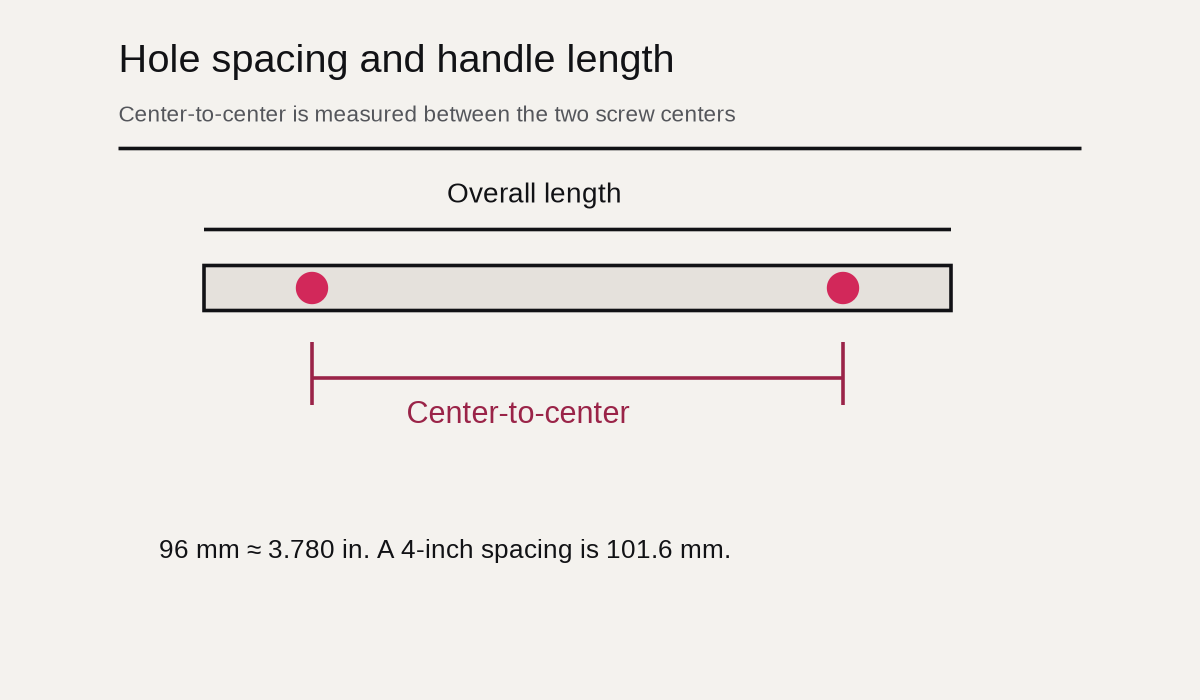
Keep inch and metric labels distinct
One inch equals 25.4 millimeters. The following table shows exact or calculated conversions; it does not mean these spacings are interchangeable.
| Stated spacing | Conversion | What to notice |
|---|---|---|
| 3 in | 76.2 mm | Different from a 96 mm pull |
| 96 mm | About 3.780 in | Often presented with an approximate inch label |
| 4 in | 101.6 mm | Not the same as 96 mm |
| 128 mm | About 5.039 in | Not exactly 5 in |
| 160 mm | About 6.299 in | Check the manufacturer’s drawing |
For example, 96 mm and 4 inches differ by 5.6 mm, about 0.22 inch. That is a real spacing difference, even though the handles may look similar in a photograph. Use the maker’s nominal specification and drawing when a retailer rounds its inch label.
Check the space around the pull
After matching the holes, check overall length and projection. A longer handle can collide with a neighboring drawer, wall or appliance when the door opens. Projection is how far it stands away from the front; clearance behind the gripping section determines whether your fingers fit comfortably.
Look at the base as well. A narrow new base can expose marks left by a wider old one. A backplate may address appearance, but still needs compatible spacing and fastening instructions. Compare one sample with the actual front before buying a full matching set.
Confirm the screws and purchase count
Check the required thread and screw length for the exact pull and the thickness of your cabinet front. The Home Depot’s guide notes that supplied screw lengths can differ. A screw that bottoms out can leave the handle loose even when its hole spacing is correct.
Count two-screw pulls separately from one-screw knobs and record any size groups. Buying a 10-pack is useful only when all ten pieces match the fronts you intend to change. This guide helps select replacements; follow the product instructions for installation and any new-hole work.
Sources & what to check
Source details checked 2026-10-12. Availability and prices can change; use the links below for current information.
Conversion values are mathematical, not universal hardware standards. Check screw specifications, hole spacing and finish for the actual hardware before ordering.