How much wrapping paper for a box? Plan the cut sheet first
Plan wrapping-paper cuts from box length, width and height. Compare sheet orientations on a roll and leave explicit seam and end-fold allowances.
For a rectangular box, plan one dimension of paper to go all the way around the box, plus a seam overlap. The other dimension covers the box’s length plus the paper needed to fold both ends. Then check whether that rectangle can be cut from the roll’s actual width.
A roll with plenty of total square footage can still be too narrow for a particular box. Paper area alone also cannot tell you how many identical rectangles fit on a roll.
Measure the box in its wrapping position
Call the long direction L, the side-to-side direction W, and the height H. These labels refer to the position you plan to wrap. Include bulging lids or projecting packaging instead of measuring only the flat bottom.
For a conventional wrap with the seam along L, the paper going around the box needs 2 × (W + H) before overlap. For the other dimension, allowing approximately half the height at each end gives L + H before extra folding overlap. Add your chosen allowances rather than cutting exactly at these minimum lengths.
Test the position with a strip of spare paper before cutting patterned gift wrap. Tall boxes, stiff paper and bulky folds may need a different allowance or wrapping method.
Work through a cut-sheet example
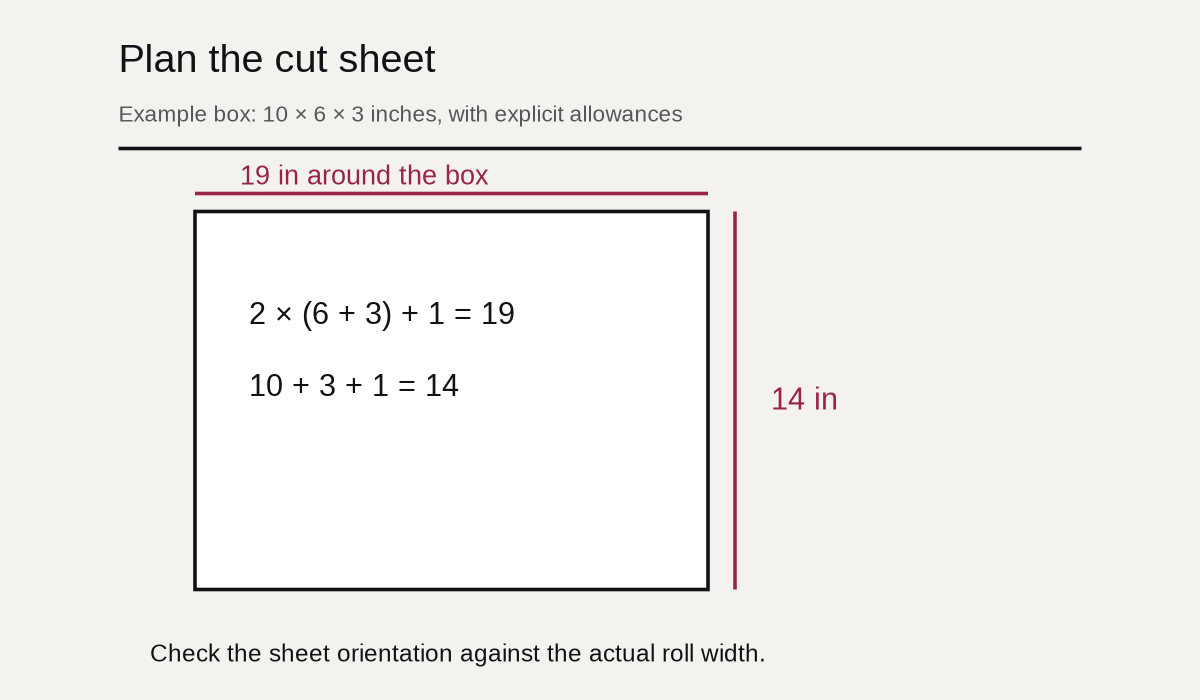
Take a hypothetical 10 × 6 × 3-inch box. Choose 1 inch of seam overlap and 1 inch of extra end allowance in total, split between the two ends.
The around-box dimension is 2 × (6 + 3) + 1 = 19 inches. The lengthwise dimension is 10 + 3 + 1 = 14 inches. The planning sheet is therefore 19 × 14 inches. These allowances illustrate the calculation; they are not a promise that the first attempt will produce neat folds in every paper.
Compare orientations on a roll
Suppose the usable roll is 30 inches wide and 72 inches long. Placing the 19-inch sheet dimension across the width gives one column; placing 14 inches along the length gives five rows. That is 5 sheets in a simple grid.
Rotating the sheet puts two 14-inch columns across the 30-inch width and three 19-inch rows along 72 inches. That produces 6 sheets in this grid. Both plans use the same sheet area, but they leave different offcuts.
Directional patterns may prevent the more efficient rotation. Damaged edges, cutting gaps or extra allowance can also reduce the count. The example is a packing layout, not a guaranteed yield or the optimum arrangement for mixed box sizes.
Keep a short wrapping list
Record each box’s dimensions, planned sheet size and quantity. Group identical cuts before mixing large and small gifts on the same roll. Mark a scrap as reusable only if its width and length fit a remaining cut; calling several narrow strips “enough square feet” does not make one intact sheet.
Compare paper rolls by width and length as well as price. Tape, tags and ribbon are separate quantities. A paper trimmer or measured cutting mat can help repeated cuts, but choose one that accommodates the sheet and follow its handling instructions. Fiskars’ linked gift-making material shows related paper-crafting tools; our dimensions above are our own examples, not copied product instructions.
For uncut rolls, choose a storage case by its stated roll-length limit before checking the space it occupies. Our wrapping-paper storage guide separates the paper fit from the container fit.
For an awkwardly shaped gift, compare a suitable bag or reusable wrap before assuming that one rectangular sheet is the right solution. For a photo gift, our portable photo-printer comparison starts with the recipient’s intended print size.
If you are still choosing a coffee gift’s contents, use the four-piece coffee basket checklist before measuring the assembled package. For an awkward shape, the gift-bag fit guide checks the opening, base and usable height as a separate packaging choice.
For several different boxes, the portable gift wrapping station works through a four-gift batch and shows how its cut sheets fit together on one roll.
Sources & what to check
Source details checked 2026-10-12. Availability and prices can change; use the links below for current information.
These original geometric examples cover rectangular boxes and a conventional wrap. Paper thickness, folds and directional prints can change the usable cuts; try a spare-paper strip before cutting the final sheet.