How many curtain panels do you need for your rod?
Use rod width, desired fullness and each panel's flat width to estimate the number of curtain panels. See two worked examples and check stack-back and length.
Start with the width of the installed curtain rod, not the glass. Divide the total flat fabric width you want by the listed flat width of one panel. If you want equal panels opening to both sides, round up to an even number.
Use your measurements and product details. Inputs stay in your browser.
The panel-count calculation
Panels = rod width × chosen fullness ÷ flat width per panel, rounded up. If panels part in the middle, round the result up to the next even number. Fullness means how much flat fabric you allow relative to the rod width: 1.5 produces lighter gathering than 2.0. It is a visual preference, not a rule that every window must follow.
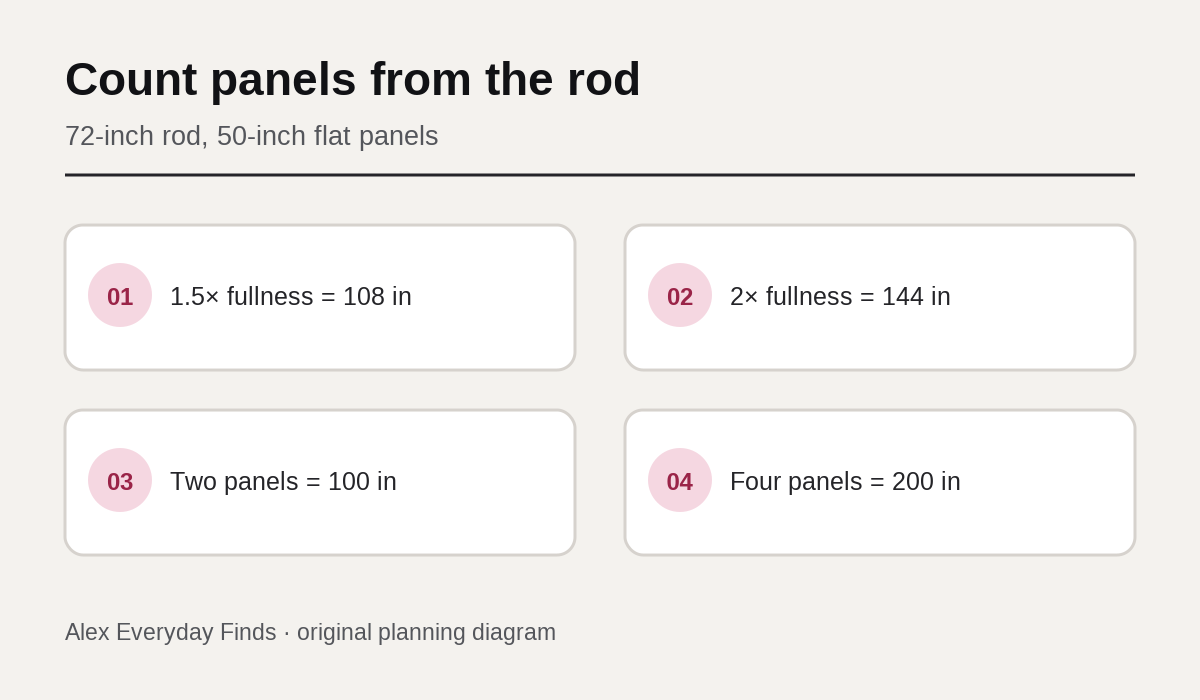
For a 72-inch rod with 50-inch flat panels:
On a narrow screen, swipe the table sideways to see every column.
| Chosen fullness | Fabric target | Raw count | Equal two-sided purchase |
|---|---|---|---|
| 1.5× | 108 in | 2.16 | 4 panels |
| 2× | 144 in | 2.88 | 4 panels |
Four panels provide 200 inches of flat fabric, giving 2.78× nominal fullness across this rod. If that is more fabric than you want, look for a wider panel rather than silently rounding down to two; two 50-inch panels provide only 100 inches, or 1.39×. A one-way curtain can use an odd panel count if the heading and track allow it.
Check the measurement the listing actually gives
The Home Depot’s measuring guide starts from the rod length for curtain width. Read the product listing to see whether “50 inches” means each panel or a pair, and whether the stated width is the fabric laid flat. Pinch-pleat, ripple-fold and other made-up headings may be sold by finished coverage instead. In that case use the supplier’s finished-width method, not the flat-panel formula above.
Measure the installed rod between its usable ends, excluding decorative finials that the curtain cannot travel across. Decide whether you want fabric to cover just the opening or extend past it when closed. The rod placement and return to the wall affect light gaps; extra fabric alone does not ensure darkness or privacy.
Do the second fit check
Panels need somewhere to gather when open. Estimate the stack-back from the actual heading and fabric, and check whether it blocks the glass or a nearby door. Then select length using the height from the rod or hanging point to the desired hem, following the product’s heading instructions. Width and length are independent purchase choices.
Before checkout, record: rod’s usable width, opening direction, panel width as sold, chosen fullness, calculated count, desired hem and whether hooks or rings consume hanging height. If different windows share a room, calculate each rod separately.
If the chosen heading uses clip rings, calculate the ring count and spacing per panel separately from fabric fullness. If window film is also part of your privacy plan, the whole-cut window-film planner checks roll quantities; confirm film and glass compatibility with the maker before using that result.
Sources & what to check
Source details checked 2026-10-17. Availability and prices can change; use the links below for current information.
Fullness is a design choice. The examples do not predict blackout performance, finished pleat width or a particular panel's shrinkage.