Laundry sorters: two or three compartments that fit your routine
Compare two- and three-bag laundry sorters by sorting groups, bag removal and working footprint, with model dimensions and a printable planning sheet.
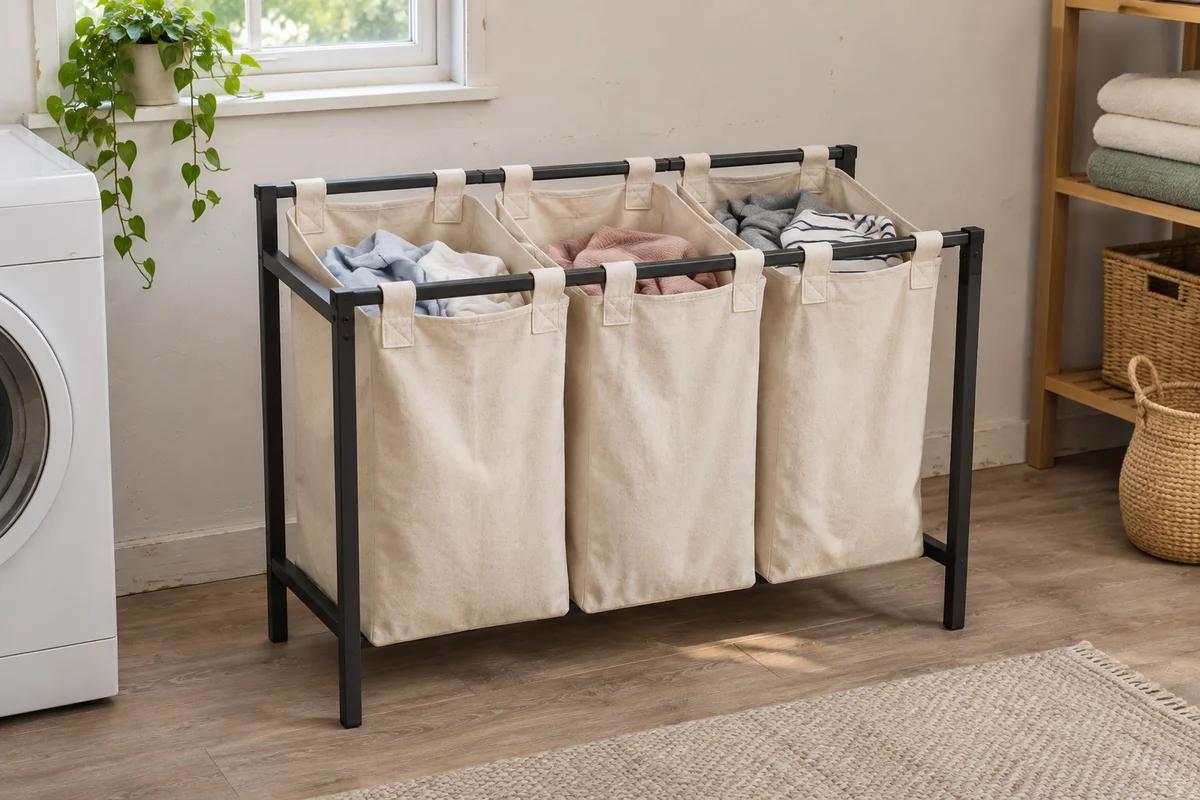
Choose a two-section laundry sorter when you actually keep two groups apart between washes. Choose three sections when a third group needs its own place and the bags can be removed easily. Check the space used while filling and emptying it, not just the closed footprint. A third bag is useful only if it solves a recurring sorting problem.
Write down the groups you already separate according to your garments’ care directions. Then use the sorter planning sheet to compare two current designs against your room. This guide helps choose storage; it does not prescribe washing temperatures or translate litres into washing-machine loads.
Count the groups you need to keep separate
Think through the interval between your normal wash days. Perhaps you need one place for ordinary dark clothes and another for light clothes. If towels travel straight to the machine in a separate basket, a permanent third compartment may add width without improving that routine. Conversely, a third group that repeatedly lands on the floor is a reason to consider another bag.
Also note which group fills first. Three equal sections can be less useful than two larger sections if most of your laundry belongs to one group. Do not use the total advertised capacity as though every litre could move freely between compartments.
Two designs with different working space
Specifications below come from the linked US manufacturer pages and Seville’s assembly instructions, checked November 5, 2026. Prices are item prices before tax and delivery; local availability is not confirmed.
| Check | Joseph Joseph Tota 2 Twin 90L, Pale Mushroom | Seville Classics SHE16157B |
|---|---|---|
| Separation | Two removable 45L totes | Three removable bags |
| Published outside size | W60 × D40.6 × H73.9 cm; SKU 5000018 | Product page: W33 × D18.1 × H40.9–66.1 in |
| Useful construction difference | Enclosed body; lid docks on its side | Rolling frame with adjustable hanging bar |
| More detailed document | Product dimensions and care on listing | Manual gives W33.07 × D18.11 × H40.95–66.15 in; bag D9.45 × W15.75 × H23.63 in |
| Loading information | No carrying-weight limit established here | Manual: 12 lb per bag, 36 lb on frame, 40 lb on bar |
The Seville page rounds its measurements and gives the bar rating as 39.9 lb. Retain the manual’s more detailed dimensions when screening a tight space. Its bag rating is a limit, not a recommended weight to carry. Do not treat the hanging-bar rating as extra bag capacity or convert the bag dimensions into a verified usable volume.
A two-group example
Suppose you have two sorting groups and a 70 cm wide × 50 cm deep parking area, open above. Tota Twin’s body leaves 10 cm across the width and 9.4 cm front to back. That makes it a body-fit candidate. The result is not yet a complete fit: check where the lid docks, whether you can reach both handles and whether each filled tote can be lifted out without catching a counter.
Seville’s manual footprint converts to approximately 84 × 46 cm. It exceeds the 70 cm width in the usual orientation. Rotating it would put approximately 84 cm into the 50 cm depth, so that also fails. For these inputs, two totes are the better shortlist; a third compartment has neither a demonstrated need nor a place to stand.
Exception: a 30 × 18 in parking area rejects Seville in either orientation. Its 33.07 in side is too long for the 30 in width, and rotating it puts that same side into only 18 in of depth. Removing a support or pretending the wheels do not count does not solve the fit.
Check the full filling and removal routine
Mark the outside footprint with paper or tape, keeping the walkway clear. Next mark the place you stand to deposit clothes and the space used by the open or docked lid. Put an existing laundry bag where the proposed tote would be and rehearse the removal direction. That rehearsal checks your room; it does not establish the exact new bag’s opening or load behaviour.
For the rolling design, include the hanging bar at your intended setting, nearby doors and the route used when the frame moves. Our rolling hamper route guide follows doors, turns and thresholds in more detail. If you will carry laundry instead, the collapsible basket guide compares the transport and storage compromise.
Keep the bags serviceable
Tota 2’s listing says to remove plastic trim before washing the totes and follow their labels. Its exterior is wipe-clean, not machine-washable. Seville describes its bags as machine-washable; use the directions supplied with the exact model. Do not assume two fabric-looking containers share a cleaning method.
Choose once every recurring sorting group has a home, the busiest bag is manageable and removal has a clear route. If the footprint passes but a fixed countertop blocks tote extraction, keep the result unconfirmed until you have the required removal dimensions. You may need a front-access or different location rather than another nominal litre size. For the next stage of the routine, compare drying rack space separately.
Sources & what to check
Source details checked 2026-11-05. Availability and prices can change; use the links below for current information.
Manufacturer specifications and documents checked November 5, 2026. Confirm the exact selected version, remaining fit measurements, current price and availability before buying.