Medicine cabinet organizers: shallow shelves and door clearance
Fit toiletry trays inside an existing mirrored cabinet. Check closed-door depth, item height and usable compartments with a shelf-by-shelf worksheet.
Choose a medicine-cabinet organizer by the shelf space left when the mirror door closes, then by the toiletries you need to reach. A narrow open tray can group short items, but taller tubes may work better standing directly on another shelf. A tray that fits with the door open can still collide with a hinge or the mirror’s inner frame.
Measure the existing cabinet before buying containers. The shallow-shelf layout sheet separates outside tray fit, usable compartments and item removal. This guide covers toiletry organization inside an existing mirrored cabinet; follow individual product storage directions, and use separate professional guidance for medication storage or dosing.
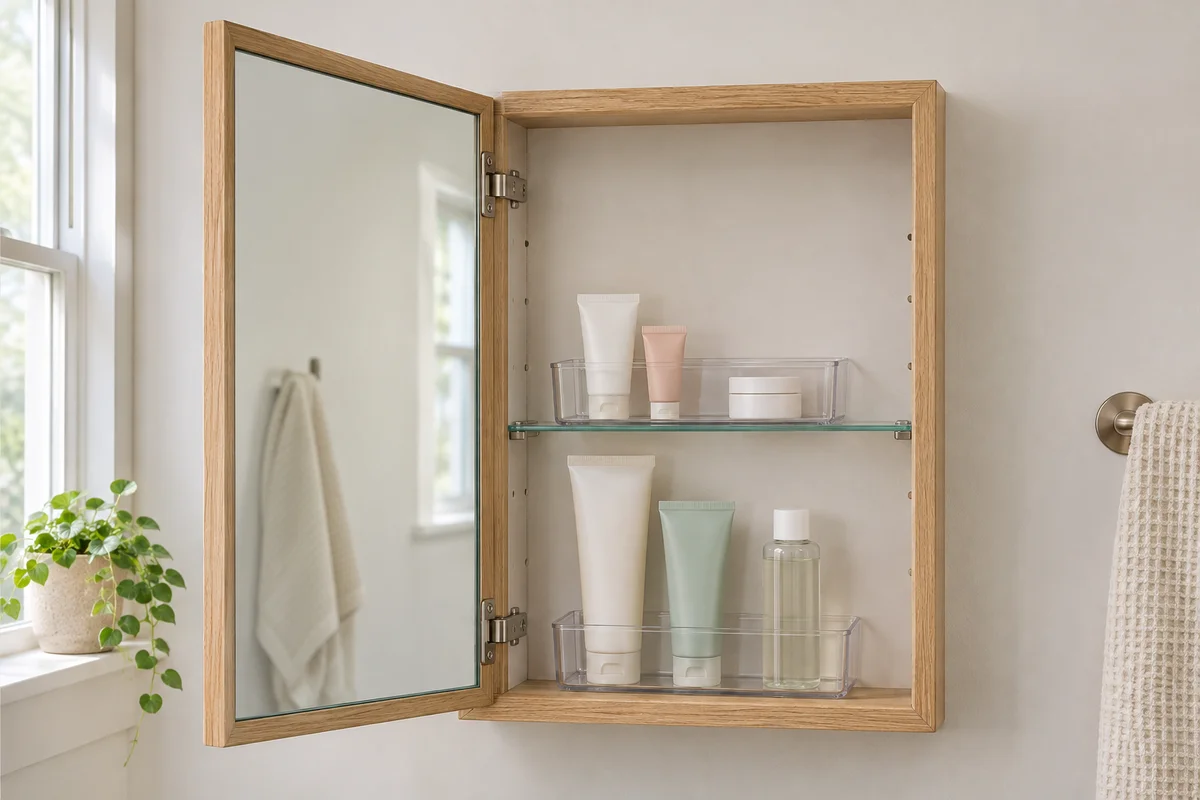
Measure the closed-door plane
Record clear width, front-to-back depth and height for each shelf. Measure to the nearest part of the closed door or hinge, rather than to the cabinet’s outside face. Keep fingers and measuring tools clear of the hinges; do not force the mirror shut against a trial container.
An empty paper outline helps screen the footprint. A lightweight cardboard block can represent a proposed tray’s outside height, provided it does not interfere with closing or fall from the shelf. Check carefully along the door’s path as well as at its final position. Do not stick accessories to the mirror or glass shelf unless the accessory and cabinet makers support that installation.
A narrow tray is a candidate, not an automatic match
The iDesign Crisp listing checked November 5, 2026, offers 3 × 9 × 2 in and 3 × 12 × 2 in variants. The selected 3 × 9 × 2 in variant shows SKU 72150 and a listed price of $15.99, before tax and delivery. Confirm the chosen size and its price at purchase.
With the 9 or 12 in side running across a shelf, both formats need at least their 3 in outside depth and 2 in outside height before contents and access are considered. The longer option needs another 3 in of shelf width. Turning a 9 in side front to back will not help a shallow shelf.
| Arrangement | Useful when | Essential check |
|---|---|---|
| Crisp 3 × 9 × 2 in tray | A small group belongs together on a sufficiently deep shelf | Outside fit; actual inside space for tubes; grip over tray wall |
| Crisp 3 × 12 × 2 in variant | A longer uninterrupted shelf holds the same group | Extra width; hinges at both ends; selected variant dimensions |
| Items standing directly on shelf | A tray would use the remaining depth or block a tall tube | Individual stability, closed-door clearance and access |
The reviewed listing does not establish usable interior dimensions for every variant or a model-specific cleaning method. Ask for the usable inside length/depth if one particular box must fit, and follow the supplied care directions. Do not subtract an invented wall thickness or transfer another iDesign product’s dishwasher instructions.
Lay out the actual items
Group the items you reach for together, keeping original labels and required information. Measure the widest cap and the tallest tube in its intended position. A tube’s flexible body can be slimmer than its cap; use the part that actually has to pass through the opening.
Use the lowest shelf for taller items when that creates a clear removal route. A tray can keep short containers together on another shelf. Avoid stacking trays merely because the product is stackable: lifting an upper tray may turn the daily item below it into a two-handed job beside a fragile mirror.
Record outside fit and inside fit as separate answers. A 3 in deep tray might fit the cabinet yet fail to hold a 2.9 in deep box because the tray’s interior is smaller than its outside measurement. Without the inside dimension, that box’s fit is unconfirmed.
A shelf-by-shelf example
Suppose the middle shelf is 12 in wide × 3.5 in usable depth × 6 in clear height, already measured against the closed door. The 9 × 3 × 2 in tray has a smaller outside footprint, leaving 3 in of shelf width and 0.5 in of depth in this rectangle. That makes it an outside-fit candidate, not proof of clearance at the hinge.
Keep the 5 in tube on a separate lower shelf with 7 in clear height if its own footprint and handling fit there. Put the short containers in the tray only after checking its interior and making sure each can be grasped and lifted past the 2 in wall. The worksheet records those as named follow-up checks; it does not label an unknown inner fit as confirmed.
Exception: if the usable depth is only 2.75 in, reject both Crisp formats for this horizontal orientation. Their 3 in outside depth exceeds the shelf by 0.25 in. Do not call a cabinet “3 inches deep” from its brochure and assume the same clearance behind the closed mirror.
Keep the result useful
You may finish with one tray, a mix of tray and open shelf, or no new organizer. Choose the arrangement that leaves everyday items visible, reachable and clear of the door. For larger groups that belong outside the mirrored cabinet, the countertop makeup organizer comparison covers drawers and trays with different working footprints. For storage elsewhere in the bathroom, use the mounting and no-drill guide rather than adding an unsupported attachment to this cabinet.
Sources & what to check
Source details checked 2026-11-05. Availability and prices can change; use the links below for current information.
Manufacturer specifications and documents checked November 5, 2026. Confirm the exact selected version, remaining fit measurements, current price and availability before buying.