Calculate overnight work hours with an unpaid break
Calculate one overnight shift, subtract an unpaid break and convert minutes to decimal hours. Includes a free calculator and clear worked examples.
For a shift that crosses midnight, add the time from the start to midnight and the time from midnight to the finish. Then subtract only the break minutes you intend to exclude. Divide the remaining minutes by 60 to get decimal hours.
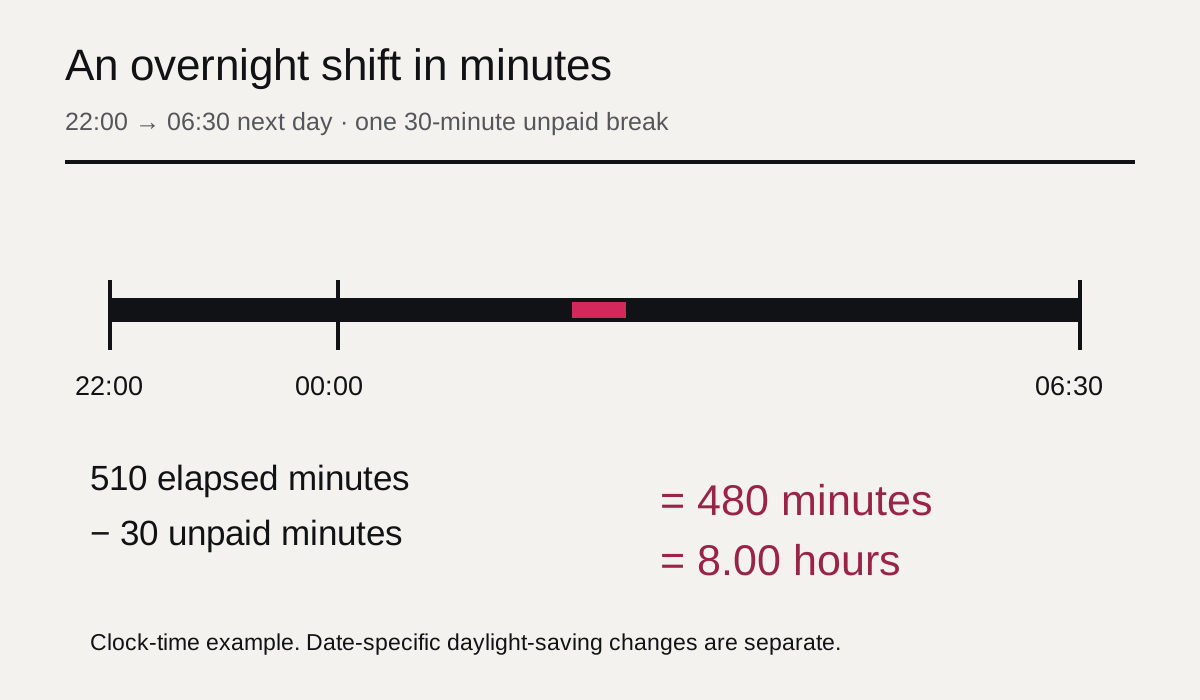
For example, 22:00 to 06:30 next day is 8 hours 30 minutes. Subtracting a 30-minute unpaid break leaves 8 hours, or 8.00 decimal hours. The calculation does not decide whether a break is legally paid or unpaid; enter that according to the records you are checking.
Calculate a single shift
Clock-time arithmetic for one shift up to 24 hours. Does not adjust for daylight saving time, payroll rounding or overtime. Inputs stay in your browser.
The next-day box makes the date change explicit. Leave it off for a same-day shift. The calculator accepts one interval up to 24 hours and rejects a break longer than that interval. Your inputs stay in the browser and are not saved by this tool.
Do the arithmetic in minutes
Convert the start and finish times to minutes after midnight. At 22:00, that is 22 × 60 = 1,320 minutes. At 06:30, it is 6 × 60 + 30 = 390 minutes.
For a next-day finish, add 1,440 minutes to the finish value:
390 + 1,440 − 1,320 = 510 minutes between the clock entries.
Subtract the 30-minute break: 510 − 30 = 480 minutes. Convert to hours: 480 ÷ 60 = 8.
Keep minutes until the last conversion. Repeatedly rounding intermediate values can change the result, especially when you later add several shifts.
Three worked examples
| Clock entries | Time between entries | Entered unpaid break | Remaining time | Decimal hours |
|---|---|---|---|---|
| 22:00–06:30 next day | 8 h 30 min | 30 min | 8 h | 8.00 |
| 23:45–07:15 next day | 7 h 30 min | 45 min | 6 h 45 min | 6.75 |
| 09:00–17:30 same day | 8 h 30 min | 45 min | 7 h 45 min | 7.75 |
These are hypothetical arithmetic examples, not payroll records. If you have two unpaid breaks of 15 minutes and 30 minutes, enter their combined 45 minutes. Do not subtract a paid break merely because you stopped working during it.
Decimal hours are not hours and minutes
7 hours 45 minutes is 7.75 hours, because 45 ÷ 60 = 0.75. It is not 7.45 hours. Similarly, 15 minutes is 0.25 hours and 30 minutes is 0.50 hours.
For a spreadsheet, store the original start, finish and break entries as well as the result. Those original fields let you check a total later instead of relying on a single rounded decimal number.
If you add several shifts, add their unrounded minute totals first. A screen displaying two decimal places is convenient to read, but it need not be the precision you use for a weekly calculation.
Check date and time changes separately
An earlier finish time does not by itself prove an overnight shift: it can also be a typing mistake. Record the actual dates. If a shift spans more than one day, use a system that accepts full date-time entries rather than extending this single-shift calculator.
On a daylight-saving transition, clock readings can repeat or skip an hour. NIST documents those US clock changes. This tool performs ordinary clock arithmetic and does not resolve them. Use dated records with the correct time zone when an elapsed-time result must account for that change.
Changing time zones also requires a dated calculation in a common zone. Overtime thresholds, payroll rounding and paid-break rules are separate from the subtraction shown here.
What to look for in a time-tracking app
If this is a recurring task, compare tools by the records you need: explicit start and finish dates, separate break entries, editing history and an export you can inspect. Check how a candidate app handles overnight shifts before relying on a weekly total.
A web time-card calculator, such as the linked Toggl tool, is another option to investigate for broader timesheets. We have not tested its paid product or compared time-tracking subscriptions. A larger system is useful only if it handles a real limitation in your current records.
For planning the publications around your work, see our simple Notion content calendar. Scheduling a task and measuring its duration are different jobs; keep the records that answer each one clearly.
Sources & limitations
Product and documentation checks: 2026-10-12. Availability and prices can change. Read the linked sources for the current details.
Our calculator was checked against worked arithmetic examples. It measures clock-time differences, not legal payable time. It does not adjust for daylight saving time, time-zone changes, overtime or employer rounding.