How many tubes of caulk for your measured joint?
Estimate caulk cartridges from measured linear feet, bead diameter and labeled cartridge volume. Includes 3/16-inch and 3/8-inch examples and a waste input.
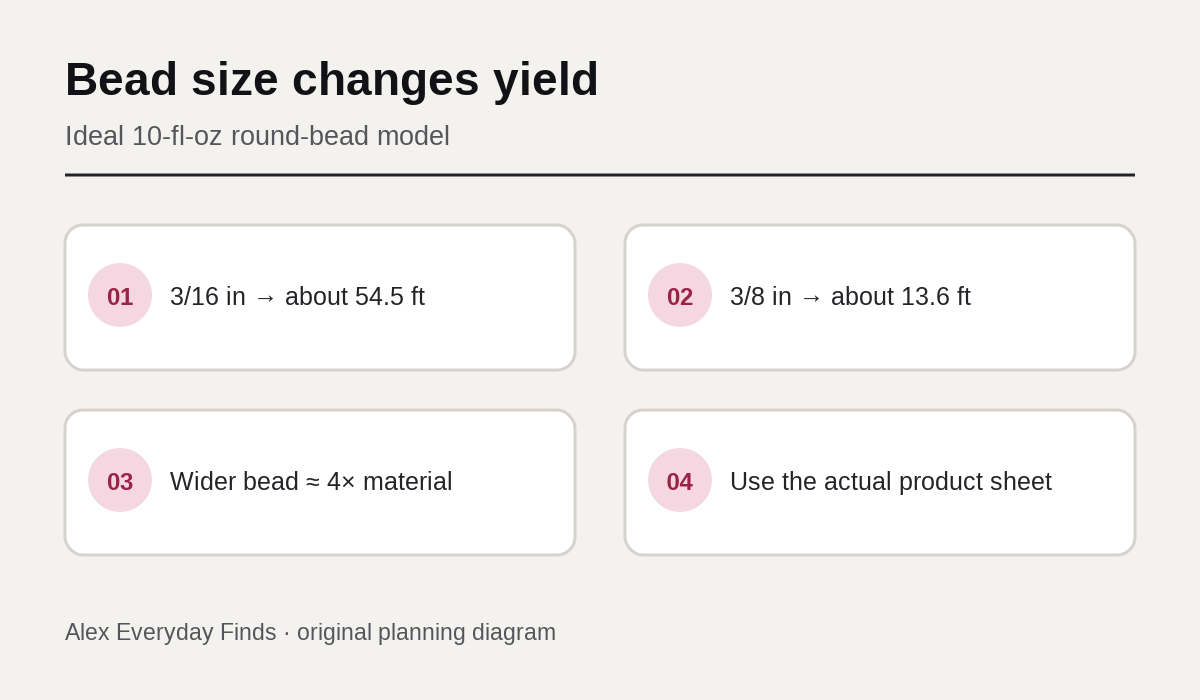
Count cartridges from the length of the joint and the amount of sealant it needs, not from the number of rooms. A bead twice as wide uses about four times the material if its cross-section remains circular. The cartridge’s labeled volume and the actual joint shape matter more than a generic “feet per tube” rule.
Use your measurements and product details. Inputs stay in your browser.
Measure the run
Add the lengths of every joint you intend to seal. Record doors, tubs and trim separately if they need different products or bead sizes. For an example with 18, 12 and 10 feet, the total is 40 linear feet. Measure around corners once; do not add the same edge to two runs.
Choose the bead diameter or joint-fill dimensions recommended for the specific joint and sealant. A deep gap may call for backer material and a specified sealant depth. A surface bead calculation should not be used as an installation design for an unprepared wide joint.
Do a transparent volume estimate
For a round bead, volume in cubic inches is length in inches × π × (diameter ÷ 2)². One US fluid ounce is about 1.8047 cubic inches. For a hypothetical 10-fl-oz cartridge, ideal continuous coverage is approximately:
On a narrow screen, swipe the table sideways to see every column.
| Round bead diameter | Ideal feet from 10 fl oz | 40-foot run, before waste |
|---|---|---|
| 3/16 in | 54.5 ft | 1 cartridge |
| 3/8 in | 13.6 ft | 3 cartridges |
The table is mathematical, not a promise from a manufacturer. It assumes every drop becomes a perfect cylinder. Real joint geometry, leftover material in the nozzle, starts and stops, and tooling change the result. The linked DAP technical sheet gives product-specific coverage information; use the technical sheet for the exact sealant you buy when available.
To include your own allowance, divide measured feet × (1 + chosen allowance) by the coverage for your product and bead, then round up. With a 10% planning allowance, the 40-foot run becomes 44 feet; the examples above still round to one 3/16-inch cartridge or four 3/8-inch cartridges. The 10% is an example input, not a universal recommendation.
Before purchasing
Check whether the product is appropriate for the surface and exposure, its joint size guidance, cure and paintability instructions, and its expiration or storage information. Match a caulk gun to the actual cartridge size. Keep dissimilar sealants and colors on separate lines of your estimate.
If the calculated quantity is close to a whole-cartridge boundary, consider your ability to obtain another matching cartridge during the job. For another material where package rounding matters, our tile box calculator shows the same purchase-count principle.
Sources & what to check
Source details checked 2026-10-17. Availability and prices can change; use the links below for current information.
Volume calculation assumes a circular bead and is a planning estimate, not guaranteed cartridge yield. Joint shape, tooling and waste change usage; follow product and joint instructions.