How many boxes of tile do I need? Measure, allow and round
Turn measured square feet into whole tile boxes using the carton coverage and your chosen waste allowance. Includes a calculator and bathroom example.
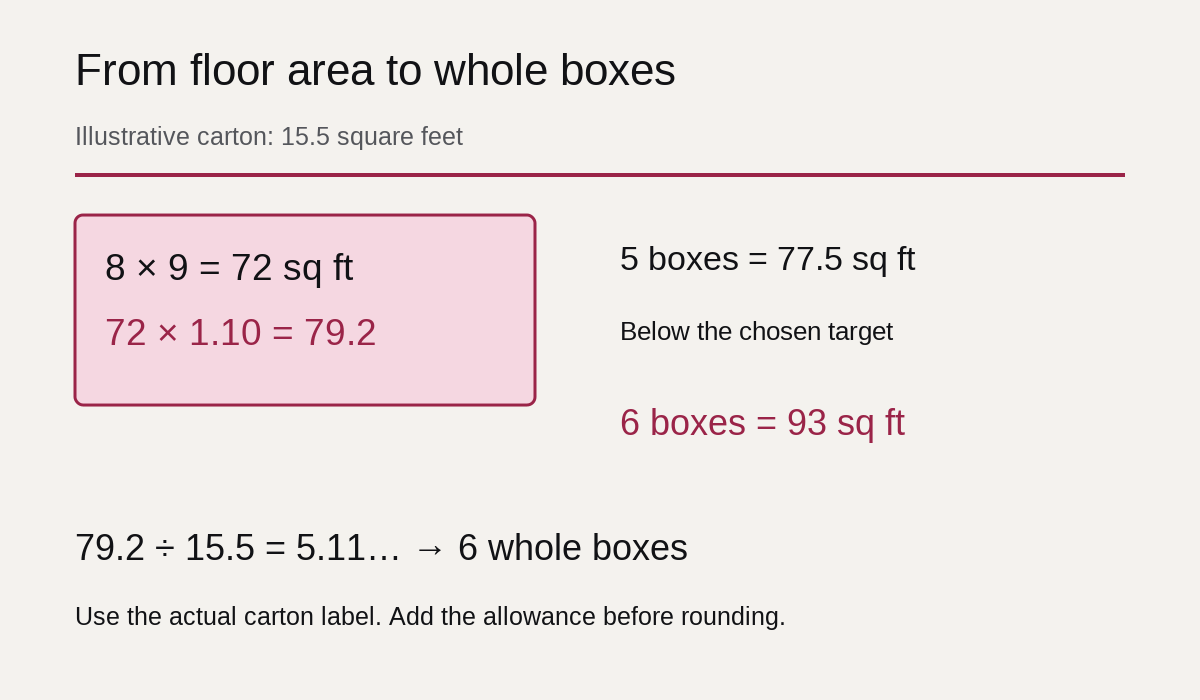
Tile boxes needed = measured area × (1 + allowance ÷ 100) ÷ coverage per box, rounded up to a whole box. Use the square-foot coverage printed on the carton you plan to buy. Tile size alone does not tell you how much one box contains.
For an 8 × 9-foot bathroom, the floor is 72 square feet. A chosen 10% allowance makes the target 79.2 square feet. If a carton covers 15.5 square feet, you need 6 boxes, which supply 93 square feet. Five boxes supply only 77.5 square feet, below that target.
Calculate the box count
Enter the actual carton coverage and your chosen allowance. Inputs stay in your browser.
The initial numbers are the worked example, not a standard bathroom size or carton. Use your measurements and your seller’s coverage. The calculator estimates quantity for one tile product; keep each different tile, trim or border separate.
Measure the surfaces you will actually tile
For a rectangular floor, multiply length by width. Measure in feet for square feet, or meters for square meters. Keep the carton coverage in the same area unit. For instance, 8 feet 6 inches is 8.5 feet, not 8.6 feet.
For an L-shaped floor, divide it into rectangles and add their areas. A 6 × 8-foot section plus a 3 × 4-foot section totals 48 + 12 = 60 square feet. Make sure the rectangles do not overlap.
For walls, record width and tiled height for each wall. Deduct an opening only if that surface will not receive tile. A recess may add sides and a back even when it looks like a hole in the main wall. Include those surfaces separately.
Do not deduct the footprint of every movable cabinet or appliance automatically. Decide the tiled boundary with the installer first, then measure that boundary. A quantity calculation cannot make that installation decision for you.
Choose an allowance for this layout
An allowance covers material beyond the measured surface: cuts, damaged pieces and spare stock. Daltile’s FAQ recommends purchasing approximately 10% extra as attic stock. That is a useful reference, but a particular layout can need a different amount.
Ask the installer or seller about diagonal layouts, herringbone, very large tiles, narrow edge cuts and matching veining. A fixed percentage does not describe where the cuts fall. If the layout has been drawn and counted, use that more specific estimate instead of treating 10% as a promise.
Avoid adding the same allowance twice. If the supplier has already quoted an area including extra stock, either enter the net measured area with the allowance or enter the supplied total with zero additional allowance.
Compare carton sizes before ordering
The bathroom example can produce different counts for different cartons:
| Coverage on carton | Target including 10% | Whole boxes | Coverage purchased |
|---|---|---|---|
| 10 sq ft | 79.2 sq ft | 8 | 80 sq ft |
| 15.5 sq ft | 79.2 sq ft | 6 | 93 sq ft |
| 20 sq ft | 79.2 sq ft | 4 | 80 sq ft |
These are hypothetical package sizes. The smaller box count is not automatically the cheapest option. Compare the total price for all required boxes, delivery and any relevant return conditions. Do not compare only the price per carton.
The difference between 93 and 72 square feet is 21 square feet. Some of that is the chosen allowance and some is the unavoidable whole-box rounding. Do not then add another 10% to the six-box result unless you have a separate reason.
Use Build24 for repeated material estimates
For a one-off purchase, this page and the carton label may be enough. Build24 becomes a more useful option when the same project also needs paint quantities or concrete estimates. Compare the app’s tile fields with this web tool and the current App Store listing before relying on an estimate.
Take these details to the seller
Bring your measured area, a sketch of the tiled boundary, the layout, the chosen allowance and the calculated carton count. Record the exact product, finish, size and any batch or shade information on the cartons you receive. If the seller proposes a different quantity, ask which assumption changed.
For another material sold in packages, our wallpaper roll guide shows why full-length pieces and pattern matching can change the purchase count even when the area looks sufficient.
If the installation plan also specifies a sealant bead, use the separate caulk tube quantity calculator with its own run length and bead size. Tile area does not determine sealant quantity or which joints need which material.
If you still need a measured layout before ordering, see the bathroom remodel app comparison with a worked tile estimate.
Sources & what to check
Source details checked 2026-10-17. Availability and prices can change; use the links below for current information.
Original arithmetic examples and a checked quantity calculator. Carton coverage and allowance are entered values. Confirm layout, substrate, adhesive and installation method for the actual project.