How much deck stain for boards and railings?
Build a deck-stain quantity estimate from board area, railing faces and each coat's product coverage. Includes a worked worksheet and purchase-rounding check.
Estimate stain from the surfaces you will actually coat, one coat at a time. Deck boards are only part of the job if you will also stain rails, posts, stair treads or exposed edges. The first coat and second coat may have different coverage; use the chosen product’s technical sheet for both.
Use your measurements and product details. Inputs stay in your browser.
Draw a surface list
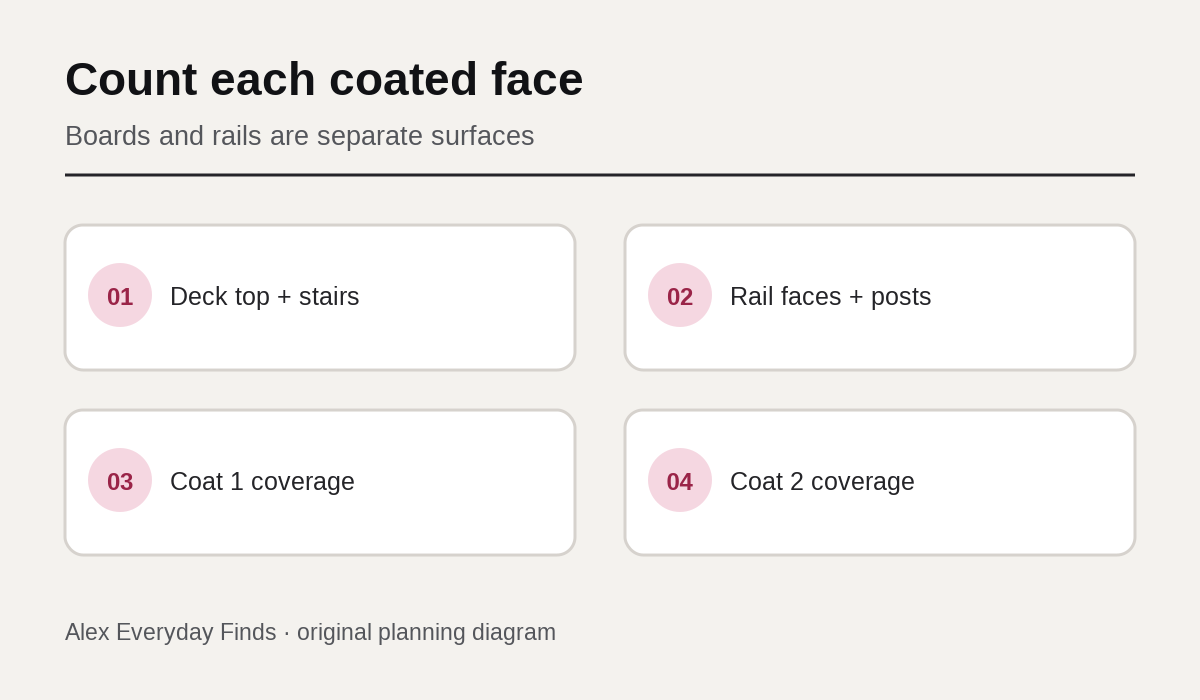
Measure the deck’s length and width for its top area. For a rectangular 12 × 16-foot deck, that is 192 square feet. Add stair treads as separate rectangles. Do not add the full deck footprint again for board edges unless you truly plan to coat those exposed edges.
For railings, list each part you will coat: top rail, bottom rail, posts and pickets. A rectangular rail with two visible sides has two face areas; a post may have four. Multiply the length × visible width of each face, then count the actual number of matching pieces. A photo and a sketch with tally marks reduce double counting.
Work through one example
Suppose your measured deck top and stair surfaces total 220 sq ft, and the sum of all railing faces you will coat is 80 sq ft. The coated area is 300 sq ft per coat. For illustration only, imagine your selected product’s sheet says 200 sq ft per gallon for coat one and 300 sq ft per gallon for coat two under your conditions:
On a narrow screen, swipe the table sideways to see every column.
| Coat | Area | Example coverage | Estimated gallons |
|---|---|---|---|
| First | 300 sq ft | 200 sq ft/gal | 1.5 gal |
| Second | 300 sq ft | 300 sq ft/gal | 1.0 gal |
| Total | 2.5 gal |
Those coverage figures are hypothetical, not BEHR specifications. Replace them with the actual product’s values and account for rough wood, application method and any instructions on maximum or minimum spread. BEHR’s linked technical information is an example of why coat-specific guidance matters; doubling the first-coat quantity can misstate the total.
Add your chosen allowance for spillage, roughness or touch-ups as a separate explicit input, then round to purchasable container sizes. Compare the price and return rules for, say, three 1-gallon cans versus another package combination. Avoid assuming a leftover opened can will store indefinitely.
Check the job before you stain
Read the exact stain’s surface preparation, drying and weather directions. Moisture, previous coatings and exposure can change both suitability and coverage. A quantity worksheet cannot decide whether the deck is ready for coating. If the plan includes underside boards, list them as their own area rather than hiding them in an arbitrary multiplier.
For a different paint calculation, our room paint guide covers walls and ceilings; use its measuring approach, not its product coverage, for a deck.
Sources & what to check
Source details checked 2026-10-17. Availability and prices can change; use the links below for current information.
Example coverage is hypothetical. Actual product coverage, preparation, required coats and application weather must come from the chosen stain's current technical sheet.