How much paint does a room need for two coats?
Estimate wall paint from room length, width, height, openings and label coverage. Calculate two coats and round to gallon and quart quantities.
For a rectangular room, calculate the wall area, subtract the areas you will not paint, multiply by the number of coats and divide by the coverage on your paint label. Floor area alone is not enough: two rooms with the same floor space can have different wall areas and ceiling heights.
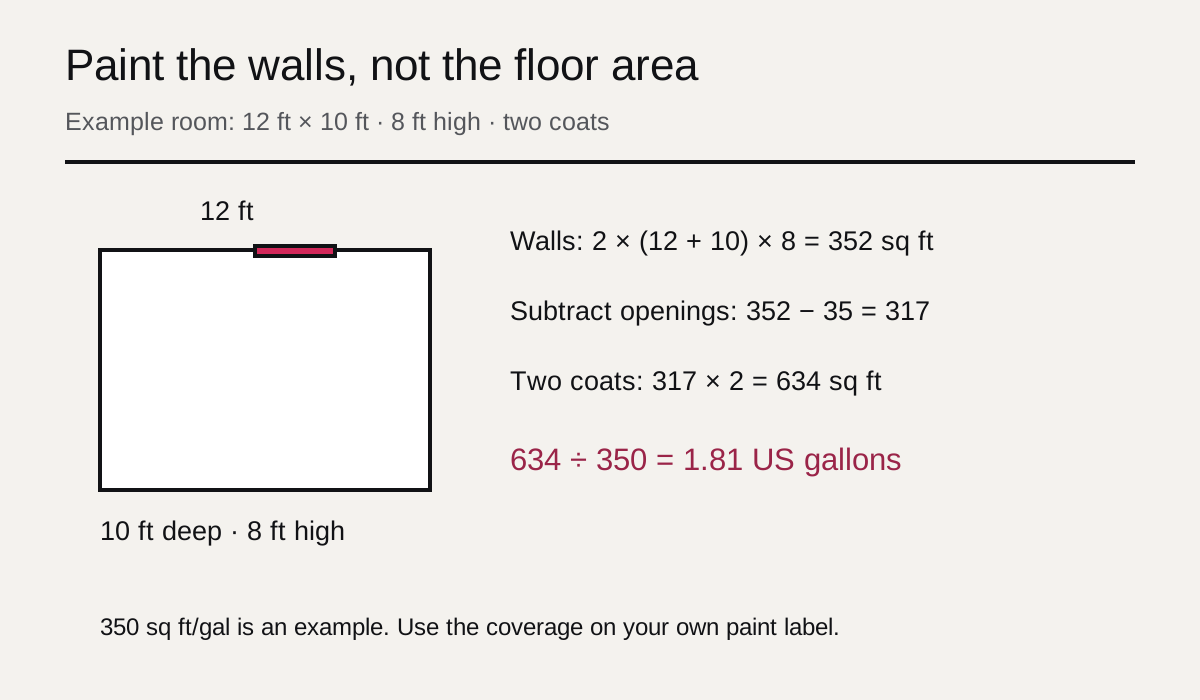
For a 12 × 10-foot room with 8-foot walls, subtracting 35 square feet of openings gives 317 square feet of wall per coat. Two coats at an assumed 350 square feet per US gallon need about 1.81 gallons before any extra allowance. Two 1-gallon cans cover that calculated quantity, but actual coverage may change the estimate.
Estimate the walls of your room
Rectangular walls only. Ceiling, trim and primer are separate. Enter the coverage and coats for your actual product. Inputs stay in your browser.
The calculator estimates the four walls of a rectangular room. It does not include the ceiling, painted trim, doors, primer or a vaulted section. Enter a separate calculation for each paint or finish rather than combining them into one purchase quantity.
Use this formula
Gross wall area = 2 × (length + width) × wall height
Net wall area = gross wall area − openings not being painted
US gallons = net wall area × coats ÷ coverage per gallon
If you choose an extra allowance, multiply the calculated gallons by 1 + allowance ÷ 100. An allowance is a planning choice; it does not guarantee that a poor coverage estimate will be sufficient.
Measure each unusual wall separately. A sloping ceiling, alcove or partial-height wall needs its own area calculation. Do not force an irregular room into the simple rectangle if that misses a large surface.
Work through the 12-by-10-foot example
The perimeter is 2 × (12 + 10) = 44 feet. Multiplying by the 8-foot wall height gives 352 square feet of gross wall area.
Subtract the example’s 35 square feet of unpainted openings: 352 − 35 = 317. For two coats, the covered area becomes 634 square feet. At the hypothetical 350-square-foot coverage, 634 ÷ 350 = 1.81 US gallons.
The 35-square-foot deduction is an entered example, not a standard allowance for every door and window. Measure yours. If you are painting a door in a different product, keep its quantity separate.
Coverage matters more than a tidy-looking answer
Behr’s linked PREMIUM PLUS Interior page lists 250–400 square feet per gallon. That range is a useful reminder to check the actual product; the calculator’s initial 350 value is an illustrative input, not a universal coverage promise.
For the same 634-square-foot two-coat job:
| Entered coverage per US gallon | Calculated gallons, no allowance | Rounded if buying only whole 1-gallon cans |
|---|---|---|
| 250 sq ft | 2.54 | 3 |
| 350 sq ft | 1.81 | 2 |
| 400 sq ft | 1.59 | 2 |
These are mathematical scenarios, not tests of the paint. Surface texture, porosity, application and the required finish affect what you should enter. Read the label and preparation directions for the exact finish and surface.
Round after adding coats and any allowance
For buying, round the finished quantity upward to the packages you can actually obtain. A US gallon contains four US quarts. The tool therefore shows both a gallon-plus-quarts amount and the number needed if only 1-gallon cans are available.
For example, a 12 × 12-foot room with 8-foot walls, 40 square feet of openings, two coats at 350 square feet per gallon and a chosen 10% allowance gives about 2.16 gallons. Rounding to quarter-gallon quantities gives 2 gallons plus 1 quart; buying only 1-gallon cans would require three.
A quart may cost more per unit, and a store may not stock your finish in that size. Compare the available packages and tinting options instead of assuming the smallest rounded combination is cheapest. Keep the product name and color information with any leftover paint.
Separate the shopping decisions
Decide what the calculation covers before buying rollers, brushes or additional coatings. Wall paint, ceiling paint, primer and trim paint are not interchangeable quantities just because all are sold in cans.
If your current product requires another coat or a separate primer on the selected surface, calculate it separately. This guide estimates quantity; it does not replace those application instructions.
For another project where package rounding changes the shopping list, see our concrete-bag calculator for fence posts. In both cases, measure first, use the actual product’s yield or coverage, and round only after the full quantity is known.
Sources & limitations
Product and documentation checks: 2026-10-12. Availability and prices can change. Read the linked sources for the current details.
Our rectangular-room arithmetic and package rounding were checked against worked examples. This is an estimate, not a coverage test or painting tutorial. Surface preparation, primer, drying times and required coats are product-specific.