Shiplap calculator: count complete board runs
Compare horizontal and vertical one-piece courses on a rectangular wall. Use installed coverage, check stock length and keep the first-course edge detail explicit.
Start with the length of each complete course, then count courses across the wall. Dividing wall area by board coverage can give a lower estimate that does not supply enough whole runs. This calculator checks both directions and refuses a one-piece plan when the stock is too short.
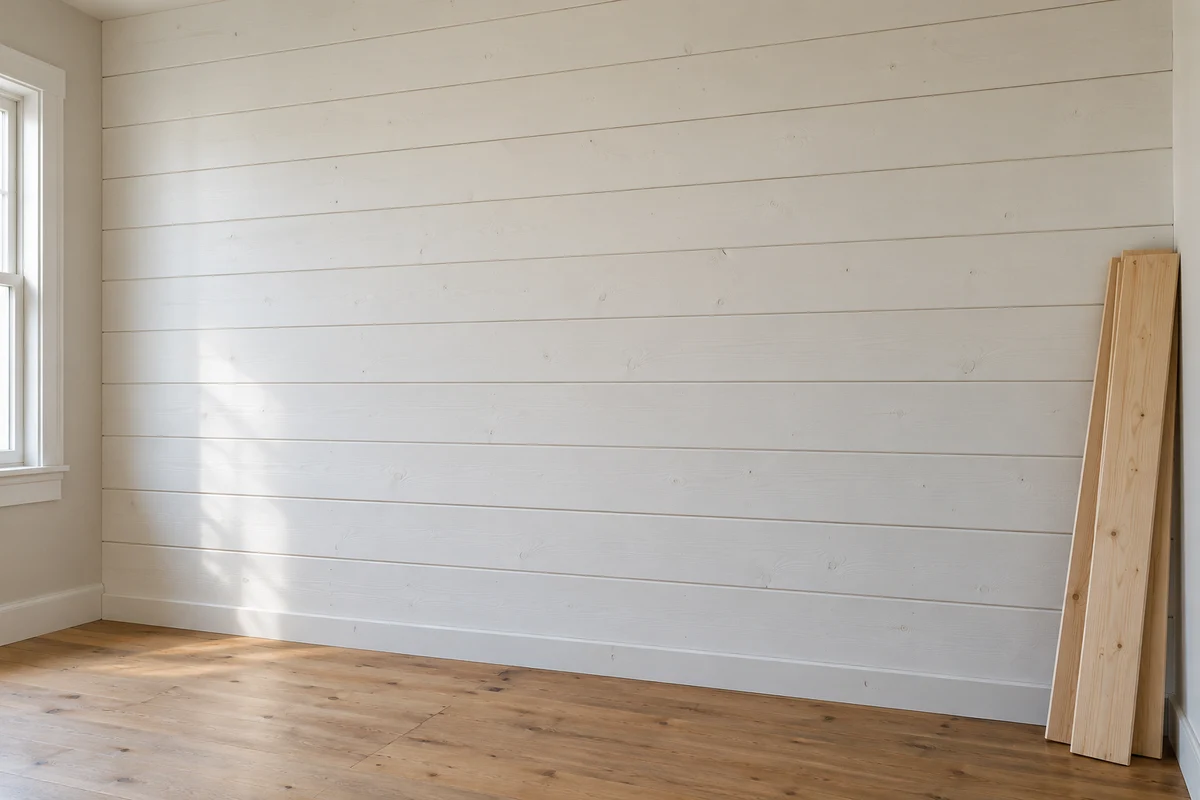
Compare complete board runs
One rectangle, one stock length, one board per course. Enter the wall span after any required perimeter clearance.
Enter measurements or load the worked example.
Your direction comparison
Counts exclude spare boards, openings, supported joins and offcut reuse. Direction feasibility here means length only; it does not approve installation or fastening.
Find the installed coverage for your profile
The calculator needs the width each additional board covers after overlap. That is different from its nominal size and can differ from the full measured face. For a specific example, the UFP Edge Rustic product table lists a 1 × 6 profile with 5.38 in actual width and 4.63 in exposed face. Those figures belong to that product family; they are not a rule for every board called 1 × 6.
Read the selected profile’s instructions and check the boards you will buy. The linked UFP installation sheet permits trimming the last board but does not give a separate numerical first-course coverage. We therefore do not turn the actual 5.38 in width into an automatic first-course assumption. The default uniform model treats every course as adding the same coverage. Select the separate first-course mode only when you have verified the effective starting width for your edge treatment.
Enter the usable rectangular span after any required perimeter clearance. The tool does not choose a clearance. Enter the extra length reserved for end preparation in its own field. If you also want spare boards for damage or matching, add them separately after the geometric calculation.
Worked example: the same wall, two course counts
Take a hypothetical 70 in wide × 96 in high usable wall, 96 in stock, no length reserve and uniform 4.63 in coverage. The example uses the source’s coverage figure as an arithmetic input; it does not establish that profile’s installed boundary detail.
| Direction | One-piece run | Span to cover | Whole courses | Final coverage |
|---|---|---|---|---|
| Horizontal | 70 in | 96 in | 21 | 3.40 in |
| Vertical | 96 in | 70 in | 16 | 0.55 in |
The area calculation rounds 70 × 96 ÷ (96 × 4.63) upward to 16 boards. That is enough in the vertical uniform-course model, but it leaves the horizontal plan five complete courses short. The 26 in offcut from a horizontal run cannot supply another 70 in one-piece run.
The vertical result has no length allowance: a 96 in run uses the whole nominal 96 in input. Any positive preparation allowance makes that direction fail the length check. Its very narrow final course also needs a separate trim and installation review. Fewer boards does not automatically make a direction suitable.
How the count and drawing work
For uniform coverage C and perpendicular span H, the course count is ceil(H ÷ C). Horizontal courses use wall height for H; vertical courses use wall width. Every course requires one stock board in this model. Its run length plus the entered end reserve must fit the usable stock length.
For a verified first-course coverage S followed by added coverage C, count 1 + ceil(max(0, H − S) ÷ C). This tool accepts S at least as large as C. If the verified starting edge works differently, use a separate layout rather than forcing it into this model. The final course uses the remaining span; the drawing shows coverage boundaries rather than the physical overlap profile.
Pack rounding happens after the course count. If you need 21 boards and the selected offer sells packs of six, the minimum pack purchase is four packs, or 24 boards. That is pack rounding, not an added waste allowance. Neither calculation confirms a particular retailer’s offer.
When this one-piece model is unsuitable
Use a separate plan for openings, multiple walls, diagonal courses, patterned joints, mixed board lengths or reuse of offcuts. If the tool says stock is too short, it does not invent a joint or assume a narrow strip can be safely fastened. Check installation directions for supports, fixing and acceptable trimmed widths. The linked manufacturer sheet treats horizontal and vertical installation differently; a successful length check does not replace it.
For a measured list of shorter trim pieces, use the baseboard stock-length planner. The deck-board quantity guide handles a different material and layout; shiplap coverage should not be reused there.
Sources & what to check
Source details checked 2026-10-27. Availability and prices can change; use the links below for current information.
One rectangular usable span, one stock length and one board per course. No openings, supported-joint design, mixed-stock optimization or installation approval. Verify the actual first and last edges before ordering.