Deck board calculator: compare rows in both directions
Estimate surface boards for a rectangular deck in two directions. Use actual board width, your specified gap, stock length, end trimming and an extra-board allowance.
Count rows across the coverage width using the actual board face width and the specified gap. Then check that one purchased board can span each row after your end trimming. This calculator compares both directions for a rectangular surface. It does not design a deck structure or a layout with butt joints.
Compare two deck-board directions
One stock board per row, with no butt joints or reuse of offcuts.
Enter your measurements or load the example.
Your planning result
Entries stay in this tab. Optional site analytics records completion without the dimensions.
Use net coverage and actual dimensions
Enter the finished rectangular area you intend the surface boards to cover. Account for perimeter clearances, borders and overhangs in that plan first. The calculator does not add or select them. Enter every length in the same unit: a 16 ft stock board is 192 in, not 16 in, when using inches.
Use the board’s actual face width rather than a nominal lumber name. Get the side gap from the instructions for the exact decking and fastener system. Trex’s 2026 guide, for example, gives product-specific gapping requirements; the 3/16 in side gap used in this worked example is not a universal rule for wood or every composite system. Verify the current installation document before planning material.
Why the row formula includes one extra gap
A run of N boards has N − 1 internal gaps. Its maximum coverage is therefore N × board width + (N − 1) × gap. Rearranging that expression gives:
Rows = round up [(coverage span + gap) ÷ (actual board width + gap)].
The last strip width is the remaining span after all earlier board-and-gap pitches. It can be less than a full board. The tool reports that geometric remainder; it does not approve ripping a board to that width or fastening it. Check edge-board requirements before deciding the layout.
Occasionally a fixed gap would consume more than the tiny space left at the boundary. The tool then withholds a purchase count and asks you to revise the coverage or border plan. A zero or negative “last board” is not a valid cut.
Compare a 12 by 10 foot surface
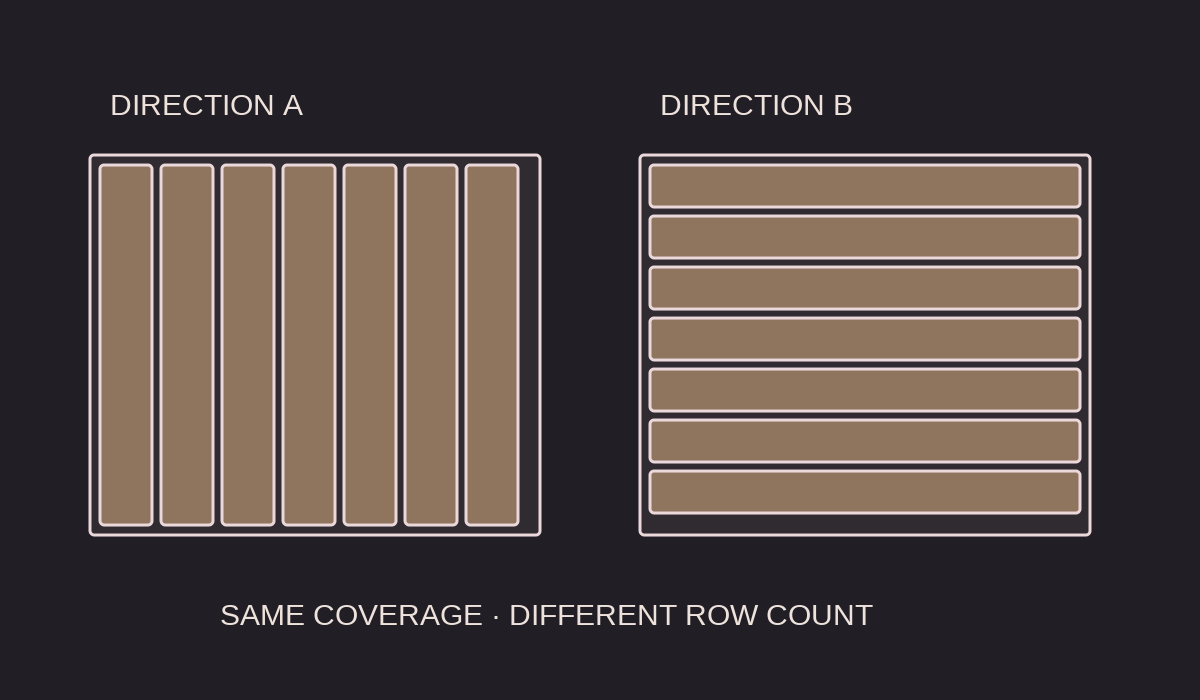
Use 144 × 120 in net coverage, 5.5 in actual board width and 0.1875 in gaps. Along the entered length, there are 22 rows, each 144 in long. The last strip is 0.5625 in wide. That narrow strip is a reason to revisit the layout and product rules, not a recommendation to install it.
Turn the direction and there are 26 rows, each 120 in long, with a 1.8125 in last strip. Both are geometric counts. With 192 in stock and 1 in total end trimming per board, remaining stock length is 47 in or 71 in, respectively.
Understand what the purchase number includes
This deliberately simple purchase model assigns one whole stock board to each row, without reusing offcuts. A chosen 10% extra-board allowance gives 25 boards for 22 rows or 29 boards for 26 rows, rounded upward after adding the allowance. It is not a cutting-stock optimum.
If usable stock length is shorter than the row, the tool withholds that direction’s purchase count. Do not multiply short boards together without a joint and support layout. Framing direction, spans, fasteners, fascia, picture-frame borders, steps and structural suitability require their own plan.
For finishing an already specified surface, use the separate deck-stain quantity tool. For lumber volume, use the board-foot calculator; board feet and surface-board rows answer different purchase questions.
Sources & what to check
Source details checked 2026-10-25. Availability and prices can change; use the links below for current information.
Surface-board count only. The tool does not specify structural design, joints, minimum ripped width or an optimized cutting plan.