How many wallpaper rolls for one wall? Count full strips
Estimate wallpaper rolls from full-height strips, roll dimensions, trim and a straight pattern repeat. Includes a free calculator and worked examples.
To estimate wallpaper for a rectangular wall, count the full-height strips needed across its width, then count how many usable strips each roll provides. A roll’s advertised square footage includes offcuts that may be too short to cover the wall. Pattern matching can reduce its usable yield further.
Estimate one wall
One rectangular wall, full-height strips. Plain/random or straight match only. Reserves one full repeat at the head of each roll. Excludes half-drop patterns, murals and opening deductions. Inputs stay in your browser.
The tool uses feet for wall dimensions and roll length, inches for roll width, trim and repeat. Enter the actual packaged roll length, regardless of whether the seller calls it a single or double roll. Total trim means the extra cut length for top and bottom together, not the amount at each end.
It plans full-height strips without subtracting doors or windows. Openings can sometimes use offcuts, but that requires a cutting layout. Subtracting their area automatically can promise savings the roll cannot provide.
Why an area estimate can be too low
Take a hypothetical wall 9 feet wide and 8 feet high, with a 20.5-inch-wide, 16.5-foot-long roll. The wall needs 108 ÷ 20.5, rounded up, or 6 strips.
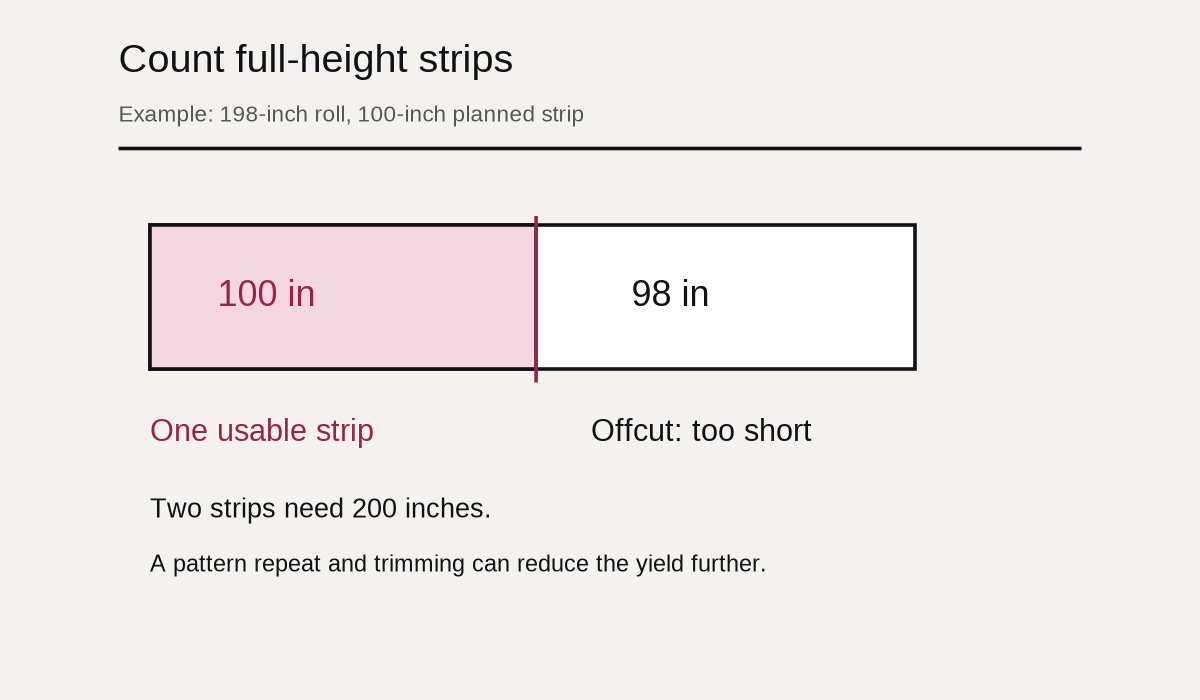
Choose 4 inches of combined trimming allowance for this example. Each plain strip then needs 96 + 4 = 100 inches. A 16.5-foot roll has 198 inches, so it provides one such strip. Two strips would need 200 inches. The planned quantity is therefore 6 rolls.
An area-only calculation gives 72 square feet of wall divided by about 28.2 square feet per roll, rounded up to 3. Those three rolls contain enough total paper area, but only three full-height strips under these assumptions. That difference is why roll dimensions matter.
Add the pattern match deliberately
Ethan Allen’s glossary distinguishes straight, half-drop and random matches. A straight match aligns the pattern at the same height on adjoining strips. A half-drop shifts that alignment; it needs a different cutting plan and is outside this calculator.
For the same wall with a hypothetical 27-foot roll, plain 100-inch strips give three strips per roll and a plan of two rolls. Enter a 12-inch straight repeat, and the tool rounds each planned cut to 108 inches. It also reserves one full repeat at the start of each roll for finding the alignment: 324 − 12 = 312 inches usable. That gives two strips per roll and a plan of three rolls.
This is an explicit conservative allowance, not a claim that every installation wastes a full repeat at the start. The motif placement, roll start, trimming and installer’s layout can change the actual yield. Discuss those details with the seller rather than reducing the estimate just because a shorter offcut looks reusable.
Confirm the purchase unit and batch
Check the roll width, packaged length, match type, repeat and any required overlap for your chosen wallcovering. Different products can have the same nominal coverage and quite different cutting yields. A mural sold as numbered panels should be planned by its panel system instead.
Order compatible batches and ask about unopened-roll returns before buying extra material. Check preparation and surface instructions separately; peel-and-stick does not guarantee damage-free removal from every painted wall.
If you decide to paint the wall instead, our two-coat paint calculator estimates paint from wall area and the coverage on the product label.
Before buying rolls for a rented room, compare wallpaper alternatives by installation and removal requirements. A quantity calculation cannot establish whether a covering is suitable for the wall or permitted by your rental terms.
Sources & what to check
Source details checked 2026-10-12. Availability and prices can change; use the links below for current information.
The calculator plans strips conservatively for one wall with plain/random or straight match. Half-drop patterns, murals and opening deductions require a separate layout calculation.