Bedside caddies: check the pocket and mattress attachment
Choose a bedside pocket around mattress attachment, the items you keep nearby and a clear exit path. Includes an example and a printable buying checklist.
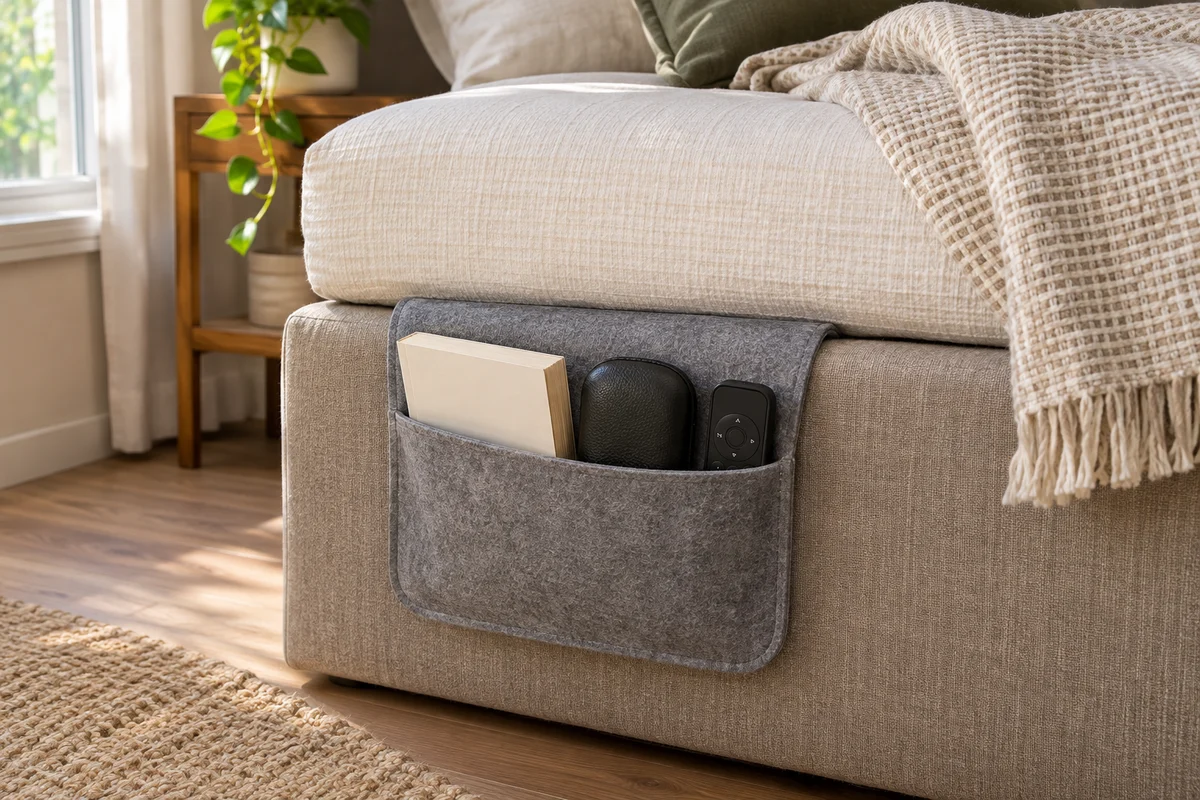
Choose a tuck-in bedside pocket when the mattress and bed base can hold its attachment as the manufacturer intends, and your small everyday items fit the useful openings. Choose a rail-mounted caddy only when its straps or hooks are specified for your rail. Outside pocket dimensions alone cannot confirm either the attachment or the fit of a tablet.
Start with a short list: perhaps a paperback, glasses case and remote. Measure the largest item, then examine the actual mattress edge, frame and route beside the bed. Use the printable bedside-pocket checklist to compare attachment, usable storage and access separately.
Choose the attachment before counting pockets
| Format | Consider it when | Confirm first |
|---|---|---|
| Flap tucked under a mattress | There is a compatible, accessible mattress/base interface | Required insertion, support and whether the bed arrangement permits it |
| Caddy attached around a rail | The exact rail shape suits the supplied straps or hooks | Approved rail dimensions, fastening and loaded access |
| Small bedside table or existing shelf | The bed has no suitable attachment point | Clear floor route and a reachable surface |
Do not treat these mounting types as interchangeable. A pocket designed for a flat tuck-in flap is not automatically suitable for a round rail, and an improvised fold does not establish a secure attachment.
A documented felt-pocket example
Kikkerland’s Bedside Pocket, SKU OR74, was listed at $25 on its US-facing page on November 4, 2026, before tax and delivery. The page gives synthetic felt and cardboard materials and dimensions of 22.8 × 28.2 × 11.5 cm. It describes a felt pocket for use beside a bed or couch.
The text does not establish a useful internal opening, a numerical load limit or compatibility with your particular mattress/frame combination. Its broad compatibility wording is not a measurement of your bed. Check the attachment shown for this exact item and ask for the useful pocket opening if the fit of a specific object matters.
The three outside numbers also should not be silently rearranged into a labeled internal width and depth. Measure or obtain the usable opening in the orientation in which you plan to store the item.
Work through the object that matters
Suppose your paperback is 13 × 20 cm, the glasses case is 6 × 16 cm, and you want to remove each without disturbing the other. Record those dimensions and compare them with the actual pocket openings and divider arrangement. A seller’s overall outside size is enough to screen the space the caddy occupies, but it is not enough to approve that two-item layout.
There are two valid next results. If the seller supplies an adequate internal opening and compatible attachment directions, the pocket can stay on your shortlist. If those dimensions remain unavailable and the book fit is essential, choose a product with documented useful openings or an existing bedside surface. The checklist deliberately allows an “unconfirmed” result instead of making you guess.
Exception: an item is 30 cm long in the direction you need to store it, while the longest listed outside dimension of the OR74 is 28.2 cm. You cannot infer fully enclosed storage in that orientation. A protruding arrangement might be possible for some objects, but it is a different requirement and needs a deliberate check of support and access. Do not promise tablet fit from the product’s outside envelope.
Check the bedside route
Look at the pocket from floor level and from your normal sleeping position. The loaded pocket should be reachable and should not obstruct the way you get into or out of bed. Check that drawers, bedding and other storage can move without catching it. If the bed adjusts or moves, consult its instructions before putting anything at the moving mattress/frame interface.
Keep the pocket for the small storage task you chose. Charging equipment needs the device maker’s ventilation and placement requirements; an enclosed fabric pocket is not a verified charging station. The pocket’s convenience does not establish a safe place for every powered accessory.
Our under-bed storage guide handles boxes and their pull-out path. That is useful if larger items need another home, but a box underneath the bed does not settle the attachment of a pocket at its edge.
Buy when the three checks agree
Confirm the bed attachment, the useful item opening and clear everyday access. Check the selected model’s care instructions and delivered cost, too. If those answers are available, compare the pocket with a small table or existing shelf on convenience and space. If attachment or essential item fit is still unknown, the practical answer is to choose a more verifiable option.
If a lamp is using most of the surface, check the layout of a small nightstand before moving the phone or buying a new lamp.
If you are also rearranging the floor beside the bed, compare two tower fan positions before committing space.
Sources & what to check
Source details checked 2026-11-04. Availability and prices can change; use the links below for current information.
Product dimensions and features are published specifications. Confirm the selected model, current price, care and compatibility with your own space before buying.