Under-bed storage: check the supports and pull-out path
Screen an under-bed box against clear height, supports and the space needed to pull it out. Compare two documented IKEA examples and make a route check.
An under-bed box needs enough height to enter, enough width between supports, and enough clear floor to come all the way out. Measure the lowest obstruction and the narrowest part of the route. The height from the floor to the bed rail alone cannot establish a fit.
Check the box and pull-out path
A rectangular size screen, followed by a real route check. It does not prove that an item will fit or work.
Enter your measurements, or load the article’s worked example.
Your planning result
Entries stay in this tab and disappear on reload. Optional site analytics records completion without these dimensions.
Map the space from the floor
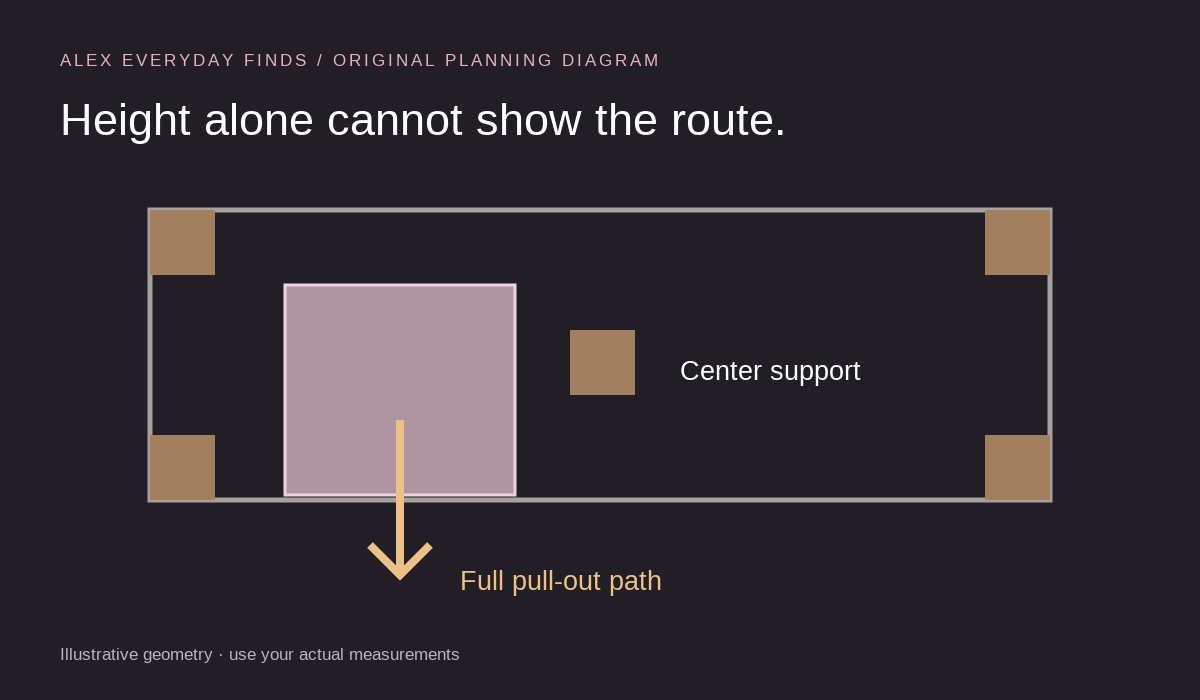
Look under the whole bed before choosing a container. Mark the outer legs, center supports, low rails, nearby furniture and any floor feature that will meet the box. Record the usable storage depth and the narrowest opening that the box must pass through.
Measure from the surface the box will actually travel on. A rug, threshold or uneven floor can reduce the available height along the route. Check the full assembled container, including its lid, handle and wheels. Do not substitute the shipping-carton height or the empty drawer’s inside height.
Compare two documented examples
The linked US IKEA listings distinguish the assembled box from its usable inside space. These are dimension examples, not tested recommendations or a promise of local stock.
| Product and article number | Outside footprint | Outside height | What to keep separate |
|---|---|---|---|
| VARDÖ 202.382.23 | 25⅝ × 27½ in | 7⅛ in | Inside drawer height is 5⅛ in |
| SOCKERBIT 204.115.24 | 19¾ × 30¼ in | 7½ in | Assembled measurements differ from its packages |
The VARDÖ example shows why an inside dimension cannot answer an outside fit question. Check the current listing and assembly instructions for the exact article and configuration you will use. Its wheels and cover are part of the assembled product; removing parts would be a different setup that this comparison does not validate.
Work through the route, then the lid
The loaded example uses a hypothetical opening 28 in wide, 31 in deep and 8 in high, with 29 in of unobstructed floor outward. A 25⅝ × 27½ × 7⅛ in box leaves 2⅜ in total width, 3½ in depth and ⅞ in height before the user’s chosen margins.
Those differences are arithmetic, not prescribed operating gaps. The form compares them with the total width/depth margin and extra headroom you enter. It also checks whether the entire box depth can travel straight outward until its back edge clears the opening. A result that clears these numbers still needs a real route check.
Cut a cardboard rectangle matching the outside footprint. Move it from the intended parked position through the full exit route without bending it. If it catches a support or cannot turn around a bedside table, an area calculation will not fix that obstruction. The rectangle tests the footprint; it does not test loaded height or how the lid opens.
Check the way you will use the box
Decide whether you will open the container under the bed or pull it out first. A removable lid may need more headroom than the closed box. A split or hinged lid has its own motion. Include the contents if they could push a soft top upward.
The calculator’s 90° orientation is a geometric comparison, not permission to pull a wheeled box sideways or use a handle in an unsupported direction. Confirm the intended movement in the product instructions. For a soft storage bag, use its filled outside envelope rather than assuming it will compress enough.
Storing long gift-wrap rolls rather than folded textiles? Our wrapping-paper storage comparison separates the stated roll-length limit from the outside case size and compares flat, upright and hanging formats.
If this storage is going onto a shelf instead, use the closet-bin fit guide. For a narrow open gap beside furniture, the rolling-cart guide checks a different route and wheel arrangement.
If bulky seasonal textiles are the obstacle, compare vacuum bags and roll-compression sacks for clothes. Check fabric suitability and the actual loaded package before assuming compression will solve the opening.
For a book and remote kept at the mattress edge, check a bedside pocket by its attachment and useful opening; an under-bed box solves a different storage task.
Sources & what to check
Source details checked 2026-10-24. Availability and prices can change; use the links below for current information.
The tool screens rectangular dimensions only; it does not model tilting, turning, soft-bag deformation or loaded lid movement.