Jewelry organizers: boxes, stands or wall storage?
Compare jewelry boxes, necklace stands and wall storage by necklace drop, compartments, access and footprint. Includes measured examples and a buying worksheet.
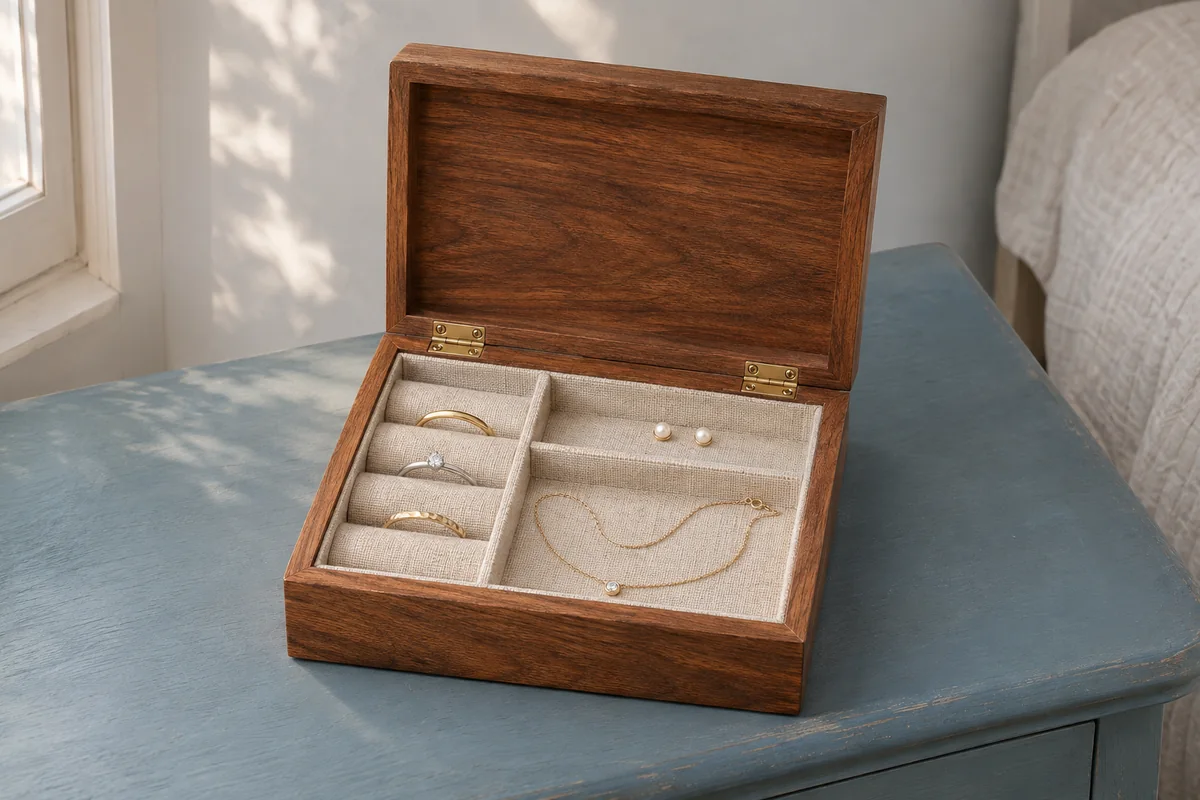
Choose a box for small pieces you want covered, a stand for necklaces you wear often, or wall storage when hanging space matters more than a countertop footprint. Start with the longest necklace and the smallest loose item. A tall stand does not automatically provide the same amount of clear hanging space, and a large box does not guarantee useful compartments.
Match the format to your collection
Lay out a normal week’s jewelry without its packaging. Keep pairs together and count the pieces you need to see every morning. Put occasional pieces aside; buying a daily organizer for the entire collection can make the daily selection harder.
| Format | Useful starting point | Measurement that decides the fit |
|---|---|---|
| Covered box | Rings, small earrings and occasional pieces | Usable compartments, opening lid and drawer travel |
| Open stand | Frequently worn necklaces and bracelets | Clear drop from each bar, bar spacing and base footprint |
| Wall-mounted hooks or pockets | A vertical collection near a dressing area | Actual hook spacing, hanging drop and suitable mounting surface |
| Shallow tray inside furniture | A small daily selection already near a mirror | Inside drawer size and height with jewelry loaded |
A box with one broad compartment may still need separate small containers. Keep chains apart rather than treating a deep bowl as a necklace organizer. For a furniture drawer, our drawer-divider guide explains why internal measurements matter more than the outside dimensions.
Two documented examples
The following Umbra examples show how two formats use space differently. Their US pages were checked on November 4, 2026. Both displayed unavailable or backorder wording for the shown variants, so check stock before planning a purchase around them. Prices exclude delivery and tax.
| Example | Published outside dimensions | Listed price | What the format provides |
|---|---|---|---|
| Trigem, White-Brass, 1017310-524-REM | 9.06 L × 4.02 W × 17.13 H in | $30 | Three hanging tiers and a base dish |
| Tesora, Brass, 1013238-104 | 5 L × 5 W × 4.38 H in | $30 | Two stacking compartments; the metal lid also serves as a tray |
Use the current dimensions of the exact SKU. A stand’s overall height includes its base and the space above or around the bars; do not turn 17.13 inches into a promised necklace drop. Tesora’s overall height does not establish the internal depth of either compartment. Neither checked page establishes an airtight or tarnish-proof enclosure.
Measure a necklace as it will hang
Fasten the clasp and hang the necklace over a temporary smooth support. Measure from the support to the lowest pendant or chain point, without stretching it. This direct measurement handles pendants and asymmetric necklaces better than guessing from the named chain length.
For a simple chain loop without a pendant, a 24-inch total length would hang roughly 12 inches below a thin support. Add a hypothetical 1.5-inch pendant extending below the loop and the drop becomes roughly 13.5 inches. The example is a planning estimate: the actual pendant position, clasp and bar thickness can change it. Measure the real piece before buying.
Check adjacent tiers too. Two necklaces can each fit vertically while their pendants collide. Leave room to lift a chain off the bar without moving three others. For wall storage, add the mounting hardware and clearance from nearby doors; use the organizer’s own installation and load instructions.
A five-line buying worksheet
- Daily collection: number of necklace drops, ring spaces and earring pairs.
- Longest drop: actual hanging necklace including its pendant.
- Smallest loose item: the piece that could fall through a pocket or disappear in a well.
- Working space: base outline plus lid, drawer or hand movement.
- Care: storage instructions for the jewelry’s materials and the organizer’s lining.
If jewelry and cosmetics share one dressing surface, compare the separate footprint in our countertop makeup organizer guide. Give each a clear access area rather than assuming one tall container will serve every shape.
Common questions
Is a jewelry stand better than a box?
A stand makes hanging pieces visible and accessible. A box covers small items and can separate occasional pieces. Choose by the collection and available working space; a small stand plus a shallow box may be easier to use than one crowded unit.
Does a jewelry box prevent tarnish?
A lid alone does not establish that. Look for specific material and care information for your jewelry, and evidence for any anti-tarnish lining claim. Do not transfer that claim between different box variants.
Can a wall organizer replace a countertop stand?
It can move hanging storage off the surface, provided the hooks, pockets and mounting suit your pieces and wall. Check the reach and hanging drop before drilling or applying an adhesive mount.
Sources & what to check
Source details checked 2026-11-04. Availability and prices can change; use the links below for current information.
Compare exact variants and confirm usable dimensions, current availability and the delivered total before ordering.