Adjustable drawer dividers: choose the right range and layout
Compare OXO dividers, SpaceAid bamboo dividers and an OXO tray by drawer size and layout. See which options to rule out before buying.
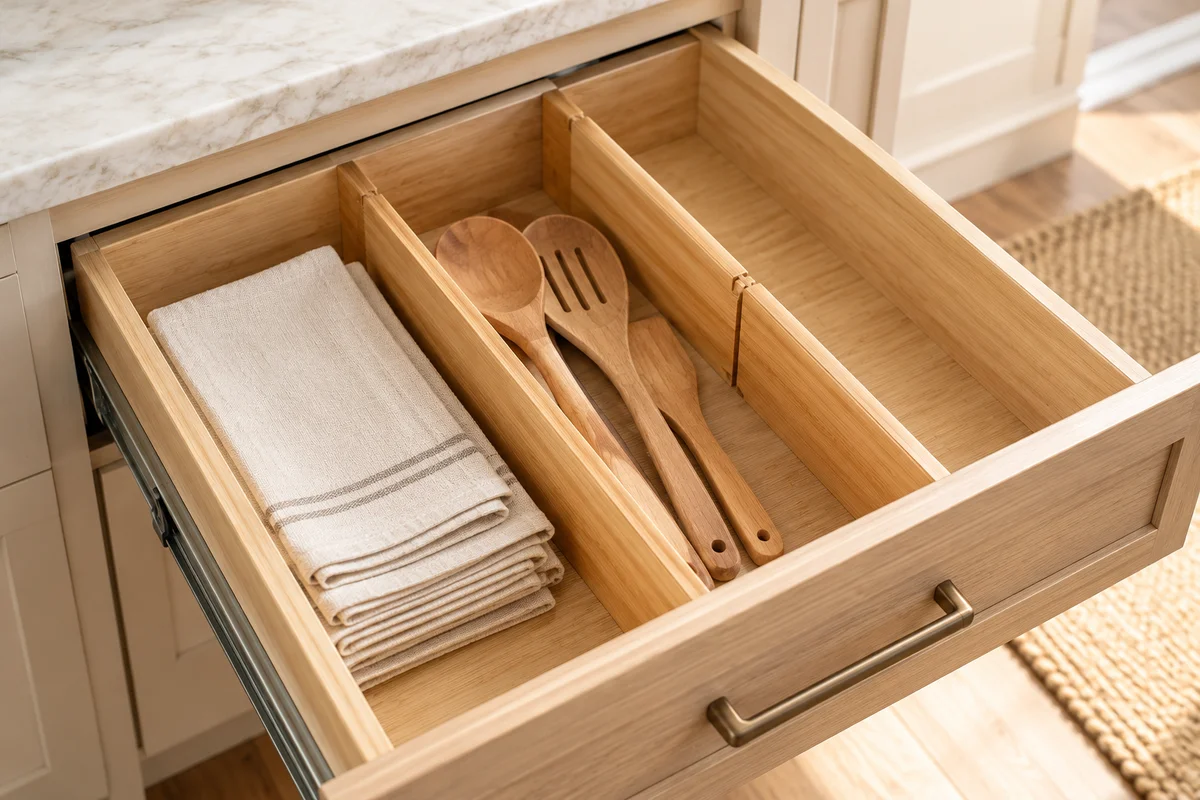
Choose adjustable drawer dividers by their shortest and longest length, full height, and the layout you want inside the drawer. A divider advertised as expandable can still be too long when fully closed. A model that spans the drawer can also leave compartments too narrow for your clothes or utensils.
For a shorter drawer and long rows of clothing, start by checking the OXO dresser divider set. For a longer span and cross-divided sections, the SpaceAid bamboo set is a candidate, with a height question to resolve. For small loose kitchen items, consider a tray with a base, such as OXO’s kitchen tool organizer.
Compare three ways to divide a drawer
These are specific products with different jobs. The tray is an alternative to pressure dividers, not another version of the same mechanism.
On a narrow screen, swipe the table sideways to compare all columns.
| Product | Published size | Layout | Listed US price |
|---|---|---|---|
| OXO dresser dividersExpandable Dresser Drawer Divider Set SKU 13227200 | 11–17 in span 4 in tall | Two plastic dividers Handle locks each in place | $26.99 Set of two |
| SpaceAid bamboo setFour dividers + nine inserts SKU zzb-kc4+9-l | 17–22 in span 0.6 in thick Height needs confirmation | Spring-loaded dividers Inserts for smaller sections | $28.99 Per set |
| OXO kitchen tool trayExpandable Kitchen Tool Drawer Organizer | 16.35 in fixed dimension 7.33–12.83 in expanding 2.49 in tall | Tray with removable dividers Small storage cup | $19.99 Per organizer |
Prices were shown on the manufacturers’ US pages on October 28, 2026, before shipping and tax. The sets contain different kinds and numbers of pieces: compare the layout you can build, then check current availability, return terms and the delivered total at the seller.
SpaceAid height check: the product text labels one dimension as 2.35 in wide, while its package illustration labels a vertical measurement as 2.5 in. The illustration pairs that number with 5.8 cm, which does not equal 2.5 in. Confirm the assembled height of this exact SKU before buying it for a shallow drawer. Do not borrow the height of another SpaceAid set.
Which option would I shortlist?
A 15-inch span with room for a tall divider
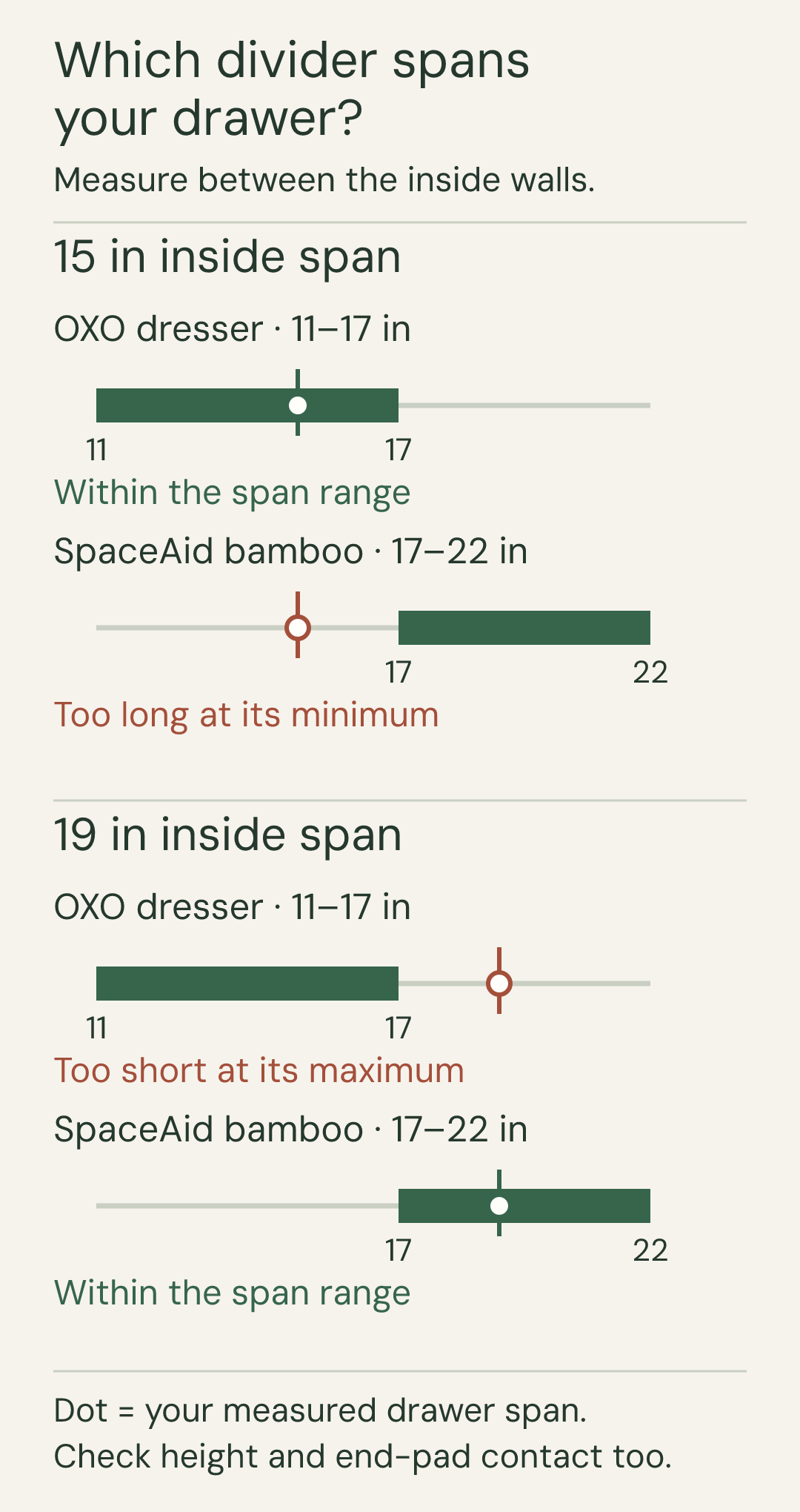
The OXO dresser model covers a 15 in span within its stated 11–17 in range. You still need clearance above its 4 in height and suitable opposing walls. The SpaceAid set starts at 17 in, so exclude it for that same 15 in gap in the chosen orientation.
A 19-inch span with smaller sections
SpaceAid’s stated range includes 19 in; its inserts offer a way to subdivide long channels. The OXO dresser model stops at 17 in, so exclude it for that span. Resolve the SpaceAid height discrepancy and check the insert positions against your belongings before ordering.
A different orientation may change the span. Measure it separately; turning a divider does not create extra space for the contents.
A shallow kitchen drawer with loose items
With a hypothetical 3 in of clear height, exclude the 4 in OXO dresser divider. The kitchen tray’s listed 2.49 in height leaves 0.51 in before accounting for contents and obstructions. That arithmetic is not a guaranteed operating clearance.
The tray also needs its 16.35 in fixed dimension and at least 7.33 in in the expanding direction. Make a paper outline of that footprint, then check the compartment shape against your longest utensil. Outside dimensions do not establish the usable space inside every section.
Bamboo or plastic?
Material is one part of the choice. Here, the bamboo set offers inserts and a longer span; the plastic dresser set offers a shorter span and a stated 4 in height. These model differences do not establish that bamboo is generally stronger, plastic grips better, or either material suits every drawer finish.
Decide whether you need long channels, smaller cubbies or a tray with a base. Then compare dimensions, contact pads and cleaning directions. A large pack is poor value if most pieces cannot be used in your drawer.
Record three measurements
Open the drawer far enough to see its back and both sides. Measure the clear inside width and depth at the height where the divider’s end pads will sit. A sloping side can give different readings at the base and near the rim. Repeat the measurement where each planned divider will go.
For height, find the lowest obstruction above the closed drawer’s contents. The front panel may be taller than the usable space inside. Include any projecting handle or locking mechanism on the divider. Leave the clearance required by the product rather than treating exact contact as a successful fit.
Write the results as inside width × inside depth × clear height, in inches. Keep that order when comparing listings; a seller’s product diagram may use a different order.
Sketch the compartments with the contents
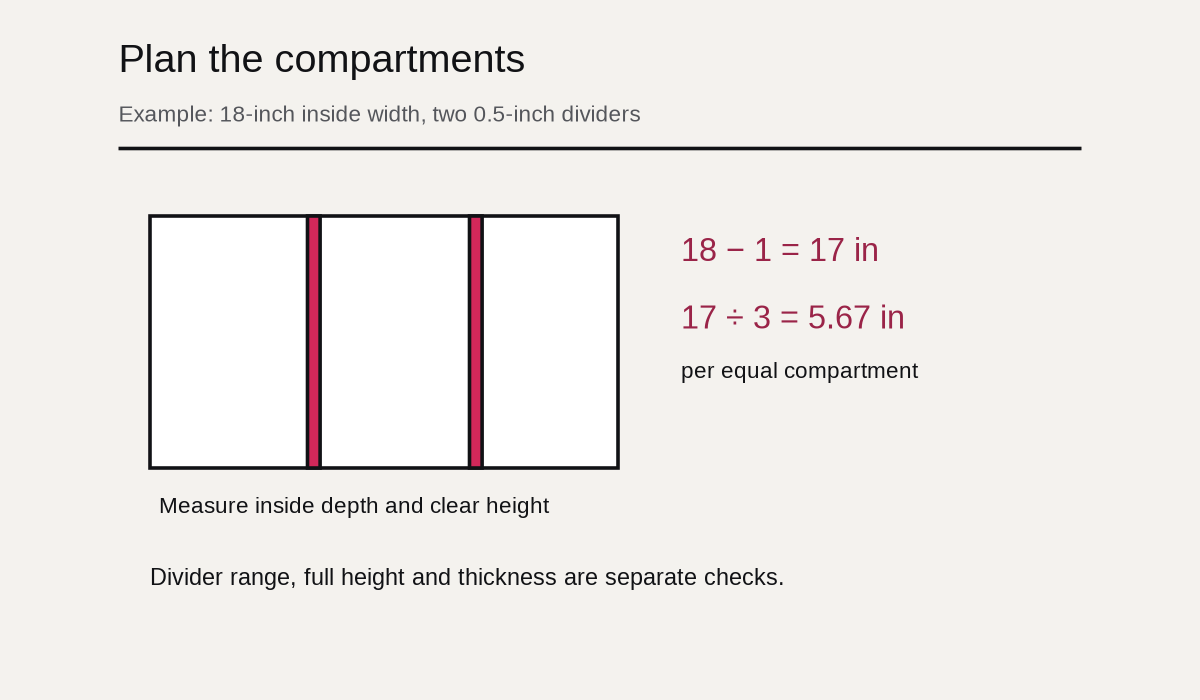
Suppose a drawer has an 18-inch usable width. You want three sections across it, and each of two hypothetical dividers occupies 0.5 inch of that width. The space left for clothing is 18 − 2 × 0.5 = 17 inches. Equal sections would be about 5.67 inches wide, not 6 inches.
The 0.5-inch thickness is an example input; measure or obtain the thickness of your chosen model. Fold a shirt to the intended width and compare it with the sketch. Socks may need a narrow section, while workout clothing needs more room. Unequal sections often make better use of the drawer than three identical channels.
Use strips of paper to mark divider positions before ordering. Check that the longest item can lie in its compartment without covering the next section. If small pieces would slide underneath a divider, a shallow tray may solve that particular problem better.
Choose the mechanism for the drawer
Pressure dividers need suitable opposing walls. Check the seller’s instructions for padded ends, locking action and allowed surfaces. A thin drawer wall or a delicate finish deserves a compatibility check; foam pads alone do not prove that the divider cannot leave a mark.
Separate trays are easier to lift out for cleaning, but their rims consume space. Fixed compartment inserts offer a ready-made layout, which is useful only when those sections fit your actual contents. Compare mechanisms after measuring rather than buying a large mixed organizer set and hoping enough pieces fit.
Keep the product’s adjustment range, full height and divider thickness together in your shopping notes. For another storage area with obstructions, our under-sink fit guide explains how an opening can be narrower than the space behind it.
For a craft workspace, first compare pegboard and drawer storage by access and object size, then measure the chosen drawers. If you are also replacing cabinet handles, measure the mounting-hole centers separately; drawer interior width does not determine handle spacing.
For a drawer of food containers, sort matching bases and lids before choosing dividers. Our food container and lid organization guide compares complete sets with nested bases and explains why standing lids can exceed the empty organizer's height.
For a daily makeup collection that lives above the drawer, compare countertop makeup organizers and their working footprints. A rotating tray needs a clear circle, while a small chest needs room to pull its drawers out.
For a dedicated flatware layout, compare flat and tiered silverware organizers by footprint, loaded drawer height and usable compartment access.
Sources & what to check
Source details checked 2026-10-28. Availability and prices can change; use the links below for current information.
Product details are manufacturer specifications, not our physical tests. SpaceAid has conflicting height information. The examples screen dimensions and layouts; they do not establish grip, loaded closure or protection of a drawer finish.