Pull-out organizer or turntable under the sink?
Compare under-sink pull-outs, turntables and lift-out bins by access, bottle height and plumbing. Use a paper layout before choosing an organizer.
Choose a pull-out organizer when you have a clear route through the cabinet door and want to bring items at the back toward you. Choose a turntable when you have room for its entire circle and the bottles can rotate without hitting pipes. Choose a lift-out bin when you want to carry one group of supplies to the counter and have enough room to lift it out.
None of those mechanisms solves a cabinet that is too short for the bottles you want to store. Start with the usable space, then choose how the contents should move.
Compare the movement, not just the dimensions
| Mechanism | Works best when | What can stop it working |
|---|---|---|
| Pull-out or rolling caddy | A long clear zone lines up with the door opening | Hinges, a center stile, floor lip or another item blocks the exit |
| Turntable | A complete round zone is clear, including the path of loaded bottles | A pipe, hose or tall bottle obstructs rotation |
| Lift-out bin | One group of supplies can be removed together | The sink bowl or pipe prevents lifting; loaded bin is awkward to carry |
| Fixed two-tier shelf | Smaller items can use otherwise wasted vertical space | Lower compartment is too short, or the upper tray overlaps plumbing |
A pull-out does not always need to be a permanently installed slide. Some freestanding caddies roll or lift forward; mounted versions may require hardware. Read the instructions for the particular mechanism rather than assuming that every product called a pull-out works the same way.
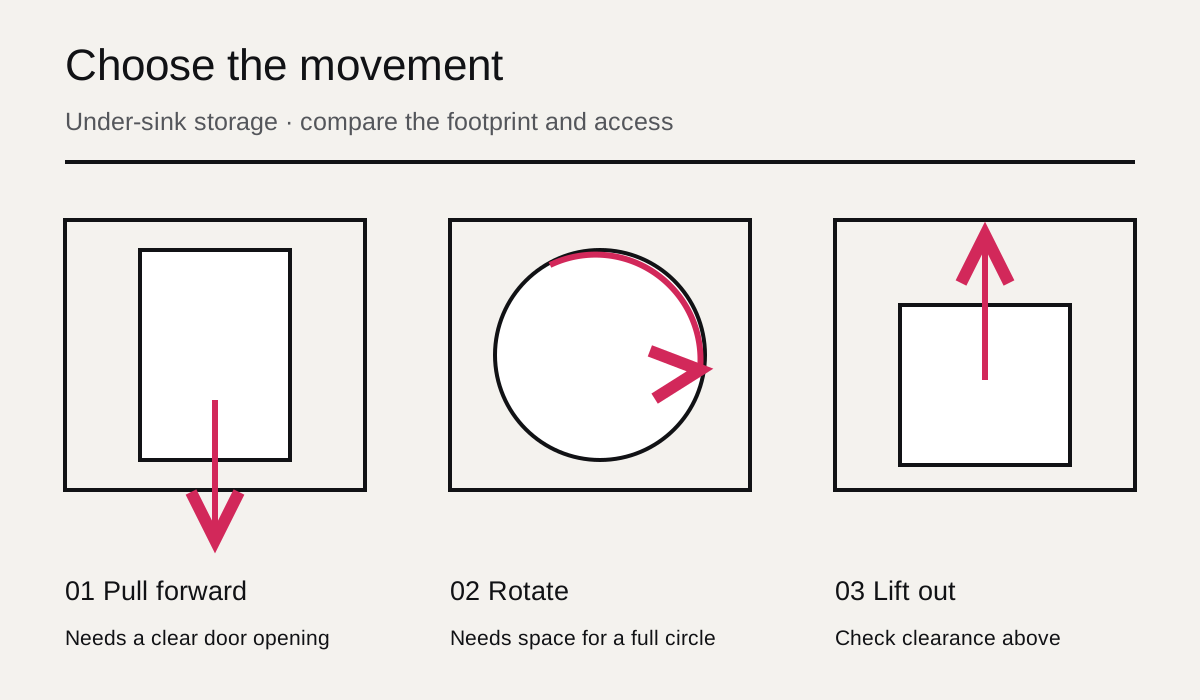
Original mechanism diagram. Not to scale; not a tested installation.
When a pull-out is the better starting point
A narrow rectangular caddy can use the space beside a drain where a large circle cannot. The trade-off is the route out: the organizer must pass through the opening, with its contents still clear of the sink and hardware.
As a documented example, YouCopia lists the RollOut 8-inch caddy at 7.7 inches wide and 16.4 inches deep, or 21.3 inches deep with the basket. Include the basket in your paper footprint if you plan to use it at the front or back. These are manufacturer dimensions, not measurements from our own cabinet test.
Draw the footprint on paper, place it inside the empty cabinet and pull it straight forward. Does it align with the opening? Can you operate the front without reaching behind a pipe? Check the product’s actual lifting or rolling instructions too. A paper template can reject a poor arrangement, but it cannot prove that a loaded unit will operate smoothly.
When a turntable is worth considering
A turntable brings a different bottle to the front while the organizer stays in place. That can suit a wide, reachable zone that has enough unused depth for the circle.
YouCopia’s SinkSuite example has a 12-inch diameter. Treat that as a circular footprint, not a narrow rectangle. Check the whole sweep of the contents: a spray nozzle sticking out beyond the rim and a bottle leaning outward can need more space than the empty turntable.
Do not choose it only because the front half fits. If the back half is obstructed, the mechanism may not give you access to the contents you wanted to reach.
Try two paper layouts before ordering
Suppose one side of your cabinet has a usable rectangle 9 inches wide by 18 inches deep, with an unobstructed door opening. The documented narrow caddy is worth checking further; a 12-inch circle exceeds the width. That is a reason to reject that turntable for that zone, not a recommendation to buy the caddy without other checks.
Now suppose a different zone is 14 by 14 inches, but a center stile blocks a straight route out. A 12-inch turntable may be worth checking for rotation and loaded height. Its round shape does not remove the need to reach it through the door.
Use our under-sink measurement guide to check height, openings and the loaded arrangement. That guide answers the fit question; this comparison helps you choose which mechanism to investigate.
What to check on the product page
Before buying, record the exact model, outside footprint, usable compartment height, mounting method and current return terms. For tiered organizers, the height of the whole frame is not the clearance inside the lower compartment.
Keep handles, spray heads and plumbing access in the plan. If several supplies are rarely used, a small removable bin may be simpler than adding another mechanism. If you use bottles every day, compare how easily each arrangement brings the label and handle within reach.
The manufacturer links here are ordinary source links, not active affiliate purchase links. We have not tested these products. Use them to check the design and dimensions, then compare the exact version available from your seller.
Sources & limitations
Product and documentation checks: 2026-10-12. Availability and prices can change. Read the linked sources for the current details.
This is a comparison of storage mechanisms and manufacturer specifications, not a hands-on review. Layout examples are hypothetical; seller stock and suitability for your cabinet are not confirmed.