Water bottle organizers: check the lid, handle and shelf
Choose a water bottle organizer by bottle diameter, lid and handle projection, shelf clearance and access. Compare two current YouCopia racks and a fit worksheet.
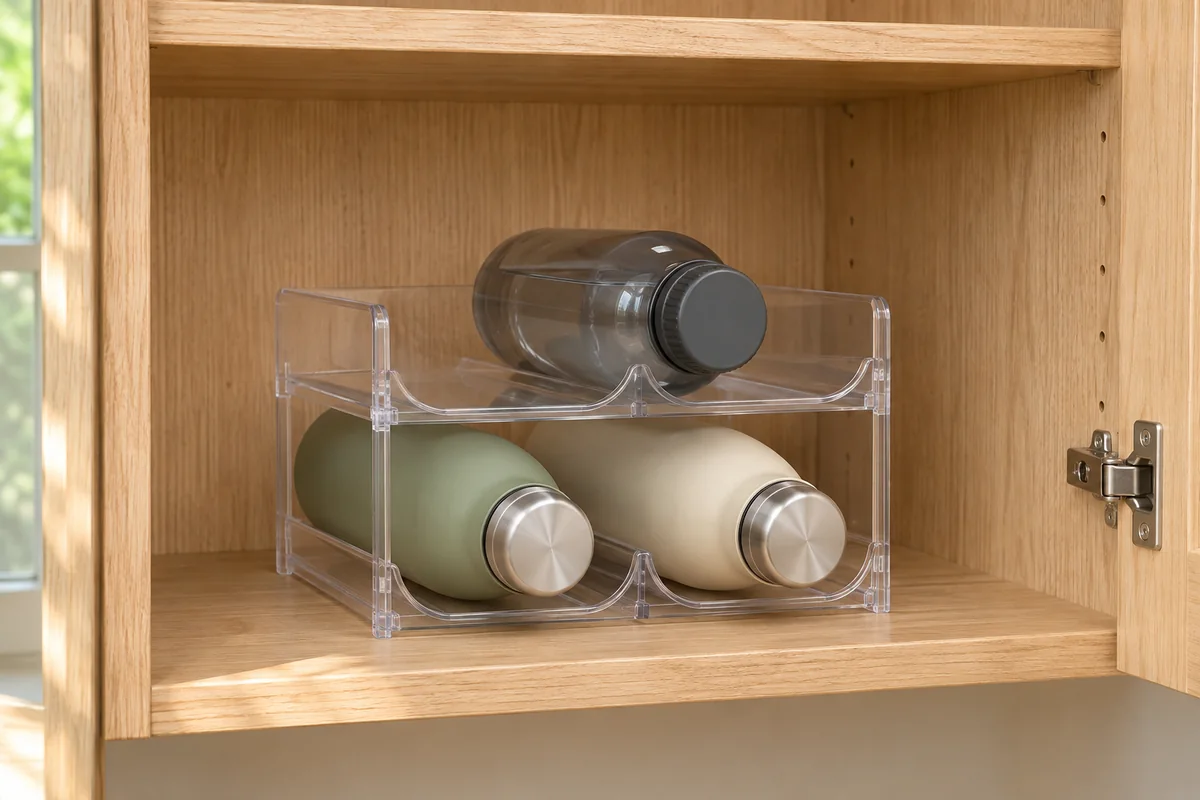
A bottle organizer fits only when the complete bottle fits and can come out easily. Measure it with its usual lid, handle and straw arrangement. Then check the cabinet opening and the rack’s usable slots. The number in a rack’s product name is a nominal capacity, not a promise that every tumbler in your collection will fit.
Begin with the awkward bottle
Choose the widest body, longest capped bottle and largest handle. Lay each bottle on its side in the orientation you intend to store it. Record its widest outline, not just the circular body diameter. A handle may need to face upward or into a neighboring empty space.
For bottles you prefer upright, a short open bin may work better than a horizontal rack. Keep frequently used bottles near the front; reserve a higher shelf for spares. Our small pantry organization guide helps separate daily-use and refill zones.
Compare two current rack sizes
These Organizing Hero UpSpace models were checked on YouCopia’s US pages on November 4, 2026. They are the current named versions below; do not borrow measurements from an older UpSpace listing with a different frame.
| Model | Outside D × W × H | Listed price | Practical decision |
|---|---|---|---|
| UpSpace 6 Bottle, Organizing Hero | 7.2 × 11.6 × 6.6 in | $19.99 | Lower, narrower footprint for a smaller shelf zone |
| UpSpace 12 Bottle, Organizing Hero | 7.2 × 16.6 × 11.7 in | $29.99 | Wider and taller footprint for a larger collection |
Both pages specify adjustable shelving with two height settings, bottles up to 4 inches in diameter and a 20-pound capacity. That is a published rack limit, not a per-slot allowance. Check the combined load and the cabinet shelf’s own limit. The models use plastic shelves and steel wires; the care direction is hand washing with lukewarm water and mild soap, not a dishwasher.
The posted $10 price difference buys a different footprint as well as a larger nominal count. It adds 5 inches of width and 5.1 inches of overall height. Check those dimensions before choosing the bigger model merely because it costs less per named bottle position. Shipping, tax, current availability and actual usable slot sizes still need checking for your order.
Check four boundaries
1. The body and lid. A 3.5-inch body with a 4.25-inch cap does not fit a 4-inch envelope simply because the body does. Measure the complete cross-section in its planned orientation.
2. The handle. In a hypothetical arrangement, a 3.5-inch body with a handle projecting another 1.25 inches has a 4.75-inch outline across that direction. Rotating the handle can change which dimension needs clearance, but does not make the projection disappear.
3. The cabinet opening. Hinges, face frames and shelf lips can narrow the route even when the shelf behind them is wide enough. Mark both the rack base and the nearest door or hinge. For a wider shelf layout, our shelf-riser guide explains how a platform divides the usable height above and below it.
4. Retrieval. Add the space needed to lift and pull a bottle from its cradle. Do not treat the rack’s 7.2-inch depth as the full depth of a loaded, longer bottle. A bottle projecting forward can meet a closed door; one projecting backward can hit the cabinet wall.
Make a paper shelf plan
Draw the usable shelf rectangle and mark its opening. Add the exact rack outline, then draw the largest bottle in its storage orientation. Use a different pencil line for the retrieval path. A rack that needs the adjacent bowl moved every morning has not solved daily access.
Before ordering, write down:
- the three awkward bottle outlines, with lids attached;
- clear shelf width, depth and height;
- hinge or door projections;
- usable rack slot dimensions, where available;
- loaded weight and both published load limits;
- the path to remove one bottle without unloading the rack.
Keep bottles clean and dry according to their own care directions. A storage rack does not replace a drying arrangement or establish that a closed wet bottle is ready for storage.
Common questions
Will a bottle rack fit a handled tumbler?
Only if its usable slot and surrounding space accommodate the complete handle and lid. A diameter limit for a plain cylinder is not a handle-fit guarantee.
Does a twelve-bottle rack always hold twelve of my bottles?
No. Large lids, handles and mixed diameters can reduce the number of usable positions. Make the plan from your actual collection rather than the product count alone.
Should I store bottles upright or horizontally?
Choose the orientation that gives each bottle a stable position and an easy route out. Check the bottle maker’s storage directions and whether the cabinet door closes around the complete arrangement.
Sources & what to check
Source details checked 2026-11-04. Availability and prices can change; use the links below for current information.
Compare exact variants and confirm usable dimensions, current availability and the delivered total before ordering.