Cabinet shelf riser fit: leave space above and below
Check a shelf riser using its underside clearance, top surface and the items above and below. Calculate both headroom values before choosing a height.
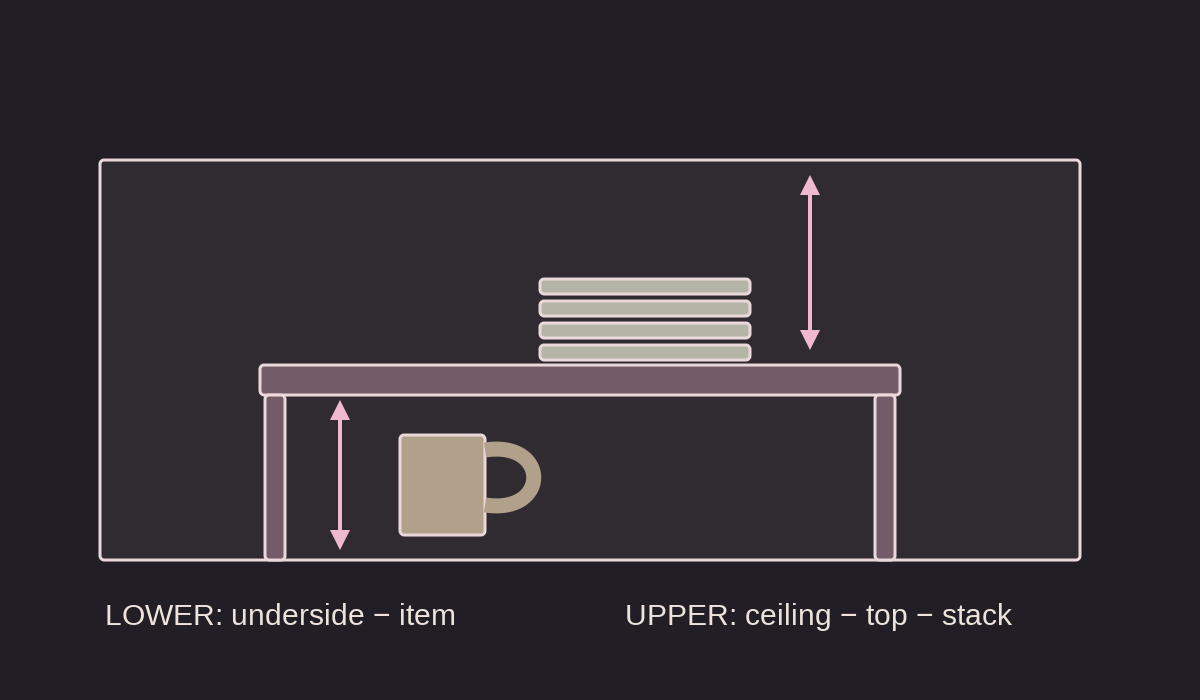
A shelf riser needs enough clearance for the lower item and the upper stack at the same time. Use the underside of the riser for the first check and the top surface for the second. Its overall height alone cannot answer both questions.
Check both sides of the riser
Use the underside for the lower item and the top surface for the upper stack.
Enter your measurements or load the example.
Your planning result
Entries stay in this tab. Optional site analytics records completion without the dimensions.
Make two measurements from the same floor
Measure the clear height from the cabinet shelf to the lowest obstruction above it. Then measure from that shelf to the riser underside, and from the same shelf to the riser top surface. Their difference is the thickness occupied by the platform at the point you measured.
Use the lowest usable underside if the platform has ribs or brackets. Include any feet or leg adjusters when measuring the top surface. For the stored items, include handles, lids and the entire stack. Do not measure an empty mug body and then forget its lid or the angle needed to pick it up.
The two checks are independent:
- Lower headroom = underside height − lower item height.
- Upper headroom = cabinet height − riser top height − upper stack height.
The calculator compares each result with your chosen extra headroom. A value of zero describes contact, not comfortable access.
Check a worked arrangement
In a hypothetical cabinet with 15 in of clear height, a riser has an underside at 6 in and a top surface at 6.5 in. A 5.25 in mug below leaves 0.75 in. A 7.75 in stack above leaves 0.75 in: 15 − 6.5 − 7.75.
Both spaces clear a chosen 0.5 in headroom allowance. Raising the riser another inch would make the lower space taller, but the upper stack would then exceed the cabinet height by 0.25 in. Adjusting the riser helps one compartment at the expense of the other.
Check the legs and the way items come out
The platform width does not necessarily equal the clear distance between its legs. A plate or pan may fit on top while a wider lower item cannot pass through the front. Check the narrowest usable opening underneath, the depth of the platform and anything projecting from the cabinet door.
Headroom also needs to support the movement you intend. A stack that stays below the ceiling may still be awkward to lift one plate from. The tool measures a static height screen; it does not simulate your hand or the lifting angle.
Use the instructions for the actual riser
YouCopia’s Shelf Riser FAQ shows a leg-adjustment and locking procedure as well as model-specific dimension diagrams. Follow the instructions for your exact model and selected adjustment. Do not infer load capacity from a large footprint or from how much room is left above it. This guide does not reproduce a universal riser size or load rating.
Before buying, record cabinet height, usable width and depth, underside clearance, top height, lower-item height and upper-stack height. Keep the chosen headroom beside those measurements. The calculator’s print button can keep that note with your result.
For a box that slides off a shelf, the storage-bin fit guide checks a different task. A riser creates two spaces rather than enclosing one.
For a seasonal display on an open shelf, the four-house Christmas village planning guide starts with the buildings and available shelf. Check those footprints and access needs before choosing a riser.
For flat items, a second shelf is only one option: compare baking sheet racks and vertical slots or upright cookware storage and short stacks when individual access is the problem. If the reason for reorganizing the cupboard is an overcrowded worktop, start with our kitchen counter plan for daily tools and clear prep space so the items you move have a useful destination.
For loose jigsaw pieces between sessions, see How to Divide a Jigsaw Puzzle Among Sorting Trays.
Sources & what to check
Source details checked 2026-10-25. Availability and prices can change; use the links below for current information.
Height calculations do not establish load capacity or access.