Board Foot Calculator: Lumber List & Cost
Add board sizes and quantities to calculate board feet, an optional lumber cost and a separate extra allowance. Print your list or save it as PDF for free.
Add board sizes, quantities and an optional price per board foot. Get a lumber list, a separate extra allowance and a printable estimate. The result is free, with no account or app installation.
Build your lumber list
Dimensions used: exactly as entered. Use measured dimensions for physical wood volume. For a purchase estimate, use the dimensions your supplier uses for its tally. This tool does not apply supplier rounding or nominal-to-actual conversions.
Your lumber estimate
Board feet from your entered dimensions. Supplier tally, rounding and billed quantity may differ.
Choose “Save as PDF” in your browser’s print dialog to keep a copy.
Your dimensions, names and prices stay in this tab. Nothing is saved when you reload. Optional analytics records completion only, without your entries.
Lumber list & board-foot estimate
Dimensions used: exactly as entered. No supplier rounding or nominal-to-actual conversion.
| Group | Dimensions | Qty | Each BF | Group BF |
|---|
Board feet from your entered dimensions. Supplier tally, rounding and billed quantity may differ. Allowance is a planning assumption, not a cutting-layout or yield guarantee. Tax and delivery excluded.
https://alexeverydayfinds.com/diy/board-foot-calculator/
Use a blank lumber worksheet
A one-page blank lumber list with explicit units, formula, optional price and a separate allowance. Use the online calculator for automatic totals.
Download the blank board foot lumber worksheet (PDF) (1 page, 3,630 bytes). No account required.
What is a board foot?
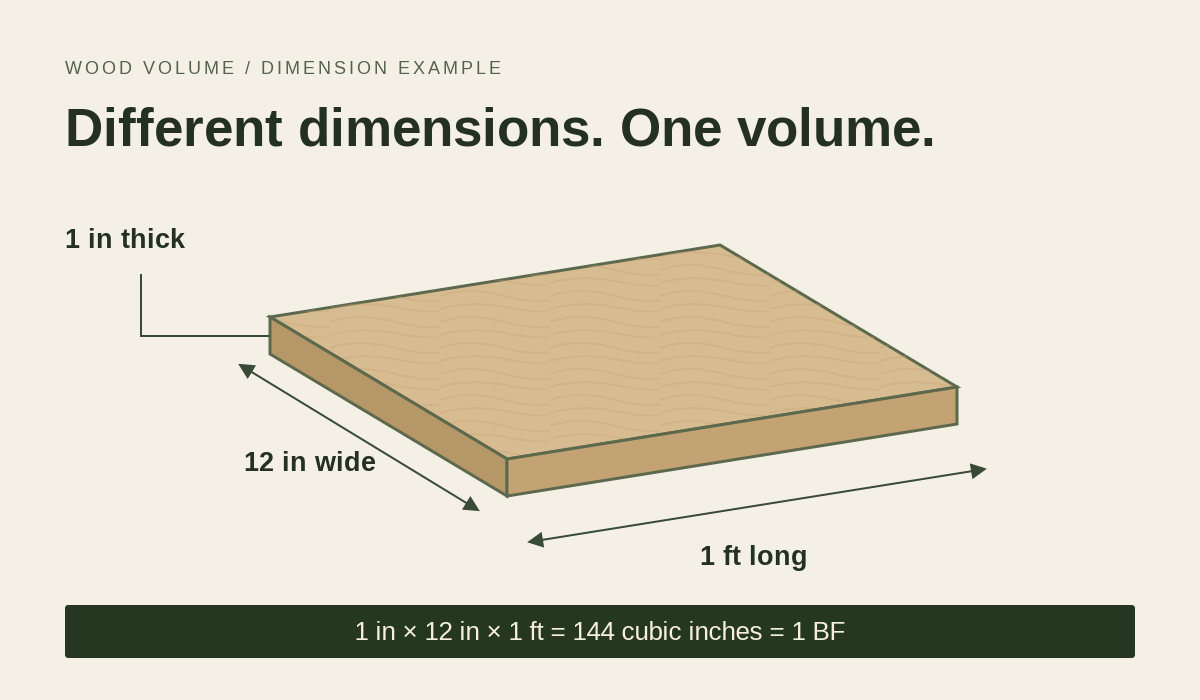
A board foot (BF) measures wood volume. One board foot is 144 cubic inches: for example, a piece 1 inch thick, 12 inches wide and 1 foot long. A longer, narrower board can have the same volume.
For thickness and width in inches, and length in feet:
Board feet = thickness × width × length × quantity ÷ 12
If all three dimensions are in inches, divide by 144 instead. This tool converts the selected units before using the formula; the unit next to each field always applies to that field. A length of 8 1/2 with ft selected means 8.5 feet. Change a unit to convert the current size, rather than relabeling the same number.
Check the five-board example
For 1 in × 6 in × 8 ft, each board contains 4 BF: 1 × 6 × 8 ÷ 12. Five identical boards contain 20 BF. At an entered $7 per BF, the base cost is $140.00.
Select Load example to put those numbers in the form. The price is an example, not a current lumber quote. Leave the price blank to calculate volume alone. A price of zero is allowed, but a blank price is never reported as a zero-dollar estimate.
For a mixed list, add a board group for each different size. Editing a group replaces its contribution to the total; selecting Calculate again does not add a duplicate. Use a separate list when different woods or groups have different prices.
Which dimensions should you enter?
Use measured dimensions when you want the physical volume of the wood. For a purchase estimate, ask the seller which thickness, width and length its price and tally use, then enter that basis explicitly.
For example, a surfaced board measuring ¾ in × 5½ in × 8 ft contains 2.75 BF by geometric volume. Entering 1 in × 6 in × 8 ft gives 4 BF. The calculator does not silently change one size into the other.
Hardwood thickness names often use quarters: 4/4 = 1 inch, 5/4 = 1.25 inches, and 8/4 = 2 inches. A quarter name does not establish the finished thickness of your board. Confirm what the supplier means before comparing prices.
Commercial measurement follows conventions beyond this formula. NIST’s hardwood retail model rules distinguish stock-width surfaced lumber from other lumber sales, with separate rules for surface measure and rounding. Its softwood standard describes board measure using nominal thickness and width. AHEC also distinguishes measurement before and after drying. This tool applies none of those trade adjustments, so its result may differ from a supplier’s billed quantity. It does not grade lumber or calculate log yield.
Keep the extra allowance separate
The optional percentage adds a planning allowance to the base volume. For the 20 BF example, an entered 10% adds 2 BF, giving 22 BF and $154.00 at $7/BF. Ten percent is a chosen assumption, not a recommended amount for every project.
The tool does not know knots, defects, saw kerf, grain requirements or how parts will fit on boards. Extra volume does not determine a whole number of extra boards, and it does not guarantee that your parts can be cut from the stock. Keep a separate cutting plan.
Row volumes display up to three decimals, while totals use unrounded values. Base and planning costs are calculated from those unrounded totals, then displayed to the nearest cent. The form uses one USD price for the entire list and excludes tax and delivery.
Board feet, square feet and linear feet
Board feet measure volume. Square feet measure area. Linear feet measure length. A board’s width and thickness are needed to turn its length into BF, so the three units are not interchangeable.
For example, 8 linear feet of 1 × 6-inch stock contains 4 BF, while 8 linear feet of 2 × 6-inch stock contains 8 BF. This calculator does not turn either number into a surface coverage or a finished cutting layout.
For other material estimates, use our tile-box calculator, which uses package coverage, or the concrete post-hole calculator, which uses the selected mix’s yield. Each calculation keeps its own units and assumptions.
Print a list, or continue in Build24
After a valid calculation, choose Print / Save as PDF. The print view includes the board groups, entered dimensions and units, quantities, price if supplied, allowance and calculation date. Select your browser’s PDF destination to save a copy. The form does not store the list after a reload.
Sources & what to check
Source details checked 2026-10-23. Availability and prices can change; use the links below for current information.
This tool calculates geometric volume from the dimensions entered. It does not apply supplier tally rules, nominal-to-actual conversions, drying adjustments, log scaling or cutting-layout optimization.