How many bags of mulch? Convert depth before counting bags
Calculate mulch bags from bed area, planned depth and the volume on the bag. Compare 1.5- and 2-cubic-foot bags with bulk cubic yards.
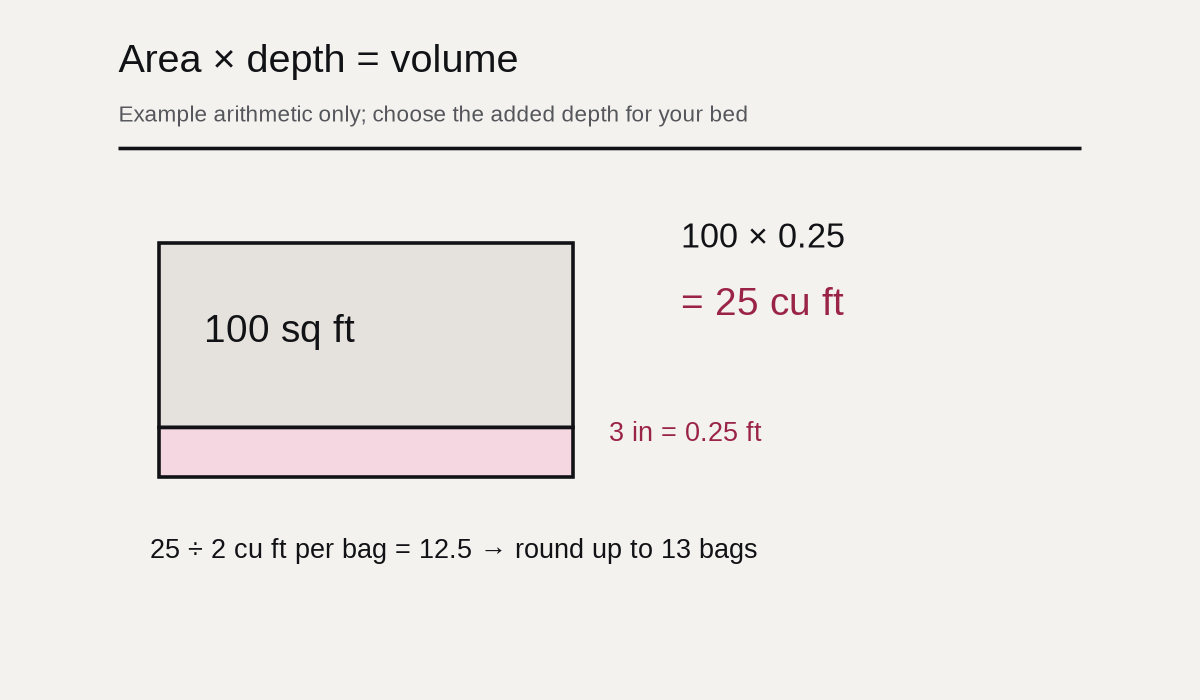
Mulch quantity is a volume: bed area multiplied by the depth you plan to add. Convert inches of depth into feet before dividing by the bag’s cubic-foot volume. A 100-square-foot bed at 3 inches needs 25 cubic feet before any extra allowance, or 13 bags labeled 2 cubic feet when rounded upward.
The 3-inch depth is an arithmetic example, not a recommendation for every planting or material. Decide the appropriate added layer for your particular bed first, accounting for what is already there.
Calculate bags or bulk volume
Quantity only. Choose depth for your plants and material. Excludes slopes, irregular depths and settlement. Inputs stay in your browser.
Read bag volume from the product you intend to purchase. Bags sold at similar prices can contain different quantities, so the number of bags is not a consistent unit for comparing sellers.
Use the depth in feet
Cubic feet = area in square feet × added depth in inches ÷ 12.
For 100 square feet at 3 inches, that is 100 × 3 ÷ 12 = 25 cubic feet. Divide by 27 to convert cubic feet into cubic yards: 25 ÷ 27 ≈ 0.926 cubic yard. A cubic yard is not a square yard; it includes depth.
At the same area and depth, a 2-cubic-foot bag gives 25 ÷ 2 = 12.5, rounded to 13 bags. A 1.5-cubic-foot bag gives 25 ÷ 1.5 ≈ 16.67, rounded to 17. Compare the labels before choosing the cheaper-looking bag.
Measure several beds separately
For a rectangle, multiply length by width. For a circular bed, use π × radius². A 10-foot-diameter circle has a 5-foot radius and an area of about 78.54 square feet. At the example 3-inch depth, its volume is about 19.63 cubic feet before allowance, or 10 two-cubic-foot bags rounded upward.
An irregular bed can be divided into rectangles and triangles for a rough area estimate. Add their areas only if they will receive the same added depth. Otherwise calculate each section’s volume separately, then combine volumes for the same material.
If you decide on an allowance, apply it before rounding. Adding a chosen 10% to the 25-cubic-foot example gives 27.5 cubic feet and 14 two-cubic-foot bags. That percentage is your planning choice; it cannot make an inaccurate bed measurement reliable.
Compare delivery and handling
For bagged material, multiply the rounded bag count by the actual bag price. For bulk, compare the seller’s order increments and delivered volume, including any delivery minimum. An estimate of 0.926 cubic yard does not imply that a supplier sells that exact quantity.
Also plan where the material will be placed and how you will move it. Include the delivery area, wheelbarrow route and the space for unopened bags in the comparison. This page estimates material volume; it does not establish a safe lifting weight or a suitable depth for plants.
The same order of operations applies to another bagged material: our concrete quantity guide calculates project volume before rounding to bags, using the specific mix’s yield.
For the soil underneath, calculate a top-up across raised beds with different fill depths.
Sources & what to check
Source details checked 2026-10-12. Availability and prices can change; use the links below for current information.
The calculator checks volume arithmetic for a uniform area and depth. It does not choose horticultural depth, predict settlement or specify playground surfacing; check the chosen product's coverage and use instructions.