How Much Soil to Add to Raised Beds You Already Filled
Calculate how much soil to add to existing raised beds. Use actual fill depth for each bed and combine volumes before rounding to whole bags.
For a raised bed that already contains soil, measure how much higher you want the soil surface to sit. Multiply each bed’s inside length and width by its own fill depth. Add the volumes of beds that will take the same product, then round up once to whole bags.
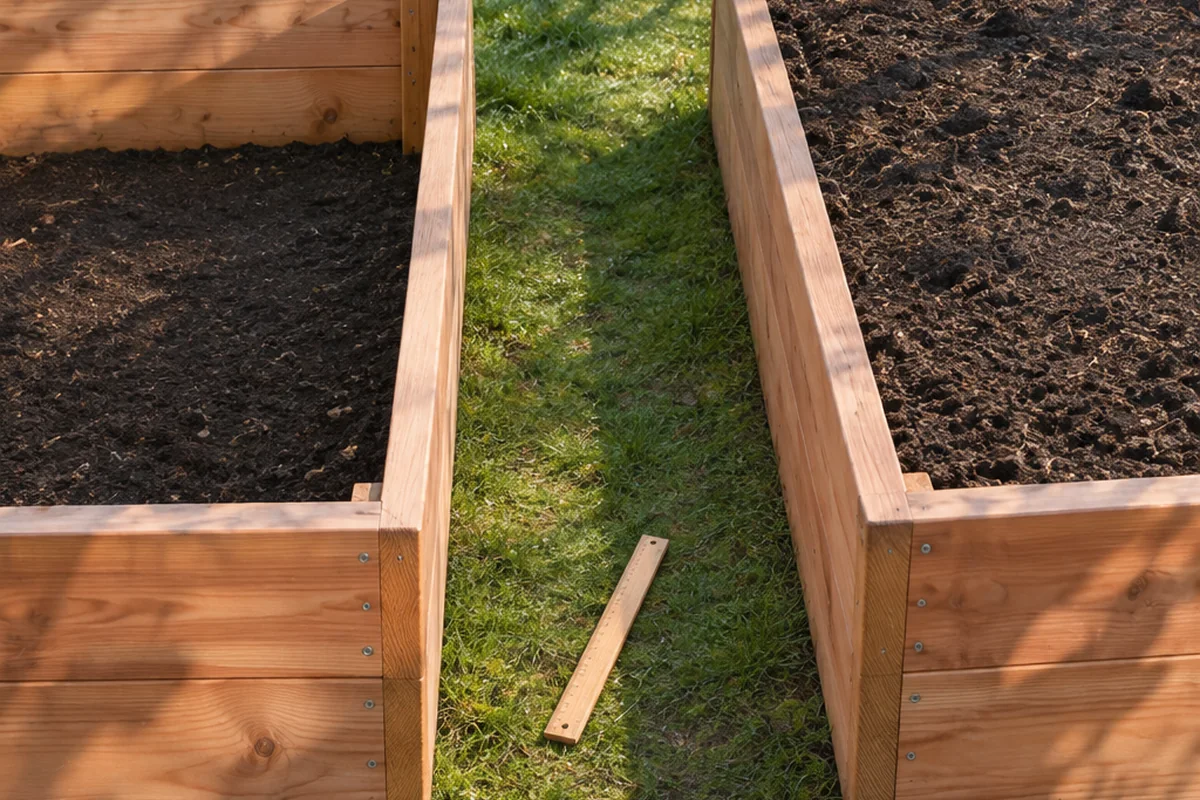
Measure the gap you want to fill
Mark the target soil surface inside the bed. Use a straight edge and measure down to the current soil in several places. If it is reasonably even, use the average depth of the gap for a planning estimate. When half the bed is clearly lower, treat the halves as two rectangles. Keep length, width and depth in feet before multiplying. Divide inches by 12 to convert to feet.
Work through two different depths
| Bed | Inside dimensions | Fill depth | Volume |
|---|---|---|---|
| A | 4 × 8 ft | 2 in | 5⅓ cu ft |
| B | 4 × 8 ft | 3 in | 8 cu ft |
| Both | Same product | Combined | 13⅓ cu ft |
At 1.5 cubic feet per bag, the two beds take nine bags for the measured gap. Rounding separately gives four and six, or ten bags. Pool the remainder only when both beds use the same material. For bulk delivery, 13⅓ cubic feet is just under half a cubic yard. Divide by 27 and check the seller’s ordering increments. These figures describe loose purchase volume against the measured gap. Spreading and settling can change the final height.
Adjust for an uneven bed
Say a 4-by-8-foot bed has 1 inch to fill over one half and 3 inches over the other half. Calculate 16 × (1 ÷ 12) and 16 × (3 ÷ 12). The total is 5⅓ cubic feet. Using 3 inches across the whole bed would give 8 cubic feet. Divide the bed where the slope or low patch changes. If you are uncertain about settling or mixing, buy in a quantity you can use, spread it and remeasure the remaining gap.
Choose a product suited to what the bed needs. The arithmetic applies to a measured space. A soil amendment may call for mixing into the existing layer or a different application depth. For a separate surface layer, use the mulch calculator for bags and cubic yards.
If the project also changes your planting layout, compare GrowVeg and Planter for a two-bed garden. Keep the crop plan separate from the measured gap used for the soil order.
For the next step, cut lumber for a 4-by-8-foot raised bed.
Sources & what to check
Source details checked 2026-11-13. Availability and prices can change; use the links below for current information.
Use the guide for a measured fill gap and a known bag size. Soil choice and settling depend on the bed.