Baking Sheet Organizers: Choose a Rack That Fits Loaded Trays
Choose a baking sheet organizer by tray size and access. Compare fixed and expandable racks, check current dimensions and plan the cupboard before buying.
A baking sheet organizer is useful when it lets you remove one tray without lifting a stack. Choose upright dividers for flat sheets and boards, adjustable spacing for mixed bakeware, or an existing cabinet slot if it already gives each piece a stable home. Check the loaded tray height and removal path before comparing the rack’s footprint.
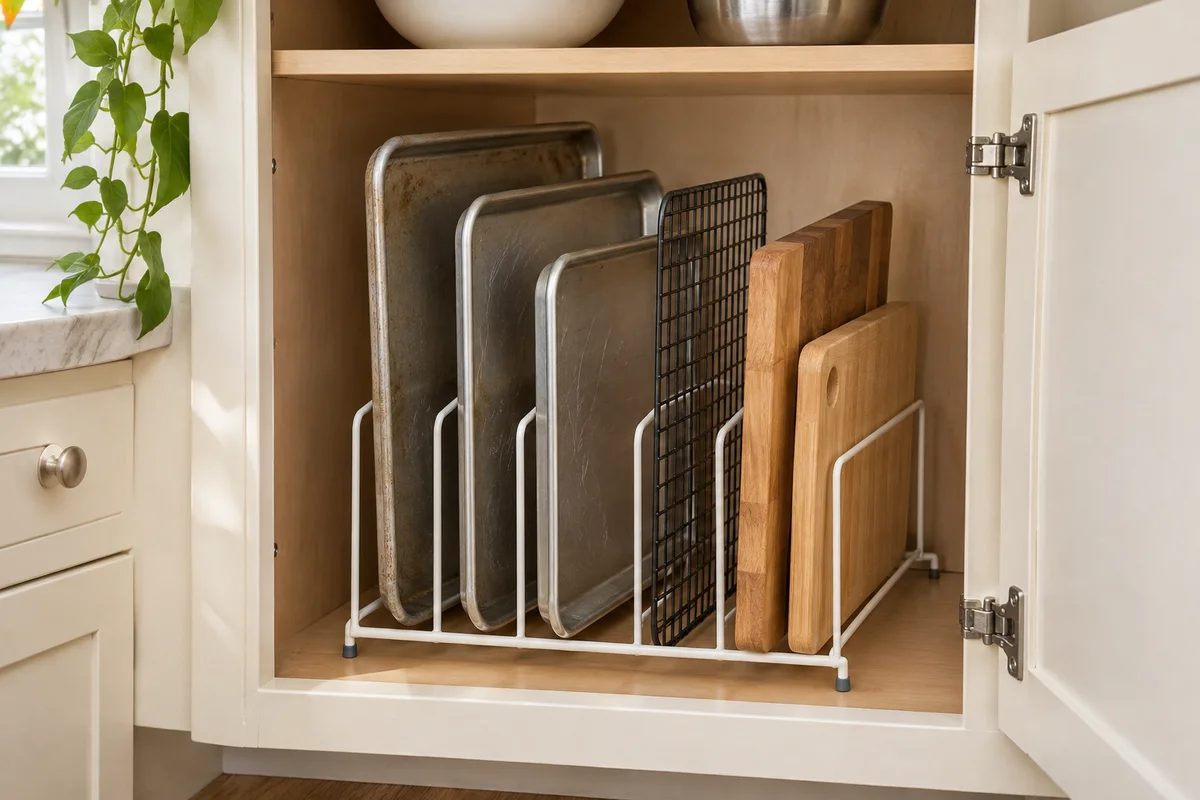
Start by separating baking sheets, cooling racks, chopping boards and deeper dishes. A thin sheet and a bulky roasting dish need different support and different amounts of space.
Compare four ways to store baking sheets
| Method | Good starting use | Main compromise | Check first |
|---|---|---|---|
| Fixed freestanding rack | A modest group of flat sheets | Fixed overall width | Divider positions and the thickest tray rim |
| Expandable rack | A wider mixed collection | Takes more cupboard width when extended | Loaded width and stable support |
| Built-in vertical slots | A cabinet already designed for trays | Slot spacing cannot easily change | Largest board and finger access |
| Short horizontal stack | A few similar sheets used together | Individual removal is less convenient | Stack stability and surface-care instructions |
Do not assume vertical storage always uses less space. It trades stack height for width and access. Keep a horizontal stack if it is stable, easy to use and causes no recurring problem.
A fixed rack and a wider alternative
The current YouCopia StoreMore Bakeware Rack was listed at $19.99 on November 3, 2026. It has seven adjustable dividers and a stated outside size of 11.6 W × 7.4 D × 6.4 H inches, with dividers inserted. The manufacturer describes it for baking sheets, boards and baking pans. Some retailer pages show dimensions for an earlier version; check the exact listing you plan to order.
For a larger arrangement, the StoreMore Pan & Lid Rack was listed at $31.99, with ten dividers and a stated size of 12.6–21.5 W × 7.3 D × 6.3 H inches. Its expandable width offers more layout choices, but it is not automatically the better purchase for a small collection.
These are manufacturer-based comparisons, not physical tests of your trays or a load-capacity guarantee. Prices are US item prices before tax and delivery; confirm the selected model and current availability. For heavier cookware, compare the separate pots and pans storage options rather than assuming every bakeware rack is suitable.
Measure the tray in the direction it will stand
Write down the complete outside size of the largest sheet, including rolled edges and handles. Check both possible orientations. A sheet that is too tall when standing on its short end might work with its long edge down, but the shelf must then provide enough depth and support.
The organizer’s 6.4-inch height is the height of the empty rack with dividers, not the finished height of a standing baking sheet. Place a representative tray in the intended position and allow room to grip and lift it out. Test the cupboard door before settling on the arrangement.
For an arithmetic example, the fixed rack’s 11.6-inch width leaves 0.4 inches total in a 12-inch clear opening. That small difference does not establish a comfortable fit. The opening may be narrower near a hinge, and a tray rim or your hand may need more space. A paper footprint can reject a poor layout before you order.
Thick boards need their own slot check
Measure the thickest point that must enter the rack, including an enlarged handle or edge. Then check the board’s supported height and the room to grasp and remove it. A rack’s empty dimensions and divider count cannot establish those three answers.
Royal Craft Wood’s three-slot cutting-board organizer, checked November 5, 2026, states 0.67 in width per slot and separately describes support for three 0.6 in boards. Treat these as different claims: a nominal gap is not a promise of stable support for any thinner shape. A 0.8 in board exceeds both figures and should be rejected for this fixed-slot holder.
The current YouCopia StoreMore Bakeware Rack linked above uses seven repositionable dividers. Its November 5 setup directions say to place the base on a flat surface, insert and lock both ends of each divider, and position dividers to keep the items upright and easy to remove. That offers a layout option for mixed thicknesses; it does not establish an unlimited slot width or load rating. Confirm the usable position and support for your actual board rather than dividing the rack’s total width by seven.
For a worked check, suppose a 0.5 in thick board occupies 11 in loaded height in its intended rack position, under 13 in clear shelf height. The fixed slot clears the simple thickness screen and is within the maker’s stated 0.6 in board description. Next verify the board’s shape is supported, it cannot tip when its neighbor is removed, and there is room to grip and lift it out. A 14 in tall standing board fails the same shelf regardless of its thinness. Turning it onto a different edge requires a new depth/support check.
Record the result on the board and tray fit sheet. Follow the board’s care directions and put it away in the condition they require; a holder is not proof of drying performance. YouCopia specifies hand washing with mild soap for this rack and says it is not dishwasher safe.
Group by the way you cook
Put the everyday baking sheet where it can be reached directly. Keep a cooling rack beside it if both are normally used together. A large occasional roasting pan can live elsewhere rather than forcing every divider farther apart.
Support each item so it remains stable when the neighboring tray is removed. Follow the organizer’s setup instructions for divider placement. Do not wedge a heavy dish into a gap that is too narrow or assume that the highest advertised divider count equals a practical tray count.
If boards and sheets share one rack, check the care instructions for both. Put items away clean and dry; an organizer is a storage device, not a drying system. Avoid using paper or soft padding in a way that interferes with the intended support.
Check the neighboring shelf before buying another unit
Sometimes a shelf adjustment or moving a rarely used appliance creates the needed slot. If dishes currently occupy a tall shelf inefficiently, the cabinet shelf riser guide helps test a second level without crowding the items below it.
Can I store a cutting board in the same rack? The selected YouCopia listings include boards among their intended uses. You still need to check your board’s thickness, size and support in the actual divider arrangement.
Should I buy two racks to use all the cupboard? Start with one complete working arrangement. Two racks are useful only if both can be reached and their contents can be removed without interfering with one another.
What makes a good result? The daily tray comes out easily, the remaining items stay supported, and returning a clean tray does not require rebuilding the whole cupboard.
Sources & what to check
Source details checked 2026-11-03. Availability and prices can change; use the links below for current information.
Manufacturer information checked November 3, 2026. Product comparisons use published specifications, without hands-on testing. US prices exclude tax and delivery; local stock and fit are unconfirmed. The new board-thickness section was checked November 5, 2026; earlier product comparisons retain their dated checks.