Pots and Pans Storage: Make the Everyday Pan Easy to Reach
Compare upright cookware racks and short stacks, with two specific racks and checks for pan diameter, handles, loaded height and cupboard-door clearance.
For pots and pans storage, give the everyday pan a route out that does not require lifting the whole stack. Use an upright divider rack for suitable pans and lids, a short nested group when floor space is limited, and a separate location for bulky occasional cookware. A new rack is useful only if the loaded pans, their handles and the cupboard door all fit.
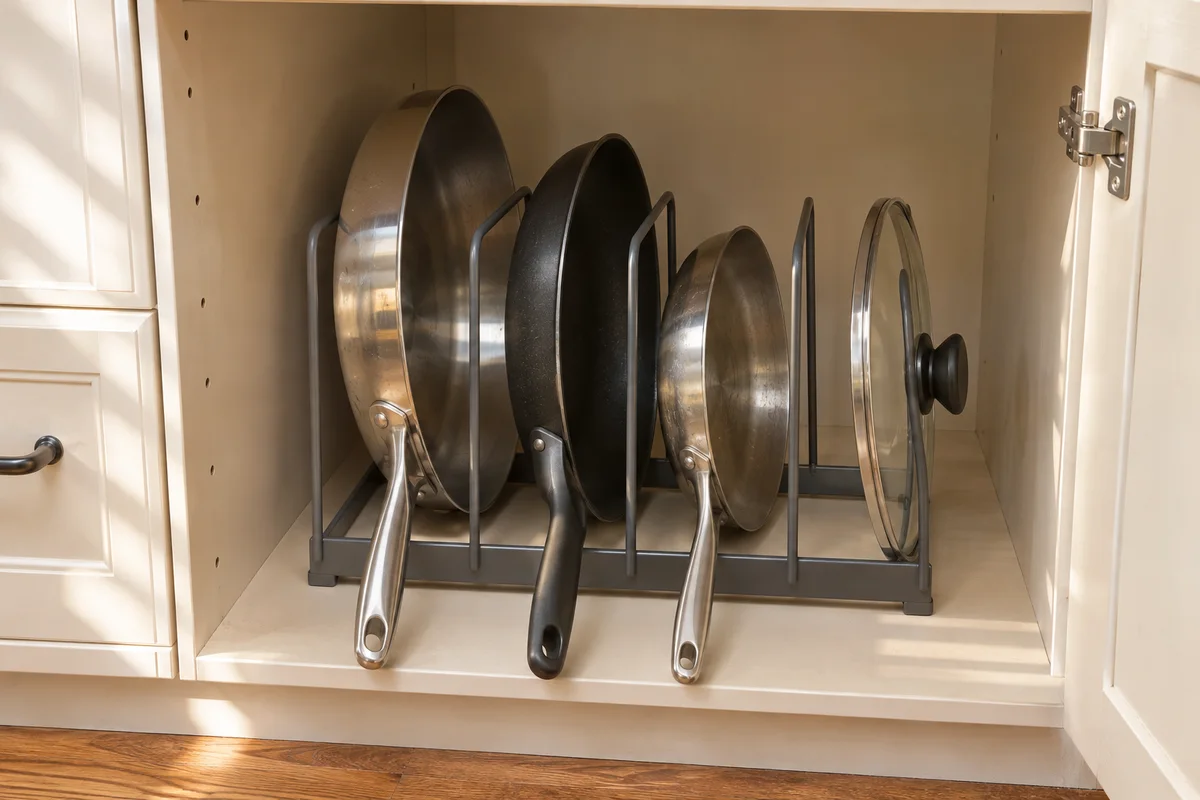
Begin with the cookware you use most often. Separate deep pots from flat pans and lids. Those shapes create different storage problems; one organizer does not have to hold everything.
Compare the main arrangements
| Arrangement | Works well when | Tradeoff | Check |
|---|---|---|---|
| Upright divider rack | You want individual access to pans or lids | Uses shelf width and needs loaded headroom | Pan diameter, handle direction, divider spacing |
| Short nested stack | A few compatible pans already nest well | Lower items require lifting those above | Cookware maker’s stacking and surface-protection guidance |
| Deep drawer | Heavy cookware is easier to reach from above | Needs a suitable drawer and load capacity | Drawer manufacturer’s rating and loaded closing clearance |
| Hanging rail | Wall storage is allowed and useful | Needs a suitable wall, fixings and secure hooks | The complete installed system and cookware weight |
Keep heavy cookware in a position you can handle comfortably. Do not assume an adhesive hook, a decorative rack or a bakeware divider is suitable for a heavy cast-iron pot.
Two racks with a meaningful size difference
The YouCopia StoreMore Cookware Rack was listed at $39.99 on November 3, 2026. Its stated size is 9.3 D × 12.0–21.5 W × 8.5 H inches, including the dividers. It includes ten adjustable dividers; the maker describes it for upright cookware, platters and cutting boards.
The StoreMore Pan & Lid Rack was listed at $31.99. Its stated size is 7.3 D × 12.6–21.5 W × 6.3 H inches, also with ten adjustable dividers. It is a shallower, lower construction, rather than simply the same rack at another price.
Neither outside height describes the height of a pan standing in it. The cookware can project above or beyond the organizer. These specifications come from the manufacturer and are not a hands-on load or stability test. Prices are US item prices, before delivery and tax; verify the chosen version and local availability.
Plan with your largest everyday pan
Measure the pan across its body, then from the far edge to the handle tip. Include an unusually deep sidewall or lid knob. Put it on a temporary paper footprint inside the cupboard and check its intended orientation.
Now check the route out. Can you grip the handle and lift the pan clear of the divider without catching the shelf above? Does the pan beside it remain supported? Does the door close without pressing on a handle? A photograph of an open cupboard cannot answer the last question.
For example, a 20-inch clear cupboard cannot hold either listed rack at its full 21.5-inch extension. Reducing the rack width may solve that footprint problem, but the pan arrangement must still work at the reduced spacing. Count the pieces you actually intend to store rather than treating ten dividers as a promise of ten comfortably accessible pans.
Separate lids without making another obstacle
Place a lid near the pot or pan it serves when there is a sensible way to do so. A small group of upright lids can be easier to browse than a stack, especially when knobs prevent nesting. Check that the lid is supported and cannot roll out when a neighboring piece is removed.
If a door-mounted lid rack is tempting, test the interior conflict before mounting anything. The door must close past the shelf, pans and hinges with the lids installed. Follow the rack maker’s mounting and load instructions; do not infer suitability from an empty product photo.
Check the lid and knob as a loaded shape
A lid has at least three dimensions that matter here: rim diameter, front-to-back depth including its dome and knob, and height in the orientation you will store it. Measure the complete shape. Do not add knob length to diameter automatically: a knob may project forward while the lid stands upright, rather than above its rim.
IKEA VARIERA, article 701.548.00 is a current adjustable example, checked November 5, 2026, at $7.99 before tax and delivery. IKEA’s Measurements section gives 3¼–19¾ in length, 5¾ in width and 4 in height. Its Good to know section instead says 3⅜–19⅝ in adjustable length. Those published ranges differ slightly: verify a tight endpoint with IKEA rather than silently choosing one. Overall expansion also does not specify usable space between supports.
Suppose you record a 10 in lid whose intended supported position occupies 10.5 in width, 3 in depth including knob and 10.5 in loaded height. A 12 in wide × 8 in deep × 13 in high clear shelf is a candidate for that loaded rectangle, but you must still verify the chosen rack arrangement, support and removal path. Record the space needed to grip the knob and lift clear of the pins; 2.5 in of stationary headroom is not proof of that movement.
Exception: a different domed lid occupies 13.5 in loaded height under the same 13 in shelf. Reject that upright placement even if the empty organizer is only 4 in tall. Turning the lid may change depth and support requirements; it is a new arrangement to check, not an automatic fix. For a door-mounted position, also close the door with the lid represented in place and check shelves, hinges and neighboring cookware.
Use the lid clearance record for the largest lid and one awkward knob. Keep plastic food-storage lids in their own container-lid layout when their shapes and retrieval routine differ from the cookware.
Baking trays need their own orientation and access check. Our baking sheet organizer guide compares fixed dividers, expandable racks and existing cabinet slots for flat bakeware. It does not assume that a tray rack has the same purpose or capacity as a heavy cookware rack.
Make one cupboard easier before reorganizing the kitchen
Move occasional items out of the main retrieval path, set up the daily pans, and live with that arrangement before adding another layer of storage. If a neighboring shelf contains plates, use the cabinet shelf riser fit guide to see whether dividing that shelf would release useful space without crowding the pans.
Should every pan stand upright? No. A stable short stack may be the simplest solution when it is easy to lift and follows the cookware’s care guidance. Upright storage is a way to improve access, not a requirement.
Will a rack protect every coating? Do not treat that as guaranteed. Follow both the cookware and organizer instructions, check contact points, and avoid forcing pieces into tight compartments.
What should I buy first? Choose a rack only after one specific pan arrangement works on the shelf. If moving an occasional stockpot already makes the daily pan easy to retrieve, that may be the entire solution.
Sources & what to check
Source details checked 2026-11-03. Availability and prices can change; use the links below for current information.
Manufacturer information checked November 3, 2026. Product comparisons use published specifications, without hands-on testing. US prices exclude tax and delivery; local stock and fit are unconfirmed. The new lid-fit section was checked November 5, 2026; earlier product comparisons retain their dated checks.