Craft supplies in a small work area: pegboard or drawers?
Compare pegboard and drawer storage for craft supplies using wall access, object depth, visibility and work-surface space. Includes a one-zone layout exercise.
Use a pegboard for light tools you need to see and reach often; use drawers for small loose items, bulk stock and things you want covered. Many work areas benefit from both, but the available wall and floor space decide the proportion. Start with the supplies, not the storage product.
Sort one work zone first
Empty just the work area you plan to organize. Put each supply in one of three groups: used every session, used occasionally, or refill stock. Measure the longest and deepest object in each group. A peg hook may hold scissors but not an open jar of paint; a shallow drawer may hold paper but not a tall bottle. Count duplicates before buying another container.
Sketch the desk as a rectangle. Mark the working surface you must keep clear for cutting, sewing or drawing. Then outline usable wall above it, including outlets and shelves. Finally mark the floor area a drawer unit could occupy without blocking your chair or a door.
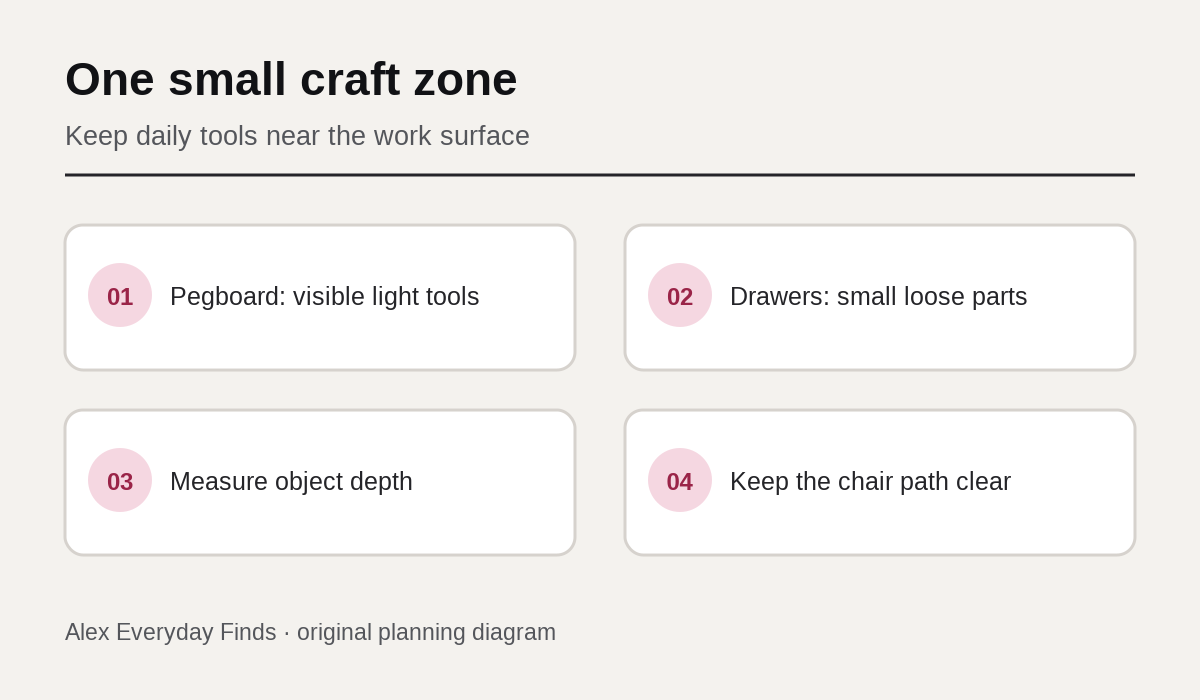
Decide with four constraints
On a narrow screen, swipe the table sideways to see every column.
| Constraint | Pegboard tends to help when… | Drawers tend to help when… |
|---|---|---|
| Access | You repeatedly grab the same light tools | You need grouped, labeled small parts |
| Visibility | Seeing a tool helps you put it away | Visual clutter distracts you |
| Depth and dust | Items are thin and can hang safely | Items are bulky, loose or need cover |
| Placement | You have approved wall mounting or a suitable freestanding panel | There is safe floor space and clearance to open drawers |
IKEA’s SKÅDIS range illustrates that a pegboard can be wall mounted or used with table and freestanding accessories, depending on the chosen components. That does not make every arrangement equally stable or load-bearing. Check the exact board, connector and wall instructions. IKEA’s ALEX unit is an example of a separate drawer-style footprint; compare the seller’s outside dimensions with your chair path and the space needed to open every drawer.
Try a low-cost layout before buying
Tape two zones on the wall or desk: a reachable “daily” zone and a closed “occasional” zone. Put the daily tools in a temporary cup or tray for one week. If you reach across the desk many times, hanging those tools near your dominant hand may be worth the wall area. If tools migrate into piles because tiny pieces are hard to rehang, shallow labeled drawers may work better.
Buy accessories only after you know which specific objects need hooks, cups or dividers. Pegboard systems can differ in hole spacing and accessory fit; drawer organizers must fit inside the drawer, not just within its external case. Our drawer-divider measurement guide shows why inside dimensions matter.
Keep lamp and equipment leads out of the cutting area; the desk cable guide compares attachment and clearance checks. If this is a quilting station, plan the next material purchase with the quilt-backing calculator and its separate margin and seam limits.
For small rolls of decorative tape, see Which Washi Tape Rolls Fit in One Dispenser.
For numbered skeins and active stitching projects, see How to File Embroidery Floss by Number and Pull a Project Palette.
For unmarked rolls on a rack, see How to Label Craft Vinyl Rolls When Colors Look Alike.
For a project you take along, see How to Pack Two Working Yarns in One Knitting Bag.
Sources & what to check
Source details checked 2026-10-17. Availability and prices can change; use the links below for current information.
Example layouts are planning sketches. Verify mounting, product dimensions and load limits for the chosen system.