Food Container Organization: Match Bases and File Lids Upright
Match food container bases and lids, compare two lid organizers and check loaded drawer height before choosing between complete sets and nested storage.
To organize food storage containers, match every base to its lid, remove the unmatched pieces from the daily group, and choose between storing complete sets or nesting bases with lids filed upright. Keep the arrangement small enough that you can find a lid and return a dry container without rebuilding a pile. An adjustable lid organizer is useful when lids are the recurring problem, not simply because the drawer looks untidy.
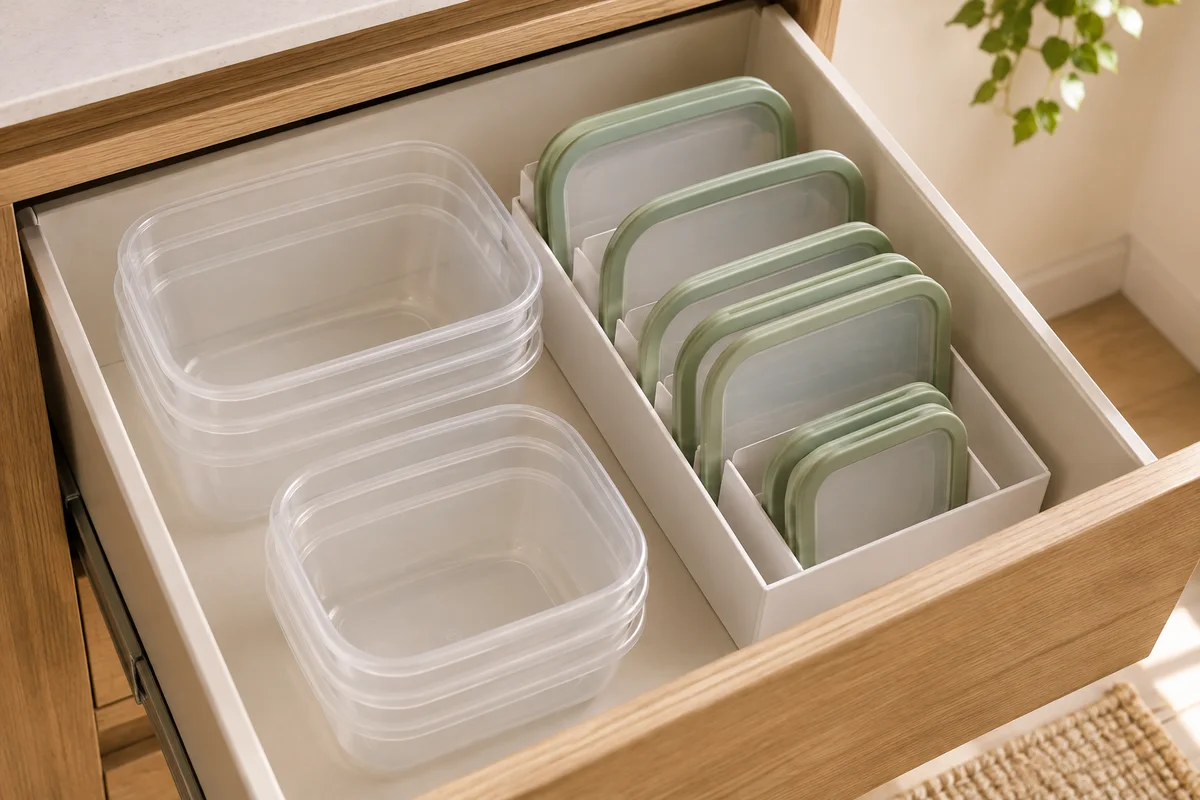
Start with an empty drawer or shelf and the containers you actually use. Separate lunch boxes, leftovers, freezer containers and unusually large pieces. Follow each container’s labeling and care instructions when deciding what remains suitable for use.
Choose a method before choosing an organizer
| Method | Useful when | Main tradeoff | A sensible first trial |
|---|---|---|---|
| Complete containers with lids alongside | You have a modest collection and enough shelf space | Uses more room than nesting | Give each regular set a defined place |
| Nested bases, upright lids | Bases nest well and lids are hard to find | Matching still needs a readable system | Group lids by shape and size |
| Separate bin for each container family | Several incompatible ranges are mixed | Too many bins can fragment a small drawer | Start with only the two most-used families |
| Small lunch-packing zone | The same few pieces leave home daily | Does not solve the whole collection | Keep daily bases and lids together |
Do not buy an organizer to preserve a large collection of unmatched lids. Make the matching decision first, then measure the pieces that have a continuing job.
Compare two lid organizers beyond the advertised count
The YouCopia StoraLid 24 Lid organizer was listed at $19.99 on November 3, 2026. It has five adjustable dividers and a stated size of 10.8 D × 13.2 W × 3.3 H inches. The manufacturer describes it for round and square lids up to 9 inches. The 3.3-inch figure is the organizer body height, not the height of a standing large lid.
The StoraLid Expandable 40 Lid organizer was listed at $29.99. Its stated size is 10.5 D × 13.2–21.3 W × 5.8 H inches, with eight adjustable dividers. It offers more layout width but also has a taller body. A shallow drawer may rule it out before the lid count becomes relevant.
The numbers in the product names describe the manufacturer’s intended capacity, not a guaranteed fit for your assortment of bulky seals and unusual shapes. These comparisons use manufacturer specifications, without physical testing. Prices are US item prices before tax and delivery; availability and the exact selected version must be checked when ordering.
Do a loaded drawer check
Measure clear drawer width and depth inside the sides, then the usable height when closed. Include rails, the underside of the worktop and any part that moves through the opening. A drawer front can be much taller than the space available above the drawer base.
Use a shallow existing box to try the lids upright. Check the tallest piece in the proposed orientation and the ability to grasp it. Do not force the drawer shut to make the layout work.
For a simple example, a drawer with five inches of usable height cannot accept the 40 Lid organizer’s stated 5.8-inch body height. The smaller unit’s 3.3-inch body is below that limit, but the loaded lids may still be too tall. That is why comparing the empty organizers alone cannot choose the winner.
If you need flexible divisions for the bases as well, our drawer divider guide explains range, usable depth and the space taken up by the dividers themselves.
Make matching obvious
Keep lids from one family together, then order them from small to large or in the order you normally use them. Avoid an arrangement that depends on remembering several almost-identical shapes. If the manufacturer’s markings identify a matching range or size, use that information instead of assuming every similar rectangle is interchangeable.
Keep the daily pieces easy to reach. Put the occasional large container in a separate appropriate space if it otherwise blocks the lunch boxes. The goal is a collection you can use and reset, not the largest possible number of pieces in a drawer.
Let washed pieces dry according to their care instructions before storage. Choose whether to nest or keep lids separate based on the actual container instructions and the way the drawer works; do not interpret a storage photo as food-safety guidance.
Buy only after a normal week
Try the matched collection with the separators you already have. If lid retrieval is still the only awkward step, an adjustable lid rack is a targeted purchase. If the bases are the obstacle, changing the lid rack may not solve it.
The surrounding cupboard may also need a simple reallocation. See baking sheet storage for flat items that sometimes invade the same cabinet, or small pantry organization for food refills that do not belong in the container drawer.
Should lids stay on the containers? Either system can work for storage when the containers are clean, dry and used according to their instructions. Complete sets favor quick matching; separate lids and nested bases favor compactness.
Is the larger organizer better value? Only if its additional space and height solve your problem. A smaller unit that leaves a usable home for the bases can be the better arrangement.
Sources & what to check
Source details checked 2026-11-03. Availability and prices can change; use the links below for current information.
Manufacturer information checked November 3, 2026. Product comparisons use published specifications, without hands-on testing. US prices exclude tax and delivery; local stock and fit are unconfirmed.