How much shelf liner do you need for shelves or drawers?
Calculate rolls for same-size shelves or drawers. Check roll width and whole-piece cuts so leftover scraps don't leave you one shelf short.
Check the roll width before calculating length. A roll must be wide enough to cover one side of each shelf or drawer if you want a single piece without a seam. Then see how many full cuts fit along one roll. Divide the number of surfaces by that per-roll yield and round up.
Why total length can leave you short: five 30-inch pieces need three 84-inch rolls, even though 150 ÷ 84 rounds up to two. Each roll yields only two whole pieces; its 24-inch offcut cannot cover another surface. Try five 30 × 18-inch surfaces with a 20-inch-wide, 7-foot-long roll below. See the cut plan.
How many full pieces can you cut?
Enter the inside size of identical shelves or drawers and the size printed on a roll. The result assumes one unjoined rectangular piece per surface.
Plan the cuts on paper
Measure identical shelves, check roll width and calculate whole cuts per roll on a one-page worksheet. Includes the four-shelf worked example.
Download the shelf liner cut planning worksheet (PDF) (1 page, 3,872 bytes). No account required.
A four-shelf example
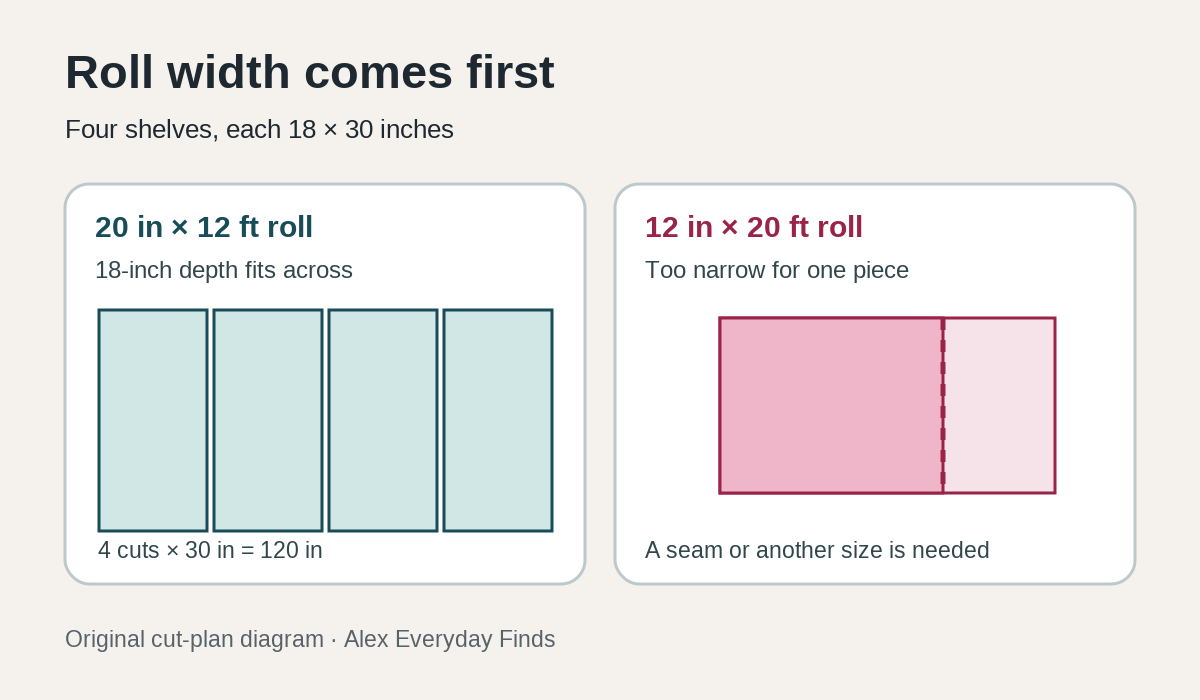
Suppose four shelves each have an 18-inch inside depth and 30-inch inside width. The Duck Brand Clear Classic listing includes a 20-inch-wide × 12-foot-long roll. Its width covers the 18-inch depth in one piece. Cut four 30-inch lengths: 4 × 30 = 120 inches, which fits within the roll’s 144-inch length. One roll supplies four full pieces, leaving 24 inches of length and a 2-inch strip of unused width before any trimming.
The same listing includes a 12-inch-wide × 20-foot-long option. Its extra length does not make it wide enough to cover an 18-inch depth in one piece. That roll would require a seam or a different layout; the calculator deliberately stops rather than presenting an area-based “one roll” answer.
Work out the count by hand
Measure the inside width and depth of each surface. For identical rectangles, choose an orientation where the roll width covers one side. The other side becomes the cut length. Divide the roll’s length in inches by that cut length and round down to find full pieces per roll. Divide the surface count by that yield and round up to find rolls.
Do not divide only the total required cut length by roll length if individual pieces cannot be split between rolls. For example, a 7-foot roll is 84 inches long and yields only two 30-inch pieces. Four shelves would need two such rolls, even though 120 inches total is less than the 168 inches supplied by two rolls. The 24-inch remainder on each roll cannot make another 30-inch piece.
Duck Brand’s measurement guide starts with drawer width because the selected liner comes in different widths, then multiplies drawer depth by the drawer count. That shortcut works when each piece fits across the roll and the cut lengths fit whole on each roll. This planner makes both checks explicit.
When total length gives the wrong purchase
Consider five identical surfaces, each needing a 30-inch cut from a roll whose width already fits. Each roll is 84 inches long. Total cut length is 150 inches, so dividing 150 by 84 and rounding up suggests two rolls. The actual cut plan needs three rolls:
| Roll | Whole 30-inch pieces | Length left before trimming |
|---|---|---|
| First 84-inch roll | 2 | 24 in |
| Second 84-inch roll | 2 | 24 in |
| Third 84-inch roll | 1 | 54 in |
Two rolls supply 168 inches in total, but neither 24-inch offcut can cover the fifth surface without a seam. This is why the planner rounds pieces per roll down before rounding rolls up. It does not join offcuts to complete a piece.
If the roll is too narrow, check the other orientation: the shelf side running across the roll must fit its width, and the other side must fit its length. A rotated layout can change the yield. If both orientations fit, compare their whole-piece counts; a directional pattern or installation instructions may rule one out.
Before cutting or choosing a material
Measure every different-sized shelf separately; the calculator above is for identical rectangles. It uses one row of cuts along the roll, so a very wide roll that holds two pieces side by side may yield more than this conservative count. For an irregular surface, trace a paper template and check it against the roll’s usable width. If you want the liner to wrap an edge or match a directional print, include that extra material in your measurements and make a cut plan before buying. Our count does not arrange mixed-size offcuts or estimate a pattern repeat.
Follow the exact material’s directions. A non-adhesive liner and a self-adhesive covering have different installation steps. Con-Tact’s instructions for its self-adhesive liners call for cleaning and drying the surface, cutting with an allowance and applying in small sections; that allowance belongs to that product and should not be treated as a rule for every liner. Check the selected material for surface, food-contact and heat restrictions.
For a cabinet with pipes or a shelf that needs a container instead of a liner, start with our under-sink measuring guide. This page answers how much roll material to buy for shelves and drawers.
Still choosing the surface treatment? Compare shelf liner alternatives and their fit checks before using the roll count as a shopping list.
Sources & what to check
Source details checked 2026-10-20. Availability and prices can change; use the links below for current information.
The planner covers identical rectangular surfaces with one piece each. It does not place multiple pieces across a wide roll or optimize mixed-size offcuts, seams or pattern matching; check the selected roll's instructions and exact size.