Shelf liner alternatives: choose for your cabinet finish
Compare bare shelves, non-adhesive liners and adhesive coverings by finish, cleaning and use. Check why no adhesive does not always mean easy removal.
The alternative to shelf liner may be a clean, uncovered shelf, a different non-adhesive liner, or a covering specifically approved for your cabinet. Choose by the problem you need to solve: sliding objects, cleaning, protecting a finish or covering an open wire surface. Those are different jobs.
If you are replacing a liner because it stuck to the shelf, “non-adhesive” is not enough information for the next purchase. Check the finish and material compatibility before putting another sheet in the same place.
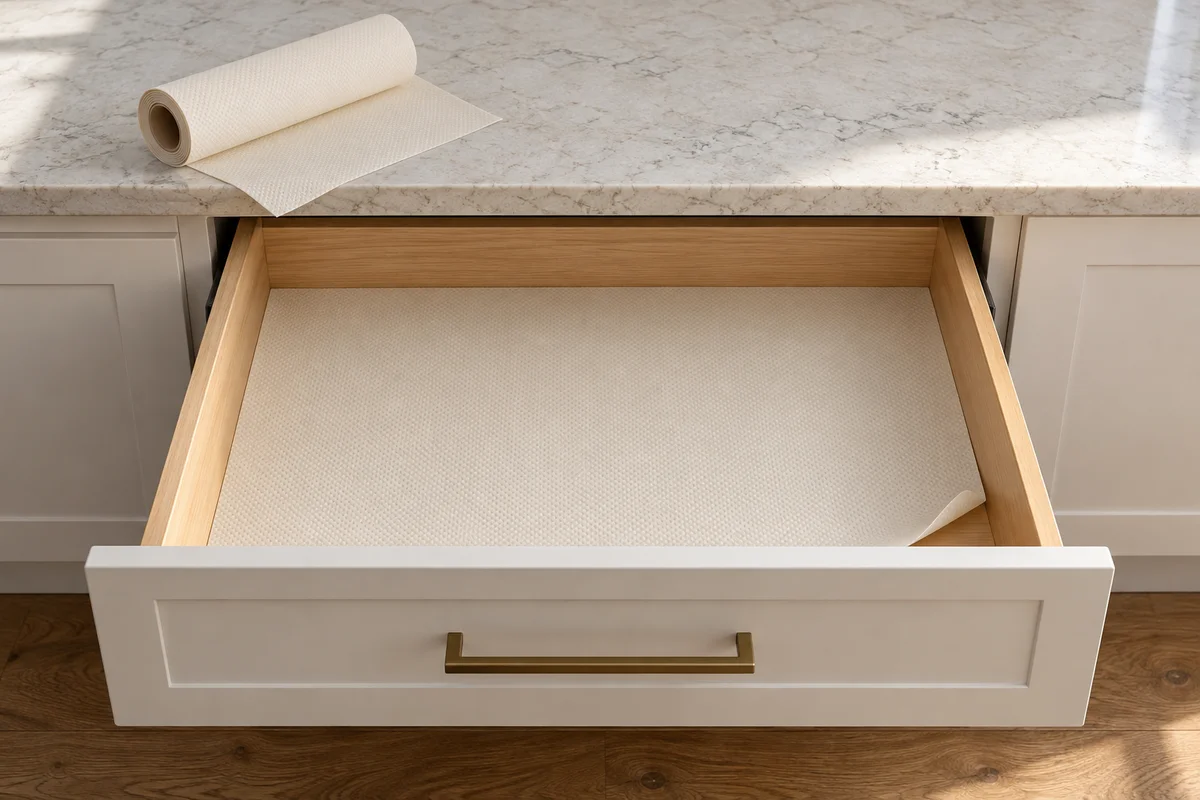
Compare four approaches
| Approach | When to consider it | The tradeoff | Check before using |
|---|---|---|---|
| Leave the shelf uncovered | The original surface is intact and its normal care meets your needs | No extra cushion, grip or removable spill layer | Cabinet care instructions and existing damage |
| Use a grip-surface liner | You want a surface intended to cushion or help hold stored items | Texture may change how objects slide when retrieved | Finish compatibility, intended room and cleaning method |
| Use a smooth-top non-adhesive liner | You want a removable layer with a surface intended for easier wiping or moving objects | The material underneath still contacts the cabinet | Manufacturer’s surface restrictions and care |
| Use an adhesive covering | You want a bonded decorative finish and accept that kind of alteration | Removal may leave residue or affect the underlying finish | Whether the adhesive is permanent, and the furniture maker’s instructions |
The uncovered option is a decision to keep the original surface, not a claim that every cabinet can tolerate every spill. If the finish is damaged or its instructions are missing, identify it before choosing a covering to hide it.
Match the liner to its intended job
Duck’s non-adhesive EasyLiner guide distinguishes products by use. It describes Select Grip for drawers and utility cabinets, Smooth Top for kitchen or bathroom cabinets, and Clear Classic among its other non-adhesive options. This gives you a starting point for checking a particular product rather than assuming every roll in the aisle behaves the same way.
Use the actual listing and care information for the version you intend to buy. A liner with holes, a smooth sheet and a solid layer over wire shelving can affect small items differently. Test the fit with the objects you actually store; product width alone does not tell you whether a bottle will stand as you expect.
For a sliding pan or bowl, consider whether grip is desirable during storage but inconvenient during removal. For loose supplies, a washable organizer may solve the storage problem without covering the entire drawer. Our drawer divider fit guide covers that separate choice.
Non-adhesive can still react with a finish
Duck’s FAQ warns that plasticizers in its EasyLiner can form a permanent bond with lacquer or urethane finishes. It also gives specific recommendations for direct food contact and cleaning. Those are product-specific statements, not proof that every non-adhesive liner damages those finishes or that every other material is safe.
If you do not know the cabinet finish, ask the furniture or cabinet manufacturer before placing a liner over it. A small-area check may help you notice an immediate issue, but it cannot establish years of compatibility or override a stated exclusion.
Do not use “BPA free,” “natural” or “non-toxic” as a substitute for the actual intended use. The relevant question is whether this material is suitable for this finish, this cleaning routine and any direct contact with food.
Adhesive covering is a different commitment
The same Duck FAQ describes its Peel & Stick Laminate adhesive as permanent and notes possible residue if removal is attempted. It does not recommend that product as wall wallpaper or near heating appliances. Its kitchen-counter guidance also distinguishes heat resistance and direct food contact.
That makes adhesive laminate a poor automatic substitute when your goal is easy future removal from a cabinet you cannot alter. Decorative appearance and a peel-off backing do not establish removability.
Measure after choosing the approach
Make a note for each shelf: finish, stored items, dry or occasionally damp use, cleaning instructions, and the exact material being considered. Measure each usable rectangle separately, including any hinge or support obstruction.
For example, a hypothetical 24 × 12 in shelf needs a different cut from a 22 × 10 in drawer bottom. Do not assume one cut size serves both just because the same roll will cover them. Once the material is suitable, use our shelf liner quantity planner to organize the cuts and roll purchase. That calculation answers how much to buy; this guide helps decide whether to buy it.
Sources & what to check
Source details checked 2026-10-26. Availability and prices can change; use the links below for current information.
Document-based material selection, not a stain, food-contact or removal test. Manufacturer statements apply to the specified liner. Existing cabinet finish and care instructions remain decisive.