Linen Closet Organization: A Practical Plan for Towels and Sheets
Organize towels, sheet sets and spare bedding with a clear shelf plan. Compare small fabric boxes and covered cases, with practical measurements before buying.
An organized linen closet gives each complete sheet set and each type of towel a visible home. Put everyday linen within comfortable reach, use small bins for loose pieces, and reserve covered storage for occasional bedding. Choose containers after folding your own linen: a box that looks right online can be awkwardly shallow for a bath towel or too deep for the shelf opening.
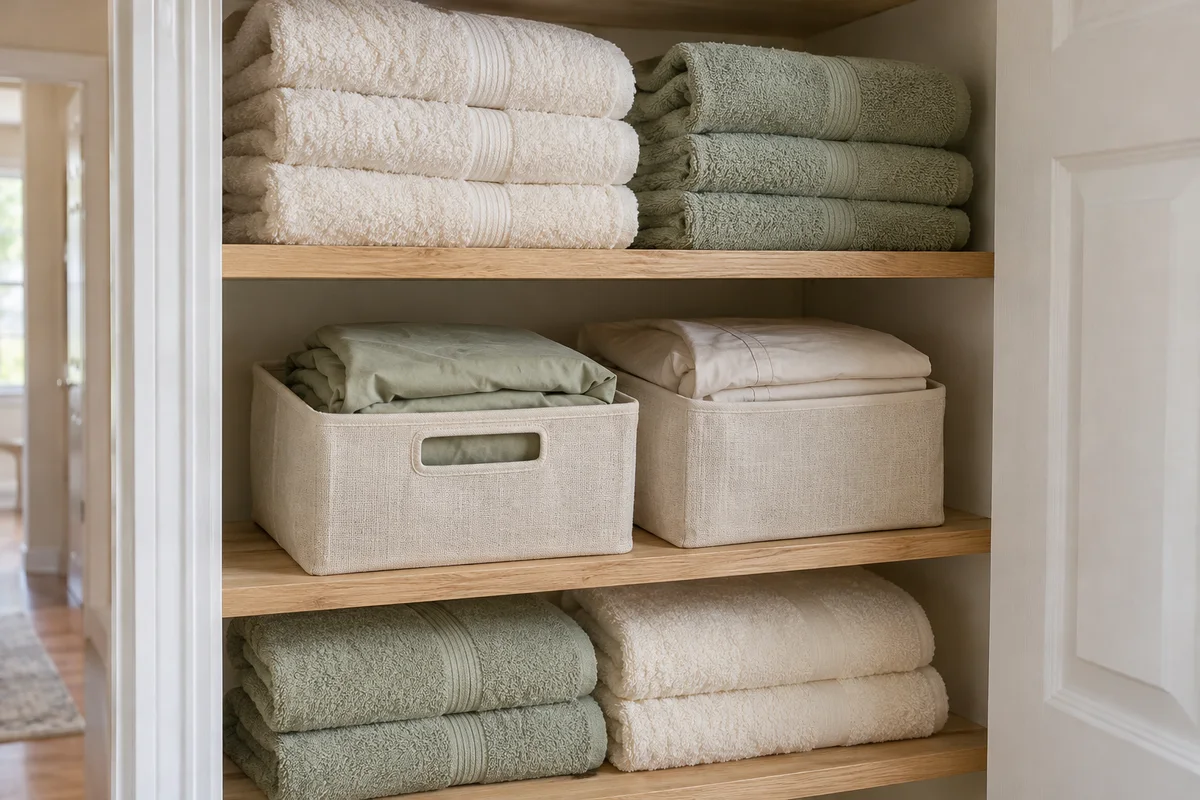
Start by making complete sets. Match sheets to their pillowcases and identify the bed they fit. Keep a small separate pile for useful cleaning cloths. Decide what will stay before measuring for storage.
A simple shelf plan
| Contents | Useful arrangement | A reason to add a product | Avoid |
|---|---|---|---|
| Frequently used towels | Short stacks with the fold facing out | Shelf dividers if stacks collapse sideways | Tall piles that topple when the bottom towel is removed |
| Complete sheet sets | One folded bundle per bed or size | A shallow open bin if bundles slide apart | Mixing pillowcases from several sets in an unlabelled basket |
| Face cloths and small pieces | Upright rows or a small divided box | A compact fabric organizer | A deep basket that has to be emptied to find one item |
| Occasional duvet or spare bedding | A separate covered case | A zipped case where its footprint fits | Treating a soft case as a rigid stacking shelf |
Leave the shelf edge easy to use. A container can be useful for carrying a whole guest set to a bedroom, but it should not turn every towel change into lifting a heavy basket.
Fold for the shelf, then decide on the container
Try two folding widths with one towel. Put each version on the actual shelf and test whether you can take it out without disturbing the next pile. Repeat with a complete sheet set. The most attractive fold is not always the fold that works with a shallow cupboard.
For sheet sets, an existing matching pillowcase can hold the folded pieces together. Leave enough slack to remove them easily rather than stuffing the case tight. Label by bed or size if several sets look alike. This approach can remove the need for a separate box entirely.
Keep a small record of what is stored: for example, “guest queen: fitted sheet, flat sheet, two pillowcases.” That is more informative than a generic “linen” label when somebody else needs to prepare the guest room.
Two budget storage examples, for different jobs
IKEA SKUBB white boxes, set of six, article 205.385.42 were listed at $8.99 on November 3, 2026. The set includes two each of 5½ × 5½ × 5⅛, 11 × 5½ × 5⅛, and 11 × 11 × 5⅛-inch boxes. These are small-item organizers, not full-size duvet cases. IKEA specifies vacuuming or a lint roller and says not to wash them; choose another material if washing the organizer is essential to you.
IKEA PÄRKLA storage case, article 503.953.82 has a stated size of 21¾ W × 19¼ D × 7½ H inches. A soft zipped case serves a different purpose: keeping occasional textiles together in a suitable storage space. Check the current price on the product page. Do not assume its large footprint will fit a linen shelf, and do not use the case as structural support for a tall stack.
These dimensions and care directions come from the manufacturer; neither product has been physically tested for this guide. Availability and delivery depend on location. Buy according to the stored contents and cleaning needs rather than to make every shelf match.
Work through one realistic shelf example
Suppose a shelf has 24 inches of clear width. Two 11-inch-wide boxes occupy 22 inches, leaving 2 inches total. That can be a starting layout for small cloths and pillowcases. It still needs adequate depth, overhead access and room around the hinges. It says nothing about how much your particular towels will compress.
The 19¼-inch depth of the PÄRKLA case is a separate issue. If your clear shelf depth is only 16 inches, the case is not a suitable shelf choice even when its height looks convenient. For the full measuring process, see closet storage bins and shelf access.
Make the system easy to reset
Return clean, fully dry textiles to their assigned places. Keep the stack size small enough that you can remove one item comfortably. If the closet fills immediately after laundry day, reassess the quantities or move occasional pieces to a suitable secondary location rather than compressing the everyday shelf harder.
For a possible alternative location, our under-bed storage guide checks bed supports and the route for pulling a case out. For bedding you use seasonally, keep covers and their correct-size inserts identifiable; the pillow insert guide helps separate a cover-size decision from a storage decision.
Do I need matching baskets? No. Containers are useful when they keep a category together or make it easier to carry. Existing boxes, small stacks and simple labels can be enough.
Should everything be rolled? Try rolling one category first. Keep it only if you can see, remove and replace the items more easily than with your previous fold. There is no universal fold that suits every shelf and textile.
Sources & what to check
Source details checked 2026-11-03. Availability and prices can change; use the links below for current information.
Manufacturer information checked November 3, 2026. Product comparisons use published specifications, without hands-on testing. US prices exclude tax and delivery; local stock and fit are unconfirmed.