Closet storage bins: check shelf depth and room to lift the lid
Choose closet bins by outside size, shelf depth, door clearance and lid access. Compare open baskets, fabric cases and rigid lidded containers.
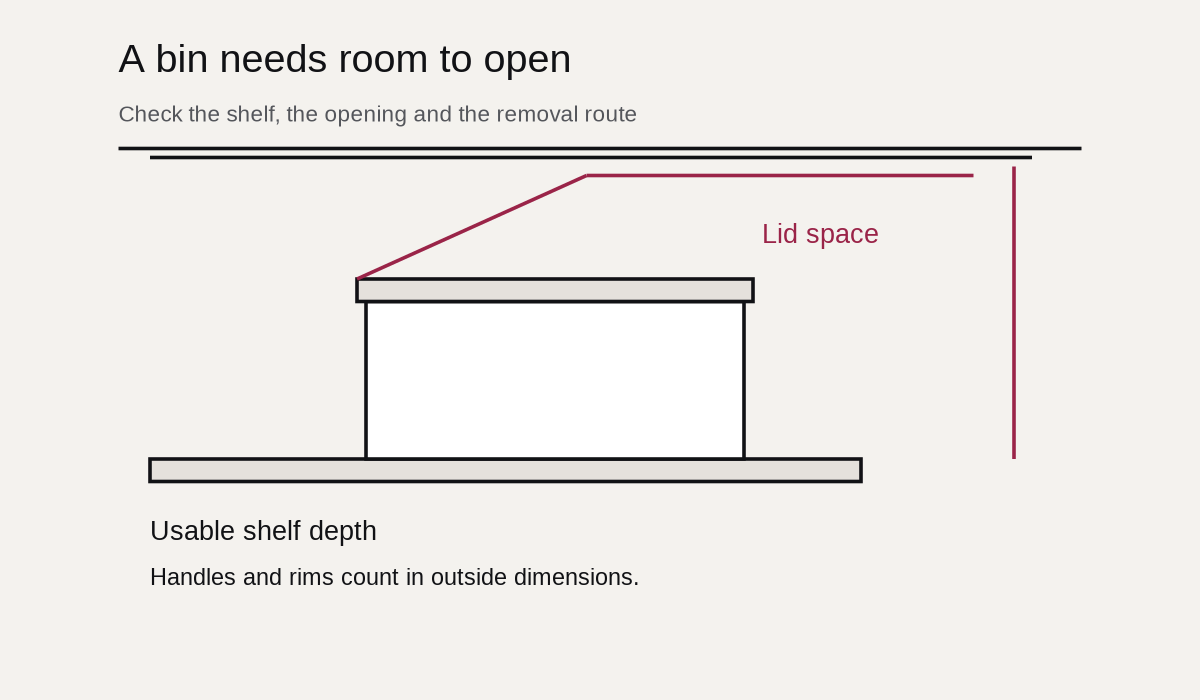
A closet bin should fit on the shelf, pass through the opening and come out while the closet contains your clothes. Check all three before buying a set. For everyday access, an open basket may be simpler than a tall box whose lid can only open after you remove it.
If you keep a folding laundry basket in the same cupboard, compare its open size and folded thickness in our collapsible laundry basket guide. A thin folded profile still needs enough shelf width and a clear removal route.
Measure the usable shelf
Measure width between obstructions, usable depth and height to the next shelf or ceiling. Brackets, hinges, door tracks and hanging clothes can reduce the space a bin can occupy or pass through. Use the smallest relevant reading along its route.
Measure the bin at its widest point. Soft handles can project beyond the body; a rigid lid can be wider than its base. A tapered basket’s bottom dimensions do not tell you whether its rim fits between adjacent bins.
Shelf depth deserves its own check. A bin that overhangs may interfere with the door or become hard to handle. Check support and loading with the shelf’s instructions instead of treating a width match as proof of a suitable storage system.
A documented size is not a promise of closet fit
IKEA US lists the linked SKUBB storage case at 17 × 20¾ × 7½ inches. Compare the labeled dimensions and product diagram with the orientation you intend to use. Even turning a case does not make a 16-inch-deep shelf fully support a footprint whose shorter side is 17 inches.
That illustrates why a product named for wardrobe storage can still be unsuitable for a particular shelf. Check its materials, zipper and carrying arrangement on the current product page before choosing it for your closet.
Plan the number across the shelf
Imagine a clear shelf width of 36 inches and three hypothetical bins each 11 inches wide. Their bodies occupy 33 inches, leaving 3 inches for all gaps. If the handles or rims add width, that spare space disappears quickly.
Draw the full outlines on paper, then divide the remaining space between the sides and bins. Do not use a universal clearance number: the space needed depends on whether you lift, slide or grip the bin. Leave a usable handhold rather than pressing every container against its neighbor.
For two bins, test whether either one can come out independently. An arrangement that requires unloading half the shelf to reach one box is best reserved for things you rarely need.
Match the opening to the contents
| Container style | Useful access pattern | Check before buying |
|---|---|---|
| Open basket | Drop in or retrieve frequently used soft items | Rim width, lining and handhold |
| Zipped fabric case | Group occasional clothing or bedding | Removal route, zipper access and support |
| Rigid lidded bin | Separate a defined category | Lid swing or lift space, loaded handling |
Choose a category before choosing a size. A large bin full of small accessories hides them; several very small bins waste shelf width on walls and rims. For a drawer underneath the shelf, adjustable dividers solve a different access problem and need different measurements.
If you want open storage above and below a platform, check the cabinet shelf-riser clearances instead of treating it as an enclosed bin. For bedding stored below the bed, the under-bed fit guide adds supports and the route needed to pull the container out.
Choose the contents as well as the box: our linen closet organization guide gives towels, complete sheet sets and occasional bedding different homes. For a collection of shoes that also crowds the entrance, compare entryway racks, shallow cabinets and benches before moving everything into the nearest shelf bin.
Inside a dresser, compare sock drawer bins and individual cells by folded-pair size and clear drawer height before choosing a compartment count.
For clothes that stay on the rail, compare flocked and wooden hangers by garment support, shoulder width and actual dressed-rail access.
If the wardrobe has spare rail space, compare hanging closet organizers by installed drop and shelf access instead of adding more freestanding shelf bins.
If the shelf fits but the clothes below it still sit in shadow, try these closet lighting positions without new wiring.
For sweaters you wear every week, check the fit of low folded stacks before putting them in a covered bin.
For games stored in their original boxes, see Will Your Sleeved Cards Fit a Board Game Insert.
Sources & what to check
Source details checked 2026-10-12. Availability and prices can change; use the links below for current information.
The examples check geometry and access. Confirm shelf load capacity, material durability and product fit for your own space.