Small Entryway Shoe Storage: Racks, Cabinets or a Bench?
Compare shoe racks, shallow cabinets and benches for a small entryway, with two IKEA examples and checks for shoe size, door swing and everyday access.
For a small entryway, choose shoe storage around the pairs you wear this week and the door’s full swing. An open rack is easy for daily shoes; a shallow wall-secured cabinet conceals them; a bench makes sense when you also need a seat and have enough depth. Keep occasional pairs elsewhere so the entrance does not have to hold your whole collection.
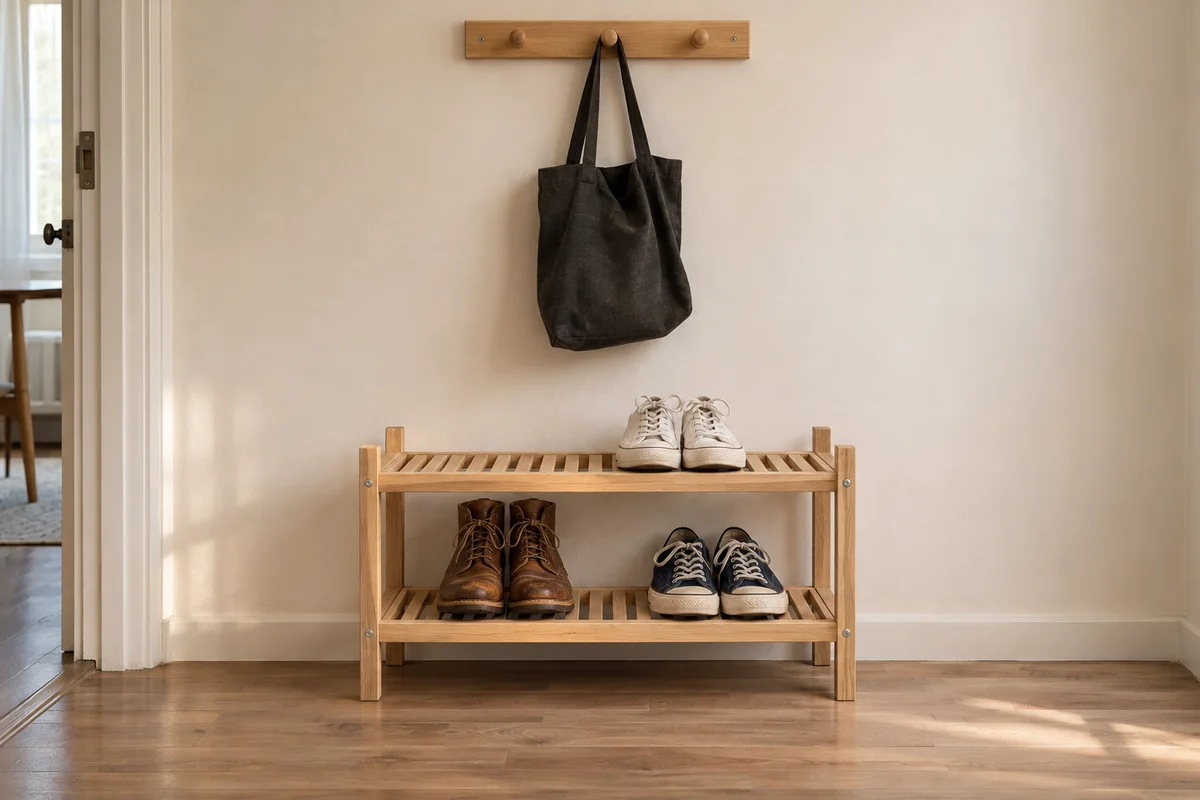
Before shopping, put your usual shoes in the entrance and open the door fully. Include the longest pair, boots and any shoes somebody needs to put on while seated. Those real objects expose problems a product’s advertised pair count cannot answer.
Compare three approaches
| Approach | Choose it when | Main tradeoff | Check before buying |
|---|---|---|---|
| Open two-tier rack | Daily shoes need a quick place to land | Shoes remain visible and may project past the frame | Your longest shoe, boot height and floor footprint |
| Shallow tilt-out cabinet | You want a visually quieter wall | Mounting and opening clearance are required | Wall fixing, shoe size and the open compartment |
| Bench with storage | Sitting down is part of the routine | A seat usually occupies more floor area | Sitting space, door swing and the complete usable route |
If the entrance cannot accommodate furniture without obstructing access, move the main collection to a nearby closet and keep only a small daily landing spot by the door. Do not choose a tall narrow tower solely because its footprint looks small; follow its assembly and stability instructions.
An open rack versus a shallow cabinet
IKEA TJUSIG white shoe rack, article 301.526.38 was listed at $29.99 on November 3, 2026. Its stated outside size is 31⅛ W × 12⅝ D × 14⅝ H inches. IKEA describes capacity as approximately six pairs and provides hardware for stacking two racks. Your shoes may require a different arrangement: large trainers and tall boots do not occupy the same space as small flats.
IKEA TRONES white shoe/storage cabinet, article 003.973.07 was listed at $39.99 per two-pack, with each stated cabinet size 20½ W × 7⅛ D × 15⅜ H inches. IKEA requires these cabinets to be secured to the wall. Check suitable fasteners for your wall and the assembly instructions before buying. The closed depth does not tell you the space required while the compartment is open.
These are useful examples of different constructions, not a ranking from hands-on testing. Product prices are US listing prices before tax or delivery. Local stock, wall suitability and fit for your particular shoes are unconfirmed.
Check the space used by the shoes, too
A rack’s frame is not always the deepest part of the finished arrangement. A long shoe can project at the front or back. A tilted boot can occupy the gap above the next shelf. Mark the furniture’s outline on the floor, then place representative shoes within it.
For a simple comparison, the listed closed depths above differ by 5½ inches: 12⅝ minus 7⅛. That is a comparison of published furniture dimensions, not proof that TRONES needs 5½ inches less working space in your home. Its opening movement and wall installation still matter.
Test the door, nearby cupboard and route while another person stands where shoes would normally be put on. Check the entry with bags or a pushchair if those are part of everyday use. Follow applicable access requirements for your home; a generic online clearance number cannot establish that your particular entrance is suitable.
Give each kind of footwear a home
Use the easiest shelf for the current rotation. Keep a place for visitors only if visitors regularly need it. Move occasional dress shoes or seasonal pairs to a suitable closet rather than letting them build a second row across the floor.
If wet or dirty shoes are common, choose a place to deal with them according to their care instructions before putting them into enclosed storage. A decorative cabinet is not a drying appliance. A removable tray can help with routine cleaning, but check the tray and floor materials instead of assuming a basket will contain moisture.
For the closet part of the system, see how to choose shelf bins that remain accessible. If occasional shoes will go under a bed, the under-bed fit guide checks whether a container can actually be pulled out past the supports.
Once the floor is clear, use these Christmas entryway table layouts to keep a spot for the things you set down at the door.
A short buying note
Write five things before ordering: the daily number of pairs; the longest shoe; the tallest item; the closed furniture footprint; and the space used while doors or compartments are open. Add whether wall fixing is allowed and what you would do if the selected shoe does not fit.
Is a shoe bench automatically better? Only when the seat is useful and its footprint works. A rack can be a simpler answer if you already have a suitable place to sit.
Should the whole collection fit at the door? Usually the more useful goal is making the daily routine easy. A limited current rotation can work better than a larger piece that crowds the entrance.
For coats and bags above the entryway floor, check over-door hooks against door thickness, top gap, permitted fixing and the loaded opening path.
If the same entry has to hold coats, test coat storage without a closet with a loaded hook before choosing the shoe rack position.
Sources & what to check
Source details checked 2026-11-03. Availability and prices can change; use the links below for current information.
Manufacturer information checked November 3, 2026. Product comparisons use published specifications, without hands-on testing. US prices exclude tax and delivery; local stock and fit are unconfirmed.