Vacuum storage bags for clothes: pump, vacuum or roll-up?
Compare vacuum storage bags, powered pumps and roll-up compression sacks. Includes fabric cautions, documented product examples and a repeat-use checklist.
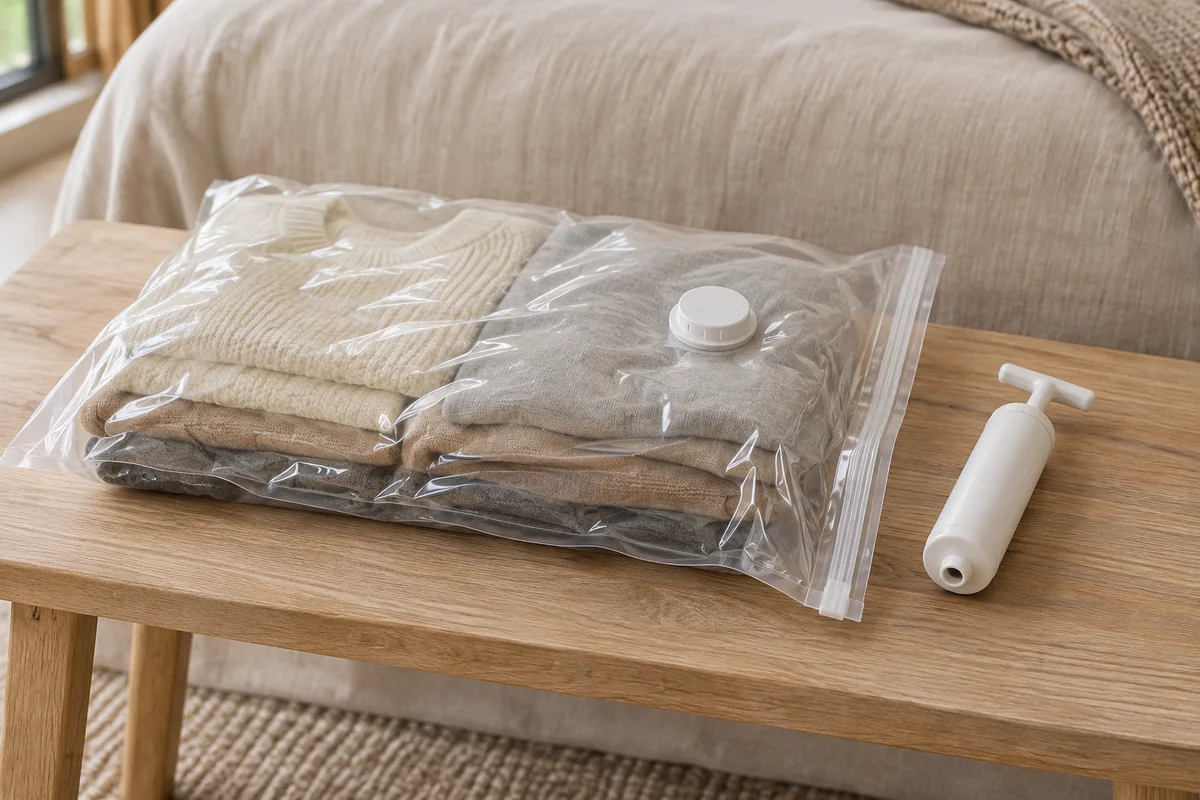
Choose a valve bag for occasional clothing storage when you can use its compatible pump or vacuum, and a roll-compression sack when you need to repack without powered equipment. Check the clothing’s storage instructions first. Compression is a poor default for every fabric, and saving volume does not reduce the weight you must lift.
A bag is useful only if it stays sealed through your intended storage period and can be compressed again when you next open it. Begin with a small trial using suitable everyday textiles before buying a large multipack.
Three ways to remove air
| Method | When it is worth considering | Confirm before buying |
|---|---|---|
| Valve bag with compatible household vacuum | Occasional storage near your vacuum | Nozzle/valve compatibility, fill line and closure method |
| Valve bag with supplied manual or electric pump | Storage or travel without the household vacuum | Exact pump included, charging or power requirements, and return-trip access |
| Roll or pressure-compression sack | Repacking away from power | The stated air-release method; a normal zip bag is not automatically a roll-compression bag |
Do not force a nozzle into a valve or assume that any electric pump fits every brand. Follow the exact bag’s sequence for loading, closing the zipper, removing air and resealing its valve. Leave the sealing area clear of trapped fabric.
Two documented products, with different compromises
The following prices were listed on the brands’ US-dollar storefronts on November 4, 2026, before delivery and tax. They illustrate different formats rather than a durability ranking.
Eagle Creek Pack-It Compression Sack Set M/L, $25. The set has a medium sack measuring 24.5 × 15.5 inches and a large sack measuring 28.5 × 17.5 inches externally. The product describes a one-way pressure valve, top zip closure and nylon-reinforced material. Confirm the rolling/air-release steps for the supplied sacks before your first trip. Flat bag dimensions do not establish the final packed shape.
TAILI Travel Vacuum Compression Bags with Wireless Pump, $43.99. The listing includes a portable electric pump, zipper closure, valve and a viewing window. Its specification lists a one-pack format. The page gives both (26/30/40) × 45 × 20 cm in its description and 17.7 × 7.87 × 1 in in its specification. Those descriptions do not establish one unambiguous filled size. Confirm the exact supplied bag, pack contents and filled dimensions with the seller before using it for a tight shelf or suitcase.
Both brands advertise an up to 80% volume reduction. Treat that as their upper marketing claim, not the expected saving for your clothes. We do not use it to promise a particular wardrobe capacity.
Check the fabric before compressing
Woolmark’s storage guidance favors breathable cotton or wool bags for delicate clothing over vacuum packing. Keep delicate wool pieces in a separate storage plan. For down, structured garments, leather, embellishments or other sensitive construction, follow the garment or bedding maker’s specific directions; a bag seller’s broad “clothes” claim does not settle suitability.
Store only items that are ready for storage under their care instructions. Check cleanliness and complete drying before sealing. A plastic bag does not correct moisture already trapped inside it or replace proper storage conditions.
Plan for the uncompressed package too
Measure the full bag after loading, including its zipper and valve. Leave space to lay it flat and operate the pump. Avoid packing one enormous bag so heavily that you cannot handle it comfortably. Smaller labeled groups can be easier to retrieve even if they occupy a little more space.
Our under-bed storage guide covers the opening, legs and pull-out path of the outer storage space. Our closet bin guide covers a rigid outer container. Neither a flat bag’s dimensions nor an advertised compression percentage proves the loaded bundle will pass that opening.
For an illustrative measurement, a 60 × 40 cm stack at 25 cm high occupies a 60,000 cm³ bounding box. If the same footprint measures 15 cm high after compression, its box is 36,000 cm³: a 40% reduction, calculated as (60,000 − 36,000) ÷ 60,000. This is a hypothetical rectangular-envelope example, not a test result or a prediction for a bag.
A repeat-use checklist
- Select a small group of suitable, clean and dry textiles.
- Follow the exact fill line and seal instructions.
- Measure the finished package instead of assuming a percentage.
- Check the closure again before putting it into a difficult-to-reach space.
- Open and repack the trial group once. Keep the pump and any required adapter accessible.
- Label contents and storage date outside the bag without damaging the film.
Common questions
Can I use a vacuum bag without a vacuum cleaner?
Only when the specific design supports a manual pump, powered pump or pressure/roll method available to you. Do not assume an ordinary valve will vent correctly when rolled.
Are compression sacks a good choice for clothes I use weekly?
Repeated opening and resealing adds work. A normal bin or breathable bag may give easier access. Compare how often you need the contents with the space you actually save.
Will a smaller package weigh less?
Removing air mainly changes bulk. Plan lifting and luggage weight from the items themselves, not from the compressed appearance.
Sources & what to check
Source details checked 2026-11-04. Availability and prices can change; use the links below for current information.
Compare exact variants and confirm usable dimensions, current availability and the delivered total before ordering.