Dish drying racks: check the counter and drain
Compare dish drying racks by closed and expanded size, drainage and loaded clearance. Includes two exact models and a printable buying worksheet.
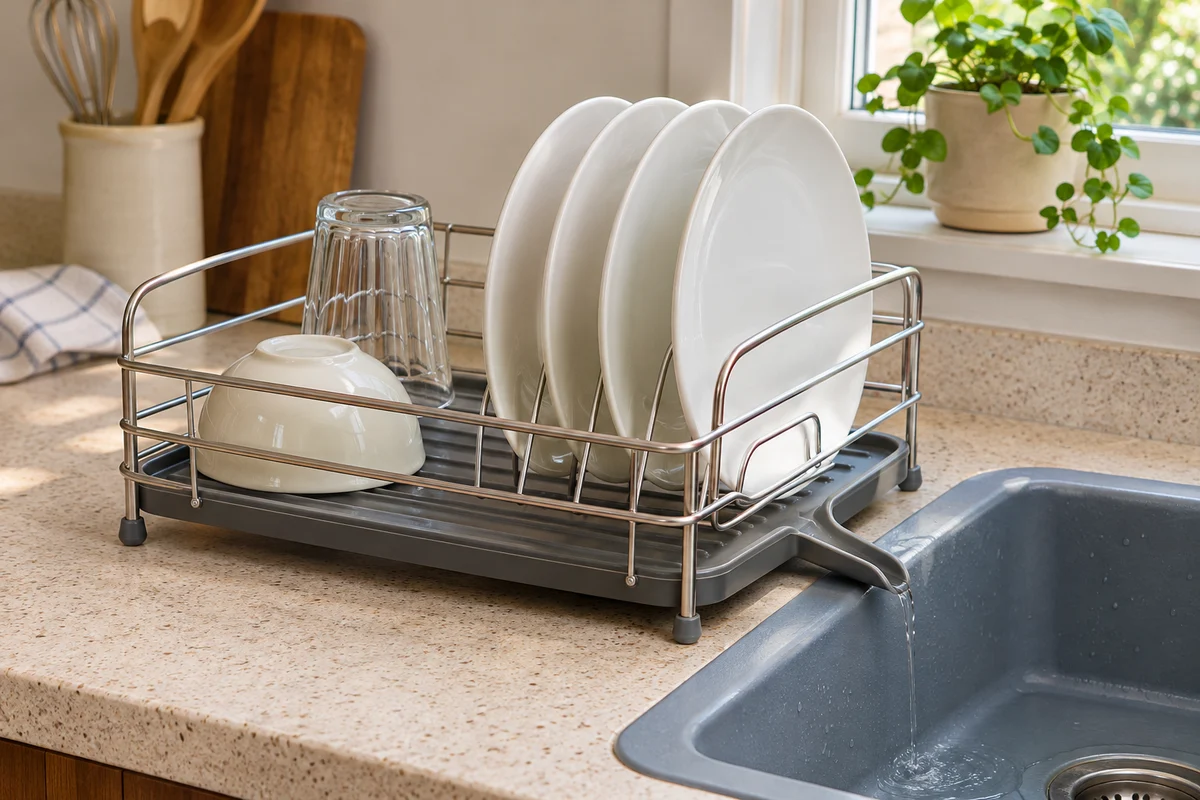
Choose a dish drying rack by the space it uses when loaded and the route its water takes to the sink. An expandable rack can suit a changing pile of dishes, while a fixed rack with glass holders needs a permanent place large enough for those attachments. Start with your sink layout before comparing plate capacity.
The Joseph Joseph Extend Steel and simplehuman Standard below illustrate these two approaches. The comparison uses manufacturer specifications checked November 4, 2026, rather than a hands-on drying test. Prices are US item prices before tax and delivery.
Two countertop racks with different footprints
| Check | Joseph Joseph Extend Steel Gray | simplehuman Steel Frame Standard Brushed |
|---|---|---|
| Exact model | 85153 | KT1181 |
| Listed price | $75 | $100 |
| Published horizontal dimensions | Closed W35.3 × D31 cm; expanded W35.3 × D51.5 cm | Manufacturer diagram shows 20.2 × 22.3 in overall |
| Published height | 16.7 cm in both positions | Diagram shows 11.5 in overall |
| Drainage arrangement | Spout has three placement positions | Swiveling spout |
| Design detail to check | Extra depth must be available when expanded | Wine-glass holder and attachments need room around the rack |
Joseph Joseph lists the same width in both configurations: the changing dimension is depth. Do not assume the rack expands along whichever side is convenient beside your sink. Its instructions also specify hand washing and drying. See the Extend Steel listing.
The simplehuman Standard listing links to an overall dimension diagram and describes a holder for up to four large Bordeaux glasses. Those are exterior dimensions and a manufacturer capacity statement; they do not establish that your particular glasses, board and pan will fit together.

Measure the counter in its working arrangement
Record the clear rectangle beside the sink, then mark where the bowl begins. Include the sink rim, faucet movement and any cabinet above. The rack body fitting on the counter does not prove that the spout reaches the bowl or clears a raised edge.
Use a paper outline before ordering. Mark the rack body and the direction of expansion separately. Then use your actual largest plate and cutting board to estimate where their tops and edges would extend. Keep those items supported during the check; the paper is only a layout aid.
For example, suppose the usable counter area is 38 cm wide and 45 cm deep. The listed closed Extend body is smaller than both dimensions. Expanded, its 51.5 cm depth exceeds the available depth by 6.5 cm. Turning it swaps the sides, but then the 51.5 cm dimension exceeds the available 38 cm width. That rejects the expanded body in either orientation. It does not confirm that the closed arrangement drains correctly.
Make a separate note for each question:
- Does the body fit in the orientation that puts the drain toward the sink?
- Can the spout discharge into the bowl without an obstruction?
- Can your tallest item be removed beneath the cabinet?
- Can you still use the faucet and the adjacent prep area?
Our kitchen counter organization guide helps decide how much of that surface to reserve for washing up and how much to keep available for food preparation.
Choose for the dishes you wash together
List a normal batch: perhaps two plates, two bowls, mugs and a saucepan. Then list the occasional awkward item separately. A rack chosen around a large holiday batch may occupy more counter than your everyday routine needs.
Consider Extend if the closed arrangement fits your daily washing and you genuinely have room to open it for larger batches. Consider the simplehuman Standard if a permanent drying station and its glass-holder arrangement suit your counter. These are layout choices, not measured rankings for drying speed or stability.
An over-sink roll-up rack solves a different layout problem: it occupies part of the sink opening while in use. Before choosing one, check the exact model’s supported span, contact surfaces and load instructions. Neither countertop model above proves that an over-sink rack will fit your sink.
Keep drying and storage separate
Give dry items a reachable cupboard home. If pans remain on the rack because their storage stack is difficult to use, a larger rack may preserve the bottleneck. Our pots and pans storage guide addresses that next step.
Likewise, a rack that holds a cutting board is not automatically suitable for a full collection of baking trays. Use the baking sheet organizer guide for upright storage after drying.
What to check before buying
Confirm the current model, finish and dimensions on the seller’s page, including any accessories shown. Check cleaning instructions and leave room to remove the tray or drain parts. Delivery availability and the fit of a fully loaded rack remain specific to your kitchen. Buy when the layout works with your ordinary dishes and the route back to their storage is clear.
Use the printable fit worksheet to record your own measurements and decisions.
For the brushes and sponges beside the rack, compare countertop and in-sink caddies by their occupied space, water collection and cleaning access.
Sources & what to check
Source details checked 2026-11-04. Availability and prices can change; use the links below for current information.
Manufacturer and official app documentation checked November 4, 2026. Product examples are compared by published specifications; no hands-on product or matched app benchmark was conducted.