How much gravel do I need? Calculate cubic yards before ordering
Calculate gravel volume from length, width and depth, convert cubic feet to cubic yards, and check what your supplier needs before quoting tons.
For a rectangular layer, cubic yards = length in feet × width in feet × depth in inches ÷ 324. The divisor accounts for both conversions: 12 inches per foot and 27 cubic feet per cubic yard.
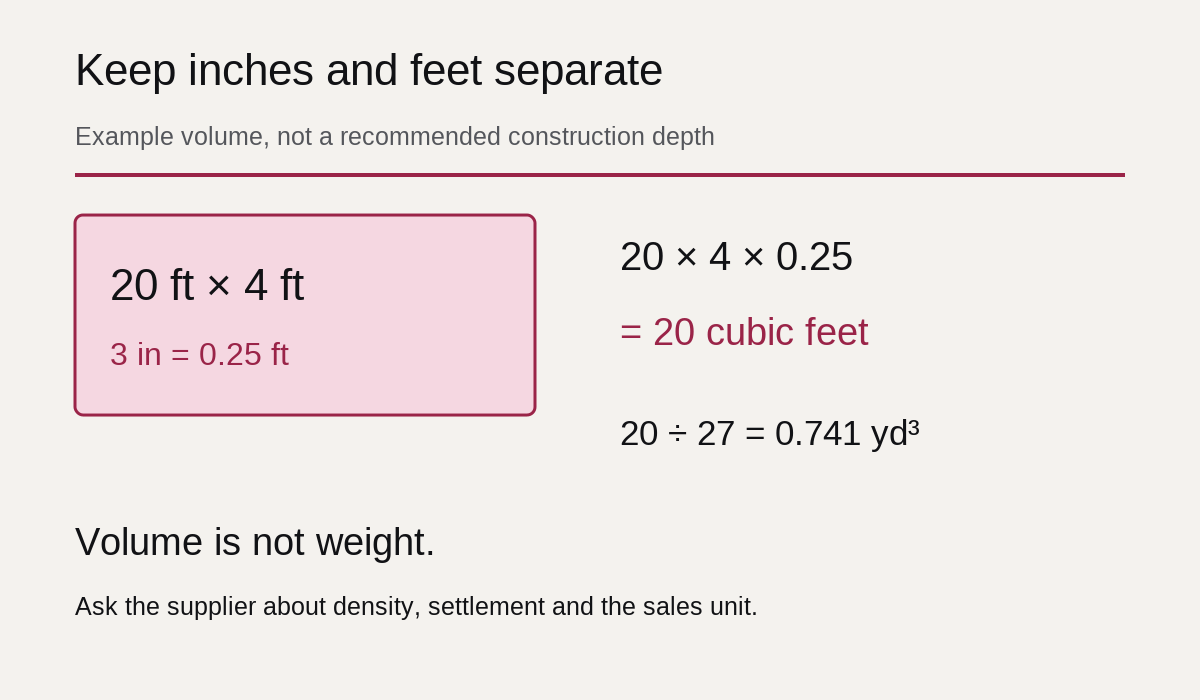
A 20-foot-long, 4-foot-wide area with an entered 3-inch depth has a volume of 20 cubic feet, or approximately 0.741 cubic yards. This is an example of volume arithmetic, not a recommendation for how deep a path, driveway or drainage layer should be.
Calculate your measured volume
Volume only: this does not choose a suitable depth or convert volume to weight. Inputs stay in your browser.
Enter the thickness of the material you plan to add, rather than an existing layer plus the new layer. Ask the supplier or project designer whether that thickness describes loose material or a finished compacted layer before using the result to order.
Convert the depth before multiplying
Three inches is 3 ÷ 12 = 0.25 feet. For the example area:
20 ft × 4 ft × 0.25 ft = 20 cubic feet
20 ÷ 27 = 0.740740… cubic yards
Multiplying 20 × 4 × 3 and calling the answer cubic feet overstates the volume twelvefold because the depth is still in inches. Writing 3 inches as 0.3 feet also changes the answer: 0.3 feet is 3.6 inches.
A useful conversion check is a 9 × 9-foot area at an entered 4-inch depth: 9 × 9 × (4 ÷ 12) = 27 cubic feet = 1 cubic yard. This checks the units; it does not establish a suitable depth for any installation.
See how entered depth changes the quantity
For the same 80-square-foot rectangular area, without an extra allowance:
| Entered added depth | Depth in feet | Cubic feet | Cubic yards |
|---|---|---|---|
| 2 in | 0.1667… | 13.333… | 0.494 |
| 3 in | 0.25 | 20 | 0.741 |
| 4 in | 0.3333… | 26.667… | 0.988 |
These rows compare quantities only. A calculator cannot choose material gradation, drainage, base preparation or a load-bearing specification. Confirm those decisions before deciding which depth to enter.
How much gravel do I need under a concrete slab?
Use the planned base footprint and base depth in the calculator above. The concrete thickness belongs to a separate calculation. If the base extends beyond the slab edges, enter the base dimensions specified for the project rather than copying the slab footprint automatically.
For a hypothetical 10 × 6 ft base area at an entered 3 in finished depth, the geometric volume is:
10 × 6 × 3 ÷ 324 = 0.556 cubic yards, or 15 cubic feet, before any allowance.
Enter Length 10, Width 6, Planned added depth 3 and Extra allowance 0 to reproduce that result. The 3 in depth is an arithmetic input, not a recommended base specification. Use the thickness and material required by your project plan.
| Separate material | Hypothetical area and depth | Geometric volume |
|---|---|---|
| Gravel base | 10 × 6 ft at 3 in | 15 ft³ / 0.556 yd³ |
| Concrete slab | 10 × 6 ft at 4 in | 20 ft³ / 0.741 yd³ |
These are separate material quantities. Do not enter the combined 7 in thickness as gravel, or treat the gravel result as concrete to buy. Use the concrete slab calculator for the slab’s own volume and bag-yield estimate.
If the entered base depth is a finished compacted depth, the result describes that finished volume. It is not automatically the loose delivery quantity. Ask the supplier which product-specific conversion applies. The Extra allowance field is a percentage adjustment you choose; it is not a verified compaction factor. For example, 10% changes this base volume to 16.5 ft³ / 0.611 yd³, without establishing how much loose material the project requires.
NRMCA’s guide to concrete cracking discusses subgrade preparation as a construction issue. This volume calculation does not check that preparation or select a suitable base design.
Split irregular areas into sections
Use separate rectangles for an L-shaped area and add their volumes. If different sections have different depths, calculate each depth separately. For a sloping or uneven surface, a single average thickness can miss low areas; measure enough sections to describe the space being filled.
An extra allowance is an explicit planning input. For the example, entering 10% changes 20 cubic feet to 22 cubic feet, or 0.815 cubic yards. It does not automatically account for a particular product’s compaction or settlement. Ask the supplier which adjustment applies, then record it rather than silently assuming one.
Cubic yards and tons answer different questions
Cubic yards measure volume; tons measure weight. You need the supplier’s density for the specific aggregate and condition to connect them. Our tool stops at volume so it does not disguise a guessed density as an order quantity.
If the supplier gives a factor in US short tons per cubic yard, multiply your cubic yards by that factor. A hypothetical factor of 1.4 would make 0.741 cubic yards about 1.037 short tons. The 1.4 value is an arithmetic illustration, not a verified specification for your gravel. Ask whether “ton” means a US short ton or a metric tonne.
Vulcan Materials provides its own aggregate calculator and recommends reviewing project conditions with a local representative. A supplier-specific quote is a better place to settle density, sales increments and available products than a universal tons-per-yard shortcut.
For lumber volume instead, use the board-foot calculator to keep several board sizes, quantities and an optional cost in one printable list.
Use Build24 when you have several project calculations
This free web calculator is enough to check the rectangular volume once. The app is an option for recurring work, rather than a requirement to obtain the answer. Compare its gravel inputs with this example and use your supplier’s density information.
Prepare a short order note
Write down the product name, measured sections, entered depth, whether the layer is loose or compacted, the volume before and after any allowance, and the supplier’s sales unit. Then confirm the available order increment, minimum quantity and delivery access.
For bagged landscaping material, see our mulch bags calculator. For a different volume where something occupies part of the hole, see concrete around a fence post. The geometric method changes when the space is not a simple rectangular layer.
If several types of estimate are becoming a recurring task, compare construction calculator apps for iPhone by the calculations they support. Keep the measured inputs and material assumptions from each job with the result.
Sources & what to check
Source details checked 2026-10-26. Availability and prices can change; use the links below for current information.
Arithmetic checked for a rectangular layer with uniform entered depth. Depths and allowances are examples, not construction specifications; enter supplier-specific density and compaction information separately where needed.